
Switch off
Oliver Optic
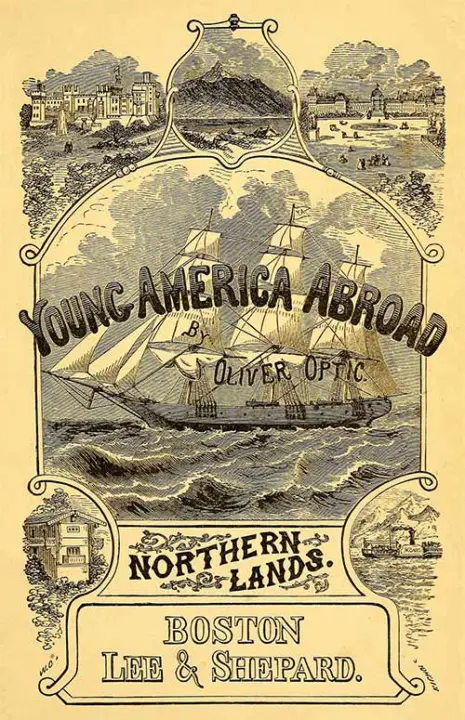
THE CLASSIC COLLECTION · 1872
"Northern Lands; Or, Young America in Russia and Prussia" by Oliver Optic is a historical account and adventure story written in the late 19th century. The book focuses on the experiences of a group of young American tourists aboard the Academy Squadron as they travel through the Baltic region, exploring the cultural landscape of Russia and Prussia. Guided by their adventures, the narrative ultimately provides commentary on political ideals and social dynamics, especially as they relate to youth and growing up. The opening of the story introduces readers to a group of young cadets enjoying a picnic on an island in the Baltic, where heated discussions revolve around the leadership hierarchy aboard their ship and a proposed electoral reform to select officers. Characters like De Forrest and Beckwith express their concerns about their shipmate Cantwell's suitability for leadership, sparking a debate on merit, power, and fairness among their peers. The tensions among students over rank and suitability for command illustrate a larger commentary on political systems and personal responsibility, setting the stage for the ensuing adventures and insights that will unfold as their journey continues.
Introduction adapted from the source catalogue; source summaries may be automatically generated.
Free to read · English · 93,780 words · No account needed
MAKE TIME FOR A GOOD BOOK
On by default. Untick to stop anonymous reading totals. Each page counts after 10 seconds in view. How this works.
Anonymous counting is on unless you have switched it off.
"O Clyde, Clyde!" exclaimed Mrs. Blacklock, as she hugged her boy. "I thought I should never see you again."
"Come, mother, don't be too demonstrative. You will make all the
fellows laugh at me."
"I'm so glad to see you, Clyde!" added Miss Celia Blacklock, his sister.
Clyde kissed them both, and then begged them to allow him to attend to
his duty.
"Up oars!" shouted he, with vigor. "Shove off!"
"I am so glad to get out of that steamer!" added Mrs. Blacklock. "I thought we should all be drowned."
"Let fall!" said Clyde, too much interested in his new duties even to heed his mother. "Stern, all! Give way!"
"And I'm very, very glad to find you again, Clyde!" continued the lady.
"Oars! Now give way together!" and Clyde gathered up his tiller-ropes, and for the first time had an opportunity to attend to his mother, whom he had not seen for nearly three months.
The young Englishman was an only son, and his mother a widow, who had been utterly unable to manage him, after she had spoiled him by early indulgence. The youth had a freak, when he saw the Academy Ship, that he should like to join her, but soon changed his mind. As the institution seemed to be the only means of saving him from his own folly and wilfulness, Mrs. Blacklock had reluctantly permitted Mr. Lowington to take the control of him. Though he had run away, and had been subjected to sharp but excellent discipline, he had done very well as soon as he found it was no longer possible for him to have his own way.
"I have been looking for you these two months, Clyde," said his mother.
"Where have you been?"
Clyde told her where he had been.
"I went to St. Petersburg, but the ship had not been there, and I returned to Stockholm, and have spent the last month in Sweden."
"We were rusticating among the islands in the Gulf of Bothnia while you
were looking for me."
"Why haven't you written to me, Clyde?"
"I did not know where you were."
"I hope you have had enough of the sea," sighed his mother.
"I am just beginning to like it first rate. Don't you see I am an
officer?"
"Are you the captain of the ship?"
"Well, no; not exactly that, mother; but I am in command of this boat."
Scott turned away, and laughed, as did the stroke oarsman, who also
heard the remark.
"I want you to go with me now. I am very, very lonely without you,"
added Mrs. Blacklock.
"Not much, as the Americans say," replied Clyde, shaking his head.
Your reading position is saved on this browser. Take it to another device with a library code. Reading pages adapt to text, rather than matching a printed edition.
BEHIND THE BOOK
This eBook is for the use of anyone anywhere in the United States and most other parts of the world at no cost and with almost no restrictions whatsoever. You may copy it, give it away or re-use it under the terms of the Project Gutenberg License included with this eBook or online at www.gutenberg.org. If you are not located in the United States, you will have to check the laws of the country where you are located before using this eBook. Read the source licence.
The original source file, including credits and licence, is retained by this library. Request an original-format copy at no charge. Please include the book title and Project Gutenberg identifier #54059.
KEEP YOUR CURIOSITY GOING
Wilfrid Scawen Blunt
Wilfrid Scawen Blunt

E. W. (Edgar Watson) Howe
Cécile Tormay

Moritz Busch
Coulson Kernahan
