
Switch off
Oliver Optic
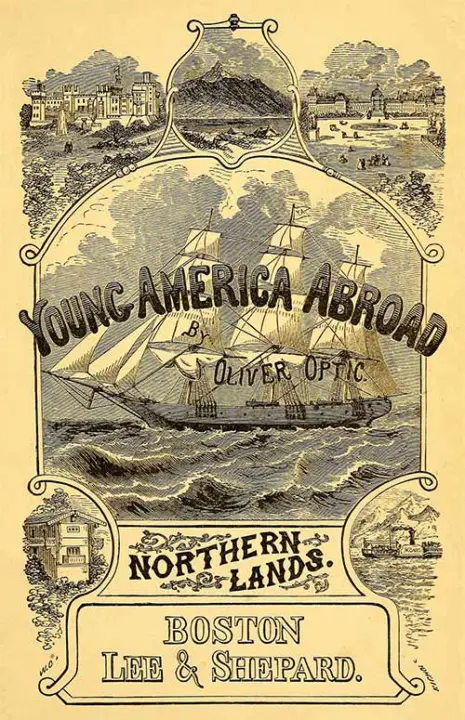
THE CLASSIC COLLECTION · 1872
"Northern Lands; Or, Young America in Russia and Prussia" by Oliver Optic is a historical account and adventure story written in the late 19th century. The book focuses on the experiences of a group of young American tourists aboard the Academy Squadron as they travel through the Baltic region, exploring the cultural landscape of Russia and Prussia. Guided by their adventures, the narrative ultimately provides commentary on political ideals and social dynamics, especially as they relate to youth and growing up. The opening of the story introduces readers to a group of young cadets enjoying a picnic on an island in the Baltic, where heated discussions revolve around the leadership hierarchy aboard their ship and a proposed electoral reform to select officers. Characters like De Forrest and Beckwith express their concerns about their shipmate Cantwell's suitability for leadership, sparking a debate on merit, power, and fairness among their peers. The tensions among students over rank and suitability for command illustrate a larger commentary on political systems and personal responsibility, setting the stage for the ensuing adventures and insights that will unfold as their journey continues.
Introduction adapted from the source catalogue; source summaries may be automatically generated.
Free to read · English · 93,780 words · No account needed
MAKE TIME FOR A GOOD BOOK
On by default. Untick to stop anonymous reading totals. Each page counts after 10 seconds in view. How this works.
Anonymous counting is on unless you have switched it off.
"Mr. Chairman, I rise to a point of order," interposed Beckwith.
"Will the gentleman state his point?"
"That the gentleman is not speaking to the question," snapped the first master, who was determined, if possible, to get even with Scott.
"The speaker stated in the beginning that the proposed measure, and the action of this meeting in connection therewith, were a conspiracy against his rights; and the chair decides that he is in order," said the chairman, with dignity.
"But, sir, must we listen to his biography?" demanded Beckwith.
"Mr. Chairman, it is as painful for me to rehearse my own virtues before this large audience as it is for him to hear me; and the sacrifice which I make in doing so ought to be appreciated by the gentleman on the other side." (Applause.)
"I appeal from the decision of the chair," said Beckwith.
"First Master Beckwith appeals from the decision of the chair," continued Cantwell, who proceeded to state the point at issue, and, taking advantage of the privilege of his position, gave his reasons at length for ruling that Scott was in order.
Most of the seamen of the ship and of the consorts enjoyed the fun, and wished Scott to go on. When the question of order was put, a large majority sustained the decision of the chair. Cantwell began to feel that he had a host of friends, and that the plot of the officers would be defeated.
"Mr. Scott has the floor, and may proceed with his remarks," said he, when the vote was declared.
"I trust I have shown conclusively that I am a good fellow," continued Scott. (Hearty applause.) "Now, to apply what I had said when I was so ungenerously interrupted, if I am a good fellow, I deserve to be the captain, or at least one of the lieutenants, of the ship" (rapturous applause), "provided I get a greater number of merit marks than any other fellow; of course I don't expect to wink the marks out of sight. Not long since I made a little excursion through Sweden with some friends of mine, without exactly running away. The fact was, we couldn't find the ship, though we searched diligently for her." (Applause, and cries of "Finkel.") "I hear 'Finkel.' Finkel was there, and had a finger in the pie. Now, no one can tell how many merits I got for that excursion, and for my struggles to find the ship; nor how many I got for the glass of finkel I drank, which, I grant, deranged my ideas. Then I was caught asleep on the anchor watch, and neither you nor I know how many merit marks I had for that. We are not permitted to examine the record books of the instructors, and therefore we cannot know how high we are marked for any recitation or exercise; but, Mr. Chairman, I got high this month" (violent applause), "and therefore I ought to have a high office. At any rate, Mr. Chairman, the highest office lies between you and me; and I think all present, who have considered the matter, will agree that it belongs to one of us" ("Hear, hear"), "and my modesty does not permit me to indicate which one. And now, Mr. Chairman, within three days of the end of the month, when the prize of a noble ambition is almost within my grasp, comes this cruel conspiracy to rob me of reward!"
Your reading position is saved on this browser. Take it to another device with a library code. Reading pages adapt to text, rather than matching a printed edition.
BEHIND THE BOOK
This eBook is for the use of anyone anywhere in the United States and most other parts of the world at no cost and with almost no restrictions whatsoever. You may copy it, give it away or re-use it under the terms of the Project Gutenberg License included with this eBook or online at www.gutenberg.org. If you are not located in the United States, you will have to check the laws of the country where you are located before using this eBook. Read the source licence.
The original source file, including credits and licence, is retained by this library. Request an original-format copy at no charge. Please include the book title and Project Gutenberg identifier #54059.
KEEP YOUR CURIOSITY GOING
Wilfrid Scawen Blunt
Wilfrid Scawen Blunt

E. W. (Edgar Watson) Howe
Cécile Tormay

Moritz Busch
Coulson Kernahan
