
Switch off
Oliver Optic
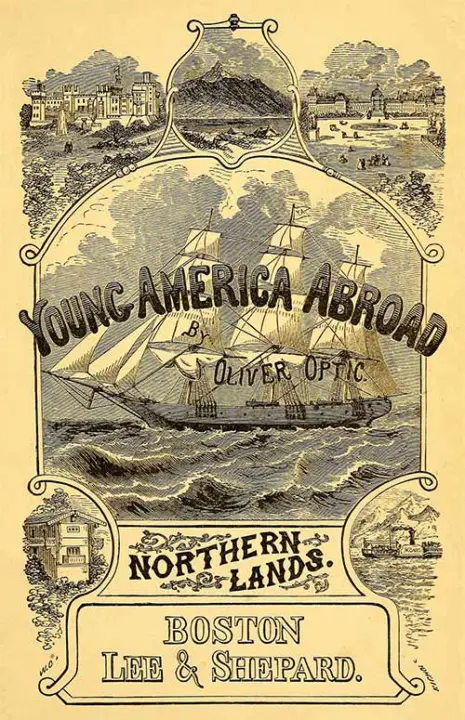
THE CLASSIC COLLECTION · 1872
"Northern Lands; Or, Young America in Russia and Prussia" by Oliver Optic is a historical account and adventure story written in the late 19th century. The book focuses on the experiences of a group of young American tourists aboard the Academy Squadron as they travel through the Baltic region, exploring the cultural landscape of Russia and Prussia. Guided by their adventures, the narrative ultimately provides commentary on political ideals and social dynamics, especially as they relate to youth and growing up. The opening of the story introduces readers to a group of young cadets enjoying a picnic on an island in the Baltic, where heated discussions revolve around the leadership hierarchy aboard their ship and a proposed electoral reform to select officers. Characters like De Forrest and Beckwith express their concerns about their shipmate Cantwell's suitability for leadership, sparking a debate on merit, power, and fairness among their peers. The tensions among students over rank and suitability for command illustrate a larger commentary on political systems and personal responsibility, setting the stage for the ensuing adventures and insights that will unfold as their journey continues.
Introduction adapted from the source catalogue; source summaries may be automatically generated.
Free to read · English · 93,780 words · No account needed
MAKE TIME FOR A GOOD BOOK
On by default. Untick to stop anonymous reading totals. Each page counts after 10 seconds in view. How this works.
Anonymous counting is on unless you have switched it off.
As the jib and flying-jib were run up, the ship began to move through the water, and De Forrest was called aft again to help set the spanker. In a few moments everything was drawing, and the ship went off on the port tack. The starboard watch had the deck, and the port watch went below to attend to their lessons again. The commodore was obliged to leave his pretty friend, who preferred to remain on deck. De Forrest was one of the two hands at the wheel, in charge of a quartermaster, and his mortification was as long continued as it was deep.
"I didn't see you again after you left us yesterday, Mr. De Forrest,"
said Julia.
"You will excuse me, but I am not allowed to talk with any one while at the wheel," stammered he.
"His conduct was such that I declined to permit him to return, and I promised to explain the matter to you," interposed the principal.
And he did explain the matter in full, and in the culprit's hearing. De Forrest could not help seeing that he had sunk to zero in the estimation of the fair girl, who, after this, hardly looked at him. At eight bells the commodore came on deck again, and entertained Miss Gurney, till the squadron anchored off Neufahrwasser, the port of Danzig, at an early hour in the afternoon.
"I am sorry we have arrived so soon," said she, when the ship had
anchored.
"Why?"
"Because I suppose I must leave you now."
"Aren't you tired of going to sea?"
"No, indeed! I think it is so delightful!"
"Then I hope you will stay with us longer. We are going to look at Danzig, and then sail for Swinemünde."
"Will you allow us to stay any longer?"
"Certainly; we shall be very glad to have you remain on board as long
as you will."
The principal indorsed this request, and the Kinnairds assented.
"You will see something new on board to-morrow, if you stay," added Lincoln. "To-morrow will be the first day of the month, and we have an election of officers."
"And will you be the commodore next month?"
"I don't know," laughed Lincoln. "Perhaps I shall not have votes
enough."
"O, I hope you will!"
"Thank you, Miss Gurney; my position is certainly a very comfortable one, for I have but little to do, except to entertain the ship's guests, which in this instance is an exceedingly pleasant duty."
"You are very kind, Commodore Lincoln. I wish I was a young man,"
added Miss Gurney.
"I don't; I'm afraid I shouldn't like you half so well if you were."
Your reading position is saved on this browser. Take it to another device with a library code. Reading pages adapt to text, rather than matching a printed edition.
BEHIND THE BOOK
This eBook is for the use of anyone anywhere in the United States and most other parts of the world at no cost and with almost no restrictions whatsoever. You may copy it, give it away or re-use it under the terms of the Project Gutenberg License included with this eBook or online at www.gutenberg.org. If you are not located in the United States, you will have to check the laws of the country where you are located before using this eBook. Read the source licence.
The original source file, including credits and licence, is retained by this library. Request an original-format copy at no charge. Please include the book title and Project Gutenberg identifier #54059.
KEEP YOUR CURIOSITY GOING
Wilfrid Scawen Blunt
Wilfrid Scawen Blunt

E. W. (Edgar Watson) Howe
Cécile Tormay

Moritz Busch
Coulson Kernahan
