
Switch off
Oliver Optic
THE CLASSIC COLLECTION · 1872
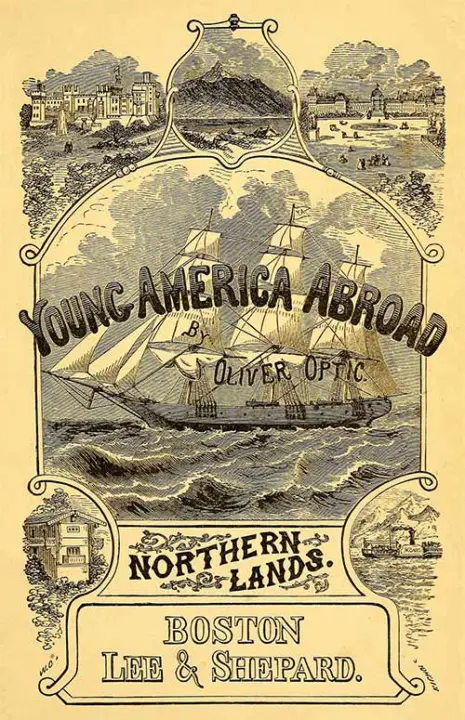
"Northern Lands; Or, Young America in Russia and Prussia" by Oliver Optic is a historical account and adventure story written in the late 19th century. The book focuses on the experiences of a group of young American tourists aboard the Academy Squadron as they travel through the Baltic region, exploring the cultural landscape of Russia and Prussia. Guided by their adventures, the narrative ultimately provides commentary on political ideals and social dynamics, especially as they relate to youth and growing up. The opening of the story introduces readers to a group of young cadets enjoying a picnic on an island in the Baltic, where heated discussions revolve around the leadership hierarchy aboard their ship and a proposed electoral reform to select officers. Characters like De Forrest and Beckwith express their concerns about their shipmate Cantwell's suitability for leadership, sparking a debate on merit, power, and fairness among their peers. The tensions among students over rank and suitability for command illustrate a larger commentary on political systems and personal responsibility, setting the stage for the ensuing adventures and insights that will unfold as their journey continues.
Introduction adapted from the source catalogue; source summaries may be automatically generated.
Free to read · English · 93,780 words · No account needed
MAKE TIME FOR A GOOD BOOK
On by default. Untick to stop anonymous reading totals. Each page counts after 10 seconds in view. How this works.
Anonymous counting is on unless you have switched it off.
"All right; he will leave us in a day or two," replied the purser, with a significant smile, as though the arrangement just suited him. "How much money have you, Beckwith?"
"I drew twenty pounds in St. Petersburg the other day, and I changed my money in Stockholm into Russian paper. I have nearly two hundred rubles."
"Is that all you have?"
"I thought that was a pretty big pile."
"I have a letter of credit for a hundred pounds, upon which I can draw in any city of Europe," added the purser.
"Well, I can get more when I write for it."
"You had better write, then, for you haven't enough left to last you
three weeks."
"I don't know where we are going next," said Beckwith.
"The squadron is going to Hamburg, I believe, and from there on a long cruise, which may use up five or six weeks."
"You mean up the Mediterranean."
"Yes; and if I were you, I would have a letter of credit sent to me at
Constantinople."
"Perhaps I will; but what's up, De Forrest?"
"Don't say a word now. All our chances for a soft thing are gone in this ship, and if you want to enjoy yourself for the rest of the season, keep your weather eye open, and follow my lead--that's all for the present."
At ten o'clock in the forenoon, the first division of the tourists, with the Volga party, embarked in the steamer for St. Petersburg. Each of the students had his pea-jacket and small bag. Mr. Agneau, the chaplain, was in charge of the division, and the surgeon, of the Volga party. On their arrival they took omnibuses for the Moscow station. Tickets for the party were procured, with places in the voiture au lit, or sleeping car. The distance to Moscow is six hundred and four versts, or four hundred miles. The fare is nineteen rubles, first class, and thirteen rubles, second class. The time is twenty hours by the express train, and four or five more by ordinary trains. Twenty miles an hour is rather slow for a fast train, but it is about the usual rate in Russia.
"That's it; this is a Yankee invention," said Scott, as Dr. Winstock handed him his ticket, which was precisely like those of the patented system used on most of the American railroads. "This looks like home. It is stamped with the date, and I suppose they have the machine for doing it. Here, doctor; the date is wrong."
"Wrong?" replied the surgeon, glancing at his ticket. "June 2; that's
right."
"To-day is the 14th, sir."
Your reading position is saved on this browser. Take it to another device with a library code. Reading pages adapt to text, rather than matching a printed edition.
BEHIND THE BOOK
This eBook is for the use of anyone anywhere in the United States and most other parts of the world at no cost and with almost no restrictions whatsoever. You may copy it, give it away or re-use it under the terms of the Project Gutenberg License included with this eBook or online at www.gutenberg.org. If you are not located in the United States, you will have to check the laws of the country where you are located before using this eBook. Read the source licence.
The original source file, including credits and licence, is retained by this library. Request an original-format copy at no charge. Please include the book title and Project Gutenberg identifier #54059.
KEEP YOUR CURIOSITY GOING
Wilfrid Scawen Blunt
Wilfrid Scawen Blunt

E. W. (Edgar Watson) Howe
Cécile Tormay

Moritz Busch
Coulson Kernahan
