
Margaret Maliphant
Alice Vansittart Strettel Carr
THE CLASSIC COLLECTION · 1878
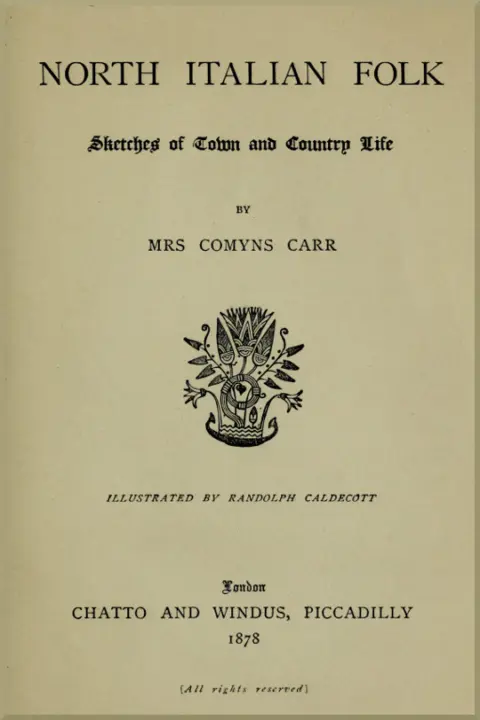
"North Italian Folk: Sketches of Town and Country Life" by Mrs. Comyns Carr is a collection of sketches that captures the essence of rural and urban life in Northern Italy, written in the late 19th century. This work offers an intimate glimpse into the daily lives, customs, and festivities of the Italian people, focusing on the cultural richness that transcends the more commonly depicted historical and artistic lens through which Italy is often viewed. The beginning of the text presents a vivid preface from the author, outlining her intent to document the everyday experiences of the people who form the heart of Italy. Carr expresses her affection and respect for the folk she describes, emphasizing their simplicity, dignity, and the joy of life in the sunlit landscapes of the Riviera and the Apennines. She contrasts their authenticity against the more superficial portrayals often presented by tourism and art. As she embarks on her collection, she invites readers to witness their charming traditions, lively festivals, and the rich, colorful tapestry of their lives, setting the stage for the sketches that follow.
Introduction adapted from the source catalogue; source summaries may be automatically generated.
Free to read · English · 62,505 words · No account needed
MAKE TIME FOR A GOOD BOOK
On by default. Untick to stop anonymous reading totals. Each page counts after 10 seconds in view. How this works.
Anonymous counting is on unless you have switched it off.
The sun glitters on the pale sea that is down and away a mile or more, beyond the sloping fields and gardens, and the dipping valley. Giovanni’s villa is above that part of Ruta’s village lying along the roadside, above the church too, and close upon the bend of a path that turns away from the sea into turf and chestnut woods; nevertheless, he keeps a hold on the great white water still, and can look over the valley that is rich of careful cultivation, can see churches standing cypress-guarded, and palaces where the land drops shore-ward—can see as much, and even more, of the sea-view than they can from the top windows of the old tavern in the village, where carriage-folk used to stop when carriages were many along the highway, and Ruta was a place for the horses to bait at and vetturini to feed at, while their signori got dinner on the terrace beneath the vines. For all he never remembers thinking of it, Giovanni would not like to have his back to the sea, not though it dazzle old eyes, even from far, as it dazzles them to-day, for no clouds have come up to make walking lighter beneath a burthen by the time Giovanni shoulders his fruit-baskets anew and comes down the steps upon the high road. The church bells ring a chime as he passes, and Maria, the pedona who sells eggs, comes down the paved way behind to go to Rappallo as well. She is a woman of years, and fit to join company with Giovanni, to whom her tongue can wag none the less fast for his economy of response. The old manente is a heavy-jawed and tough-hided specimen of contadino; one can see at a glance his words will be few, but Maria’s chatter flows not the less merrily because his deep-set eyes show no sign, and the wrinkles that strew his ancient face do not let themselves be displaced into smiles. Maria is an old woman in whose yellow cheeks the lines seem to have no rhythm, so purposeless is she; but every seam on the old husbandman’s countenance is as though set there by careful length of living. Striking into the tunnel that, just outside of Ruta’s village, covers the roadway, Maria turns to hurl a neighbourly jest after the girl whom they have met driving a donkey from some distant market. A sapphire-coloured morsel of sea lies behind a frail-foliaged aspen tree—lies framed in the green of shrubs that grow around the grotto’s mouth; a long, broken water-line hems the land that fondly goes out in crags and points to meet it, and puts forward her fairest vegetation to fringe the border; in the farthest distance the sea seems to creep into wider bays, and the cliffs to grow less, and the water margin straighter, till a mist gathers into shape, and holds dim white roofs and tall spires and domes within its folds where Genoa lies away to westward. Giovanni, standing with head bent beneath a burthen, Maria, with shrunken face and forehead bound about with crimson kerchief, have this and more before them as they linger a space out of the sunlight, but neither notes skies and seas so familiar, for Rappallo is yet a long way off. ‘The parroco of San Martino has got to manage now without that serving-woman of his that he thought so much of,’ says Maria, as they step out into the cooler shadow on the grotto’s other side. ‘Did you know it? The foolish thing is going to marry! No husband will be what that old master was to her. Yes—yes, poor holy man!—the feasts coming on, too, and he who scarcely knows where to lay hand on his own canonicals unless she’s by. And as for the sacred wafers, who, indeed, will see to them?’ Giovanni’s comment is but a suppressed murmur as he turns to look towards the priest of San Martino’s Church, whose spire lies up against a chestnut-mantled hill to left. The green is the brighter green of inland foliage here, for even olives are scarcer to mingle their silver-grey tones; hills lie behind and beside one another, and turf is fresh beneath these shadier woods, rills trickle and flowers grow; the Mediterranean’s memory is forgotten for a while, and the hot, grey aloe plants and Indian figs give place to gorse bushes and mountain ash. Giovanni tramps forward steadily, and both man and woman have soon left the few tall houses of negozianti behind, that have been built on this side the archway by those who prefer land to sea breezes for change from town. And Maria beguiles the way with many a tale about these same negozianti, till, rounding a point in the smooth high road, Giovanni pauses to rest his burthen upon the wall just where the way turns to right again and, with mountains and chestnut-clad hills behind it still, looks forward once more upon the blue, sunny sheet of the sea. Figs, and aloes, and olives grow again by the roadside with vines between, and here the chestnut-woods flourish beside them as well, and dark cypress trees crown the long crests of hills to the front. So now, as the old people walk, the sea draws ever nearer again if a bend in the road hide it sometimes from view; but the mountains are not left behind all the same, nor the chestnuts shorn for other culture, and, when they reach Rappallo, a river winds about it, and mountains guard it, in whose cleft the town lies; greenest woods girdle it round, though its front be spread beside the waves, and the stabilimento be aptly enough placed for the bathing. Maria sells her new-laid eggs for the summer visitors, Giovanni has disposed of green herbs and melons enough; but the one lingers to return with the sunset cool, and the other hastens back betimes to the village that is his home, and to the villa that reaps all his labours and his fondest affections.
Your reading position is saved on this browser. Take it to another device with a library code. Reading pages adapt to text, rather than matching a printed edition.
Alice Vansittart Strettel Carr
BEHIND THE BOOK
This eBook is for the use of anyone anywhere in the United States and most other parts of the world at no cost and with almost no restrictions whatsoever. You may copy it, give it away or re-use it under the terms of the Project Gutenberg License included with this eBook or online at www.gutenberg.org. If you are not located in the United States, you will have to check the laws of the country where you are located before using this eBook. Read the source licence.
The original source file, including credits and licence, is retained by this library. Request an original-format copy at no charge. Please include the book title and Project Gutenberg identifier #56763.
KEEP YOUR CURIOSITY GOING
Wilfrid Scawen Blunt
Wilfrid Scawen Blunt

E. W. (Edgar Watson) Howe
Francis Greenleaf Allinson & Anne C. E. (Anne Crosby Emery) Allinson
Cyrenus Cole

John Martineau