
Margaret Maliphant
Alice Vansittart Strettel Carr
THE CLASSIC COLLECTION · 1878
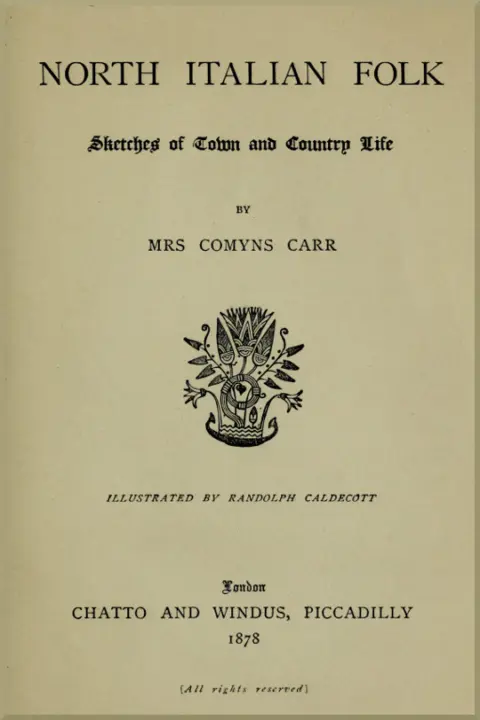
"North Italian Folk: Sketches of Town and Country Life" by Mrs. Comyns Carr is a collection of sketches that captures the essence of rural and urban life in Northern Italy, written in the late 19th century. This work offers an intimate glimpse into the daily lives, customs, and festivities of the Italian people, focusing on the cultural richness that transcends the more commonly depicted historical and artistic lens through which Italy is often viewed. The beginning of the text presents a vivid preface from the author, outlining her intent to document the everyday experiences of the people who form the heart of Italy. Carr expresses her affection and respect for the folk she describes, emphasizing their simplicity, dignity, and the joy of life in the sunlit landscapes of the Riviera and the Apennines. She contrasts their authenticity against the more superficial portrayals often presented by tourism and art. As she embarks on her collection, she invites readers to witness their charming traditions, lively festivals, and the rich, colorful tapestry of their lives, setting the stage for the sketches that follow.
Introduction adapted from the source catalogue; source summaries may be automatically generated.
Free to read · English · 62,505 words · No account needed
MAKE TIME FOR A GOOD BOOK
On by default. Untick to stop anonymous reading totals. Each page counts after 10 seconds in view. How this works.
Anonymous counting is on unless you have switched it off.
The light is everywhere, and everywhere there is something to remember. In crooked, winding ways that climb hills and go down again in steps, and thread dark passages and cross bright piazzas, in ways where winds can be icy cold and suns scarce reach, there are still things whereon memory rests fondly, amongst quaint shops and stalls of fruit-sellers, and fish and flower and green-markets, in hurrying or loitering people, beneath dingy doorways, up dusty stairs, on solemn or gaudy house-fronts. Down upon the wharfs and along the moles where the green waters of the port are not always fragrant as they lap on to time-worn marble steps, there are more things fair to think of in crowding boats and quaint, noisy boatmen, in flapping amber sails of strange fishing smacks, in fine-framed men and women whose shrill voices quarrel and joke, and whose faces and figures bring more colour to the sketch—even something perchance of gala days when stately vessels sailed into the harbour, vessels that were thickly manned and royally freighted, so that flags must needs wave from ships and skiffs and steamers on the water, and, on land, from turret and terrace, while bouquets were flung and floated, and royal salutes were fired. And from the broader of old streets, where palaces flank the way and are sumptuous with façade and arch and stair, from straight and new streets down which the Tramontana can blow grimly enough if the sun can shine also, from loggias on hills that look towards the sunrise, from the walls of tall ramparts that hang over the waves and see the best glory of the sunsets, from every open place, from every nook and corner, more recollections crowd around the first picture of the city’s whole. The steep salite that are paved with red bricks up the middle, the dark cypress standing against churches, the scent of limes and acacias, the growth of arbutus and horse-chestnut, all come telling some little story of the past. Yet, perhaps, most of all, Genoa’s gardens recall the best of Genoa’s life, because they are the most bound up with her holiday life—with her Saints and fasts and feast days—for the Ligurians make merry on most of these occasions, and the Acquasola is the way to and from many a sanctuary. And Genoa is full of gardens. Private gardens upon the hill-sides or upon terraces that appear suddenly in the streets, where flowers grow in boxes, and orange and oleander trees bloom in pots as in the free earth—gardens that are open to the public but are none the less rich in all that nature can lavish, gardens that spring at unexpected turns in the town’s heart to break the monotony of the palaces. Some of them have restaurants in their midst, and there, among Japanese medlar-trees with great fibrous leaves, beneath acanthus and willow and magnolia trees, people dine or sip coffee and ices in the company of marble nymphs and heroes, of shivering cupids who toss the water from stone fountains. But the public promenade is the garden that tells most about the town people’s public life, for to the Acquasola people are wont to go to walk and drive, and meet their acquaintance, and show off new dresses and new equipages. It is the place in which to spend a holiday afternoon. The broad walks are crowded with people, who wander beneath acacia and arbutus trees; fine ladies with attendant cavaliers, mothers of the middle class chaperoning their marriageable daughters, fathers carrying their children that the women may have leisure to enjoy the festa dress and the festa scene; along the drive and the sycamore and horse-chestnut avenues carriages roll smoothly with gay people. Flower-vendors are there, and men and women with Madonnette to sell, or filbert-strings or iced-drinks and wafers. Sometimes a group saunters away to the higher gardens, where the paths wind upward, till they reach a terrace with flowers and palms and trees from foreign lands. The whole town lies spread beneath; towers and palaces and domes seem to grow softer of outline as evening lights creep around. In the far foreground lies the great valley of the Bisagno, where troops have camped—Zouaves and Africans in gorgeous dress. It is a long stretch of dusty road and arid river-bed, but from the Acquasola none of this is to be seen, and there is only an impression of green country far away, with palaces lying on the slopes of Albaro’s hill, and a knowledge of sea beyond. Behind the rising ground runs the town’s great aqueduct, that is built through glens and copses when once it has left the city’s first outskirts. And to your right is the harbour again, with ships and flags and masts, and beyond the harbour a waste of Mediterranean neither blue nor grey nor white, that, in the doubtful light, will seem neither land nor water, lying out towards the sunset, where dim clouds hold Riviera mountains in their midst.
Your reading position is saved on this browser. Take it to another device with a library code. Reading pages adapt to text, rather than matching a printed edition.
Alice Vansittart Strettel Carr
BEHIND THE BOOK
This eBook is for the use of anyone anywhere in the United States and most other parts of the world at no cost and with almost no restrictions whatsoever. You may copy it, give it away or re-use it under the terms of the Project Gutenberg License included with this eBook or online at www.gutenberg.org. If you are not located in the United States, you will have to check the laws of the country where you are located before using this eBook. Read the source licence.
The original source file, including credits and licence, is retained by this library. Request an original-format copy at no charge. Please include the book title and Project Gutenberg identifier #56763.
KEEP YOUR CURIOSITY GOING
Wilfrid Scawen Blunt
Wilfrid Scawen Blunt

E. W. (Edgar Watson) Howe
Francis Greenleaf Allinson & Anne C. E. (Anne Crosby Emery) Allinson
Cyrenus Cole

John Martineau