THE CLASSIC COLLECTION✦Behind the Beyond, and Other Contributions to Human KnowledgeCLASSIC FREE BOOKS
Behind the Beyond, and Other Contributions to Human Knowledge
Stephen Leacock
THE CLASSIC COLLECTION · 1900
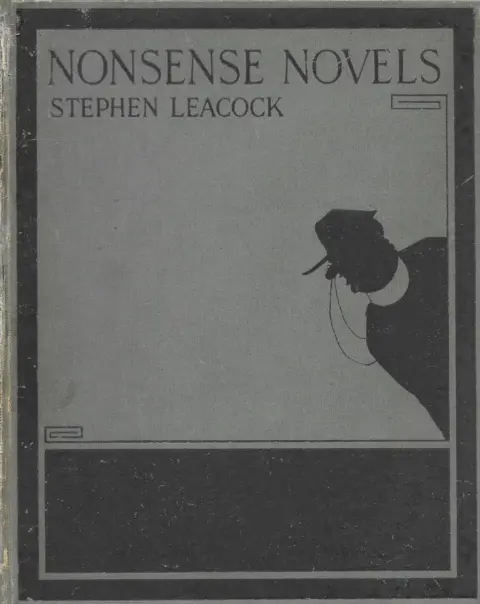
"Nonsense Novels" by Stephen Leacock is a collection of humorous short stories penned in the early 20th century. The work showcases Leacock's signature wit and clever satire, presenting a series of whimsical narratives that satirize various aspects of society, from detective stories to romantic tales, all infused with a light-hearted absurdity. At the start of the collection, Leacock's preface provides insight into his motivations for writing the book, humorously addressing critics who doubt his intellect. The first story, "Maddened by Mystery: or, The Defective Detective," introduces a comically incompetent detective tasked with solving the baffling kidnapping of the Prince of Württemberg. As the story unfolds, the detective's ludicrous analysis leads to the hilarious realization that the prince is not a human at all, but rather a prize Dachshund. This opening sets the tone for Leacock's playful approach to storytelling, inviting readers into a world where logic is turned on its head and laughter is the ultimate goal.
Introduction adapted from the source catalogue; source summaries may be automatically generated.
Free to read · English · 31,971 words · No account needed
MAKE TIME FOR A GOOD BOOK
On by default. Untick to stop anonymous reading totals. Each page counts after 10 seconds in view. How this works.
Anonymous counting is on unless you have switched it off.
Beside me sat a man. His face was hairless, but neither old nor young. He wore clothes that looked like the grey ashes of paper that had burned and kept its shape. He was looking at me quietly, but with no particular surprise or interest.
“Quick,” I said, eager to begin; “where am I? Who are you? What year is this; is it the year 3000, or what is it?”
He drew in his breath with a look of annoyance on his face.
“What a queer, excited way you have of speaking,” he said.
“Tell me,” I said again, “is this the year 3000?”
“I think I know what you mean,” he said; “but really I haven’t the faintest idea. I should think it must be at least that, within a hundred years or so; but nobody has kept track of them for so long, it’s hard to say.”
“Don’t you keep track of them any more?” I gasped.
“We used to,” said the man. “I myself can remember that a century or two ago there were still a number of people who used to try to keep track of the year, but it died out along with so many other faddish things of that kind. Why,” he continued, showing for the first time a sort of animation in his talk, “what was the use of it? You see, after we eliminated death—”
“Eliminated death!” I cried, sitting upright. “Good God!”
“What was that expression you used?” queried the man.
“Good God!” I repeated.
“Ah,” he said, “never heard it before. But I was saying that after we had eliminated Death, and Food, and Change, we had practically got rid of Events, and—”
“Stop!” I said, my brain reeling. “Tell me one thing at a time.”
“Humph!” he ejaculated. “I see, you must have been asleep a long time. Go on then and ask questions. Only, if you don’t mind, just as few as possible, and please don’t get interested or excited.”
Oddly enough the first question that sprang to my lips was—
“What are those clothes made of?”
“Asbestos,” answered the man. “They last hundreds of years. We have one suit each, and there are billions of them piled up, if anybody wants a new one.”
“Thank you,” I answered. “Now tell me where I am?”
“You are in a museum. The figures in the cases are specimens like yourself. But here,” he said, “if you want really to find out about what is evidently a new epoch to you, get off your platform and come out on Broadway and sit on a bench.”
I got down.
Your reading position is saved on this browser. Take it to another device with a library code. Reading pages adapt to text, rather than matching a printed edition.
Stephen Leacock
Stephen Leacock
Stephen Leacock
Stephen Leacock
BEHIND THE BOOK
This eBook is for the use of anyone anywhere in the United States and most other parts of the world at no cost and with almost no restrictions whatsoever. You may copy it, give it away or re-use it under the terms of the Project Gutenberg License included with this eBook or online at www.gutenberg.org. If you are not located in the United States, you will have to check the laws of the country where you are located before using this eBook. Read the source licence.
The original source file, including credits and licence, is retained by this library. Request an original-format copy at no charge. Please include the book title and Project Gutenberg identifier #4682.
KEEP YOUR CURIOSITY GOING

Charles G. (Charles Griffith) Ross
Hannah Webster Foster

Emily Lawless
Edwin Hamlin Carr

Charles De Lano Hine
Andrew Ure