Anne Page
Netta Syrett
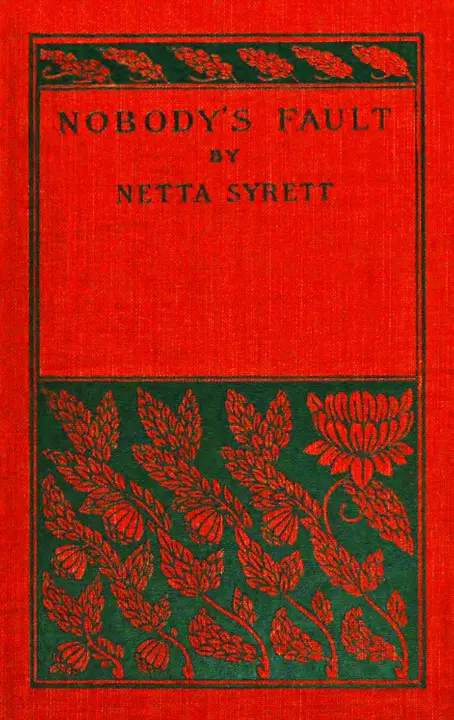
THE CLASSIC COLLECTION · 1896
"Nobody's Fault" by Netta Syrett is a novel written in the late 19th century. The story revolves around Bridget Ruan, a young woman grappling with her identity as she straddles two worlds: her upbringing as the daughter of a publican and the refined education she received at a private school. The narrative delves into themes of class distinction, personal aspiration, and the struggles of familial relationships. At the start of the novel, we are introduced to Bridget's world through the contrasting settings of a cozy drawing-room and the damp London streets outside. The dialogue reveals her background and her recent literary endeavors, which have garnered attention from her friends and acquaintances. As the opening unfolds, Bridget's character is fleshed out through her interactions with friends from school and her reflections on her social status, showcasing her longing for a more meaningful life that transcends her current circumstances. She grapples with feelings of jealousy, pride, and a deep desire for growth in her pursuit of writing. The narrative hints at her internal conflict between her origins and her ambitions as she navigates the complexities of belonging and self-identity.
Introduction adapted from the source catalogue; source summaries may be automatically generated.
Free to read · English · 50,450 words · No account needed
MAKE TIME FOR A GOOD BOOK
On by default. Untick to stop anonymous reading totals. Each page counts after 10 seconds in view. How this works.
Anonymous counting is on unless you have switched it off.
Miss Mansfield had left the room a moment or two before to give an order to the servant, and Helen was busy with the lamps.
“May I look at the books on the shelves?” Bridget said, rising as she
spoke.
“Certainly, you insatiable young woman,” returned the Professor.
He watched her with an amused, critical air, as she moved lightly from one shelf to the other, reading titles, opening a volume here and there to glance at the frontispiece, stopping to read half a page now and again.
“Like a half-starved child in a pastry-cook’s shop,” he thought, as he followed her movements.
“What have you found there?” he asked at last. The girl was bending over one of the books longer than usual, and he caught a glimpse of her absorbed face from where he sat.
“It’s an essay,--about Christ; whether he was God,” she said, glancing
at him brightly.
“Ah,--h’m!” observed the Professor, with an incipient smile of amusement. “That’s not a book for the young person.”
“But I’m not a young person, and this is just the sort of book I want,” Bridget replied eagerly.
“But the Bible tells you so,” objected the Professor, mildly.
She turned, looked at him fixedly a moment, and then laughed. Bridget was charming when she laughed. The Professor involuntarily joined her.
“What I say is quite correct, nevertheless,” he added.
“Of course; but I want to know why I should believe what the Bible
says.”
“Curiouser and curiouser,” he murmured, raising his eyes to the ceiling. “Where do the young people of the present day get their ideas, I wonder?”
“Well, chiefly from books like yours, I think,” she returned demurely. “I read your ‘Veritas’ a year ago.”
“Verily my sin has found me out!” he exclaimed. “Well, and at what conclusion have you arrived?”
“I think,” she said slowly, “that it’s impossible to tell whether there is or is not a God. If there is, I’m sure of one thing, He’s not the Bible God.”
“Why, may I ask?”
“Well, for many reasons, but chiefly because it’s so unjust to call people into the world without asking if they want to come, and then by way of adding insult to injury to tell them, directly they get here, that if they don’t believe that a man who lived thousands of years ago was God, they shall go to hell.”
“Bid!” said Helen, deprecatingly.
“But that is exactly what Christians are invited to believe,” she
returned.
The Professor was silent. He looked at Bridget attentively, without
speaking for some moments.
Your reading position is saved on this browser. Take it to another device with a library code. Reading pages adapt to text, rather than matching a printed edition.
BEHIND THE BOOK
This eBook is for the use of anyone anywhere in the United States and most other parts of the world at no cost and with almost no restrictions whatsoever. You may copy it, give it away or re-use it under the terms of the Project Gutenberg License included with this eBook or online at www.gutenberg.org. If you are not located in the United States, you will have to check the laws of the country where you are located before using this eBook. Read the source licence.
The original source file, including credits and licence, is retained by this library. Request an original-format copy at no charge. Please include the book title and Project Gutenberg identifier #71360.
KEEP YOUR CURIOSITY GOING
Coulson Kernahan

Maurice Baring
Frances Wright
Cécile Tormay

Frederic Jesup Stimson

W. H. P. (William Henry Pope) Jarvis