Anne Page
Netta Syrett
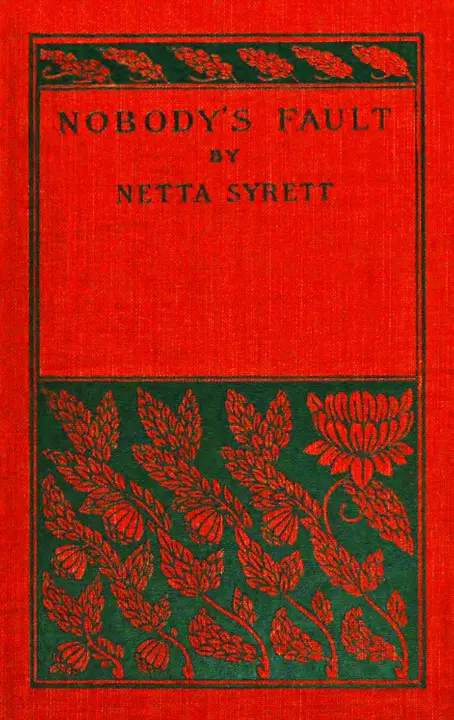
THE CLASSIC COLLECTION · 1896
"Nobody's Fault" by Netta Syrett is a novel written in the late 19th century. The story revolves around Bridget Ruan, a young woman grappling with her identity as she straddles two worlds: her upbringing as the daughter of a publican and the refined education she received at a private school. The narrative delves into themes of class distinction, personal aspiration, and the struggles of familial relationships. At the start of the novel, we are introduced to Bridget's world through the contrasting settings of a cozy drawing-room and the damp London streets outside. The dialogue reveals her background and her recent literary endeavors, which have garnered attention from her friends and acquaintances. As the opening unfolds, Bridget's character is fleshed out through her interactions with friends from school and her reflections on her social status, showcasing her longing for a more meaningful life that transcends her current circumstances. She grapples with feelings of jealousy, pride, and a deep desire for growth in her pursuit of writing. The narrative hints at her internal conflict between her origins and her ambitions as she navigates the complexities of belonging and self-identity.
Introduction adapted from the source catalogue; source summaries may be automatically generated.
Free to read · English · 50,450 words · No account needed
MAKE TIME FOR A GOOD BOOK
On by default. Untick to stop anonymous reading totals. Each page counts after 10 seconds in view. How this works.
Anonymous counting is on unless you have switched it off.
“Look at her,” urged Mary, nudging her friend again. “She’s hardly answering Charley Downs. Don’t you hate that way she has of looking on the carpet?--so indifferent; though I shouldn’t wonder if it wasn’t to show off her eyelashes. I believe she can hardly keep a sneer off her face.”
“She wouldn’t surely have the cheek to sneer at Charley Downs. Surely he’s good enough for her. Why, he’s in Bailey’s Bank, you know.”
“Oh, bless you, she wants a duke! What a dress, too. I think it’s downright affectation to come in a dress as plain as that. Just to make herself look different from us. She knew all the girls would likely wear their summer muslins.”
“It’s awfully well made, though; and that bit of lace is good, you can
see.”
“So it ought to be. They’ve plenty of money--must have, or her dad couldn’t have sent her to a swell school.”
The conversation, to which “Queen of my Heart” had made an excellent accompaniment, was broken off by the inevitable high note with which all of Carrie’s songs ended.
“Thank you, dear!” both girls exclaimed, in haste and simultaneously. “We have enjoyed it so.”
“Carrie, my girl, let’s have something to eat,” shouted Mr. Jenkins, who had persistently aimed cards at the hat throughout the song, accompanied by loud exclamations at intervals of “Got ’im!” “Boss shot!” “Try another!”
“Here, you young folks! Can’t enjoy yourselves on an empty stomach, you know. All nonsense.”
“Pa!” exclaimed Carrie, with annoyance. “How stupid you are!”
“Stupid, my dear, I may be; faint, I am. When’s supper, mother? Oh my! look at ’em frowning! Said something I oughtn’t to, ’ave I? Can’t help it. Food’s the main thing in life, eh? What do you say, all of you?”
Mr. Jenkins trotted about with a plate of ginger-nuts in one hand, and one of quartered apples in the other, talking cheerfully to the company at large.
“Now, young men, make yourselves useful. Wait on the ladies.”
Thus admonished, the youths dashed at the chiffonier, where they jostled one another for the green dessert plates.
“Have a nut, Miss Ruan,” implored Mr. Spiller, returning to her side. “So sustaining. Not one? Won’t you share one with me now?” he whispered facetiously, bending towards her.
The girl drew back proudly. There was no mistaking the gesture.
“That girl of Ruan’s is too big for her boots, as the saying is,” whispered Mrs. Jenkins to a friend.
“Is she? She’s quiet, I noticed, but she’s pleasant mannered enough, I
thought.”
Your reading position is saved on this browser. Take it to another device with a library code. Reading pages adapt to text, rather than matching a printed edition.
BEHIND THE BOOK
This eBook is for the use of anyone anywhere in the United States and most other parts of the world at no cost and with almost no restrictions whatsoever. You may copy it, give it away or re-use it under the terms of the Project Gutenberg License included with this eBook or online at www.gutenberg.org. If you are not located in the United States, you will have to check the laws of the country where you are located before using this eBook. Read the source licence.
The original source file, including credits and licence, is retained by this library. Request an original-format copy at no charge. Please include the book title and Project Gutenberg identifier #71360.
KEEP YOUR CURIOSITY GOING
Coulson Kernahan

Maurice Baring
Frances Wright
Cécile Tormay

Frederic Jesup Stimson

W. H. P. (William Henry Pope) Jarvis