THE CLASSIC COLLECTION✦No enemyCLASSIC FREE BOOKS
No enemy
Ford Madox Ford
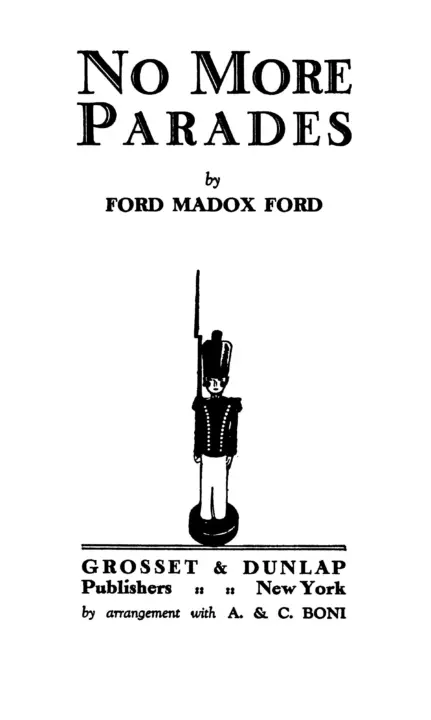
THE CLASSIC COLLECTION · 1925
"No More Parades: A novel" by Ford Madox Ford is a novel published in 1925. The second book in the Parade's End tetralogy, it follows Captain Christopher Tietjens as he struggles to command troops at a base camp in Rouen during World War I. Amid shelling, bureaucratic chaos, and the death of soldiers in his arms, Tietjens confronts his crumbling marriage to his unfaithful wife Sylvia, who pursues him to France, while suppressing his love for another woman, Valentine Wannop.
Introduction adapted from the source catalogue; source summaries may be automatically generated.
Free to read · English · 86,163 words · No account needed
MAKE TIME FOR A GOOD BOOK
On by default. Untick to stop anonymous reading totals. Each page counts after 10 seconds in view. How this works.
Anonymous counting is on unless you have switched it off.
Sylvia knew the letter almost by heart as far as that because in the unbearable white room of the convent near Birkenhead she had twice begun to copy it out, with the idea of keeping the copies for use in some sort of publicity. But, at that point, she had twice been overcome by the idea that it was not a very sporting thing to do, if you really think about it. Besides, the letter after that--she had glanced through it--occupied itself almost entirely with the affairs of Mrs. Wannop. Mark, in his naïve way, was concerned that the old lady, although now enjoying the income from the legacy left her by their father, had not immediately settled down to write a deathless novel; although, as he added, he knew nothing about novels. . . .
Christopher was reading away at his letters beneath the green-shaded lamp; the ex-quartermaster had begun several sentences and dropped into demonstrative silence at the reminder that Tietjens was reading. Christopher's face was completely without expression; he might have been reading a return from the office of statistics in the old days at breakfast. She wondered, vaguely, if he would see fit to apologize for the epithets that his brother had applied to her. Probably he would not. He would consider that she having opened the letter must take the responsibility of the contents. Something like that. Thumps and rumbles began to exist in the relative silence. Cowley said: "They're coming again then!" Several couples passed them on the way out of the room. Amongst them there was certainly no presentable man; they were all either too old or too hobbledehoy, with disproportionate noses and vacant, half-opened mouths.
Accompanying Christopher's mind, as it were, whilst he read his letter had induced in her a rather different mood. The pictures in her own mind were rather of Mark's dingy breakfast-room in which she had had her interview with him--and of the outside of the dingy house in which the Wannops lived, at Bedford Park. . . . But she was still conscious of her pact with the father and, looking at her wrist watch, saw that by now six minutes had passed. . . . It was astonishing that Mark, who was a millionaire at least, and probably a good deal more, should live in such a dingy apartment--it had for its chief decoration the hoofs of several deceased race-winners, mounted as ink-stands, as pen-racks, as paper-weights--and afford himself only such a lugubrious breakfast of fat slabs of ham over which bled pallid eggs. . . . For she too, like her mother, had looked in on Mark at breakfast-time--her mother because she had just seen Christopher off to France, and she because, after a sleepless night--the third of a series--she had been walking about St. James's Park and, passing under Mark's windows, it had occurred to her that she might do Christopher some damage by putting his brother wise about the entanglement with Miss Wannop. So, on the spur of the moment, she had invented a desire to live at Groby with the accompanying necessity for additional means. For, although she was a pretty wealthy woman, she was not wealthy enough to live at Groby and keep it up. The immense old place was not so immense because of its room-space, though, as far as she could remember, there must be anything between forty and sixty rooms, but because of the vast old grounds, the warren of stabling, wells, rose-walks and fencing. . . . A man's place, really, the furniture very grim and the corridors on the ground floor all slabbed with great stones. So she had looked in on Mark, reading his correspondence with his copy of The Times airing on a chair-back before the fire--for he was just the man to retain the eighteen-forty idea that you can catch cold by reading a damp newspaper. His grim, tight, brown-wooden features that might have been carved out of an old chair, had expressed no emotion at all during the interview. He had offered to have up some more ham and eggs for her and had asked one or two questions as to how she meant to live at Groby if she went there. Otherwise he had said nothing about the information she had given him as to the Wannop girl having had a baby by Christopher--for purposes of conversation she had adhered to that old story, at any rate till that interview. He had said nothing at all. Not one word. . . . At the end of the interview, when he had risen and produced from an adjoining room a bowler hat and an umbrella, saying that he must now go to his office, he had put to her without any expression pretty well what stood in the letter, as far as business was concerned. He said that she could have Groby, but she must understand that, his father being now dead and he a public official, without children and occupied in London with work that suited him, Groby was practically Christopher's property to do what he liked with as long as--which he certainly would--he kept it in proper style. So that, if she wished to live there, she must produce Christopher's authorization to that effect. And he added, with an equableness so masking the proposition that it was not until she was well out of the house and down the street that its true amazingness took her breath away:
Your reading position is saved on this browser. Take it to another device with a library code. Reading pages adapt to text, rather than matching a printed edition.
Ford Madox Ford
Joseph Conrad & Ford Madox Ford
Ford Madox Ford
Ford Madox Ford
BEHIND THE BOOK
This eBook is for the use of anyone anywhere in the United States and most other parts of the world at no cost and with almost no restrictions whatsoever. You may copy it, give it away or re-use it under the terms of the Project Gutenberg License included with this eBook or online at www.gutenberg.org. If you are not located in the United States, you will have to check the laws of the country where you are located before using this eBook. Read the source licence.
The original source file, including credits and licence, is retained by this library. Request an original-format copy at no charge. Please include the book title and Project Gutenberg identifier #67622.
KEEP YOUR CURIOSITY GOING
Cécile Tormay

Moritz Busch
Coulson Kernahan
John L. Ransom

Maurice Baring
Frances Wright