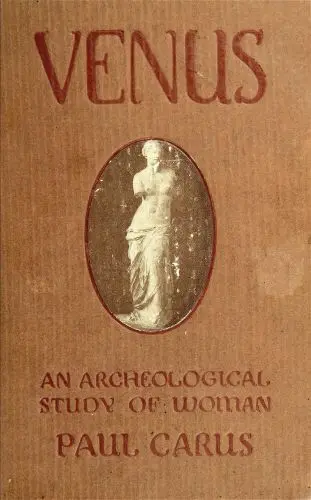
The Venus of Milo: an archeological study of the goddess of womanhood
Paul Carus

THE CLASSIC COLLECTION · 1914
"Nietzsche and Other Exponents of Individualism" by Paul Carus is a philosophical treatise written in the early 20th century. This work examines the thoughts and critiques surrounding Friedrich Nietzsche, focusing on the essence of individualism and its implications within philosophical discourse. Carus seeks to provide a nuanced understanding of Nietzsche's views alongside those of other prominent individualist thinkers, arguably critiquing their implications for ethics and societal frameworks. The opening of the text establishes a framework for understanding philosophy as a system of thought comprising knowledge, emotion, and ethics. Carus emphasizes the importance of truthfulness and objectivity in philosophy, contrasting these with the subjective philosophies exemplified by thinkers like Nietzsche. He characterizes Nietzsche's philosophy as a profound rebellion against traditional thought, presenting criticisms of its implications, particularly the glorification of the "overman" and the rejection of moral norms. The reader is introduced to the dichotomy between objective and subjective conceptions of truth, setting the stage for deeper explorations of Nietzsche's philosophies and their impact on individualism.
Introduction adapted from the source catalogue; source summaries may be automatically generated.
Free to read · English · 34,623 words · No account needed
MAKE TIME FOR A GOOD BOOK
On by default. Untick to stop anonymous reading totals. Each page counts after 10 seconds in view. How this works.
Anonymous counting is on unless you have switched it off.
"They look well at each other's fingers and trust each other not over-much. Ingenious in little stratagems, they wait for those whose knowledge walketh on lame feet; like spiders they wait.
"They also know how to play with false dice; and I found them playing so eagerly that they perspired from it.
"We are strangers unto each other, and their virtues are
still more contrary unto my taste than their falsehoods
and false dice."
Even if all scientists were puny sciolists, the ideal of science would remain, and if all the professed seekers for truth were faithless to and unworthy of their high calling, truth itself would not be abolished.
So far as we can see, Nietzsche never became acquainted with any one of the exact sciences. He was a philologist who felt greatly dissatisfied with the loose methods of his colleagues, but he has not done much in his own specialty to attain to a greater exactness of results. His essays on Homer, on the Greek tragedy, and similar subjects, have apparently not received much recognition among philologists and historians.
Having gathered a number of followers in his cave, one of them, called the conscientious man, said to the others:
"We seek different things, even up here, ye and I. For I seek more security. Therefore have I come unto Zarathustra. For he is the firmest tower and will--
"Fear--that is man's hereditary and fundamental feeling. By fear everything is explained, original sin and original virtue. Out of fear also hath grown my virtue, which is called Science.
"Such long, old fears, at last become refined, spiritual, intellectual, to-day, methinketh, it is called Science."
This conception of science is refuted by Nietzsche in this fashion:
"Thus spake the conscientious one. But Zarathustra, who had just returned into his cave and had heard the last speech and guessed its sense, threw a handful of roses at the conscientious one, laughing at his 'truths.' 'What?' he called. 'What did I hear just now? Verily, methinketh, thou art a fool, or I am one myself. And thy "truth" I turn upside down with one blow, and that quickly.'
"'For fear is our exception. But courage and adventure, and the joy of what is uncertain, what hath never been dared--courage, methinketh, is the whole prehistoric development of man.
"'From the wildest, most courageous beasts he hath, by his envy and his preying, won all their virtues. Only thus hath he become a man.
"'This courage, at last become refined, spiritual, intellectual, this human courage with an eagle's wings and a serpent's wisdom--it, methinketh, is called to-day--'
Your reading position is saved on this browser. Take it to another device with a library code. Reading pages adapt to text, rather than matching a printed edition.
BEHIND THE BOOK
This eBook is for the use of anyone anywhere in the United States and most other parts of the world at no cost and with almost no restrictions whatsoever. You may copy it, give it away or re-use it under the terms of the Project Gutenberg License included with this eBook or online at www.gutenberg.org. If you are not located in the United States, you will have to check the laws of the country where you are located before using this eBook. Read the source licence.
The original source file, including credits and licence, is retained by this library. Request an original-format copy at no charge. Please include the book title and Project Gutenberg identifier #48495.
KEEP YOUR CURIOSITY GOING

David Patterson (Spirit) Hatch
Coulson Kernahan

Ralph Waldo Emerson
Frances Wright

Edwin Abbott Abbott

Joseph Droz