
The lost dirigible
Ralph Henry Barbour
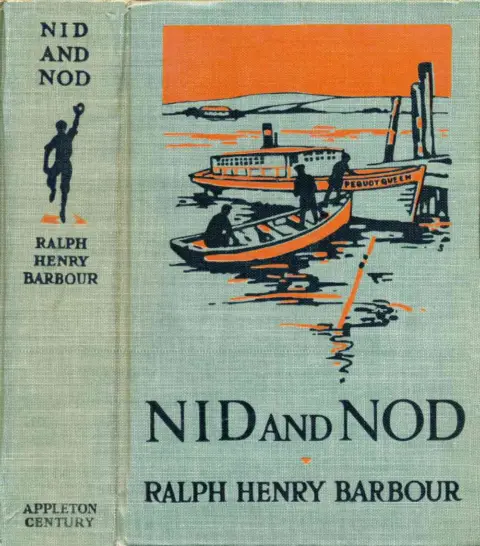
THE CLASSIC COLLECTION · 1923
"Nid and Nod" by Ralph Henry Barbour is a novel written in the early 20th century. The story revolves around twin brothers, Nid and Nod Turner, and their adventures at a boarding school, particularly with their overweight friend Kewpie Proudtree. The book explores themes of friendship, loyalty, and the struggles of fitting in, especially in a school environment where sports play a significant role. At the start of "Nid and Nod," readers are introduced to the lively atmosphere of the local soda shop where Kewpie engages in humorous banter with Polly, the shopkeeper's daughter, about his eating habits and his aspirations in sports. The chapter sets the tone for the friendships between Kewpie, Nid, and their friends as they navigate the challenges of adolescence together. Kewpie, feeling a need to prove himself, expresses a desire to join the baseball team, prompting Nid to consider how they might help him achieve this goal. Thus, the opening scene forms the foundation for both individual and collective struggles, setting the stage for the unfolding narrative.
Introduction adapted from the source catalogue; source summaries may be automatically generated.
Free to read · English · 66,981 words · No account needed
MAKE TIME FOR A GOOD BOOK
On by default. Untick to stop anonymous reading totals. Each page counts after 10 seconds in view. How this works.
Anonymous counting is on unless you have switched it off.
“Chocolate ice-cream soda. Say, what became of you after school? I
looked all over for you.”
“Ran up to the room a minute. Thought you’d wait, you dumb-bell.”
“I did wait. Then I thought you’d started over here. Whose wheel is that you’ve got out there?”
“Search me. Elk Thurston’s, I guess. I found it doing nothing in front of West. I’ll take a pineapple and strawberry, please, Polly.”
“Well, you had a nerve! Elk will scalp you.”
Laurie shrugged and accepted his refreshment. “I only borrowed it,” he explained carelessly. “Here comes the mob.”
The afternoon influx of Hillman’s boys was begun by two tousled-haired juniors demanding “Vanilla sundaes with chopped walnuts, please, Miss Polly!” and after them the stream became steady for several minutes. Further sustained conversation with Polly being no longer possible, Ned and Laurie took their glasses to the other side of the shop, where Laurie perched himself on the counter and watched the confusion. Ned’s eyes presently strayed to the array of pastry behind the further counter, and he sighed wistfully. But as Laurie, who was in training for baseball, might not partake of such things, Ned resolutely removed his gaze from that part of the shop, not without a second sigh, and, turning it to the door, nudged Laurie in the ribs with an elbow.
“Thurston,” he breathed.
Laurie looked calmly at the big upper-middle boy who was entering. “Seems put out about something,” he murmured.
“Say,” demanded “Elk” Thurston in a voice that dominated the noise of talk and laughter and the almost continuous hiss of the soda-fountain, “what smart guy swiped my bicycle and rode it over here?”
Elkins Thurston was seventeen, big, dark-complexioned, and domineering, and as the chatter died into comparative silence the smaller boys questioned each other with uneasy glances. No one, however, confessed, and Elk, pushing his way roughly toward the fountain, complained bitterly. “Well, some fresh Aleck did, and I’ll find out who he was, too, and when I do I’ll teach him to let my things alone!”
“What’s the trouble, Elk?” asked Laurie politely. Ned, nudging him to keep still, found Elk observing him suspiciously.
“You heard, I guess,” answered Elk. “Did you have it?”
“Me?” said Ned. “No, I didn’t have it.”
“I don’t mean you; I mean him.” Elk pointed an accusing finger at
Laurie.
“Me?” asked Laurie. “What was it you lost?”
“Shut up,” whispered Ned. “He’ll come over and――”
“My bicycle, that’s what! I’ll bet you swiped it, you fresh kid.”
“What’s it look like?” inquired Laurie interestedly.
Your reading position is saved on this browser. Take it to another device with a library code. Reading pages adapt to text, rather than matching a printed edition.
Ralph Henry Barbour
Ralph Henry Barbour

Ralph Henry Barbour

Ralph Henry Barbour
BEHIND THE BOOK
This eBook is for the use of anyone anywhere in the United States and most other parts of the world at no cost and with almost no restrictions whatsoever. You may copy it, give it away or re-use it under the terms of the Project Gutenberg License included with this eBook or online at www.gutenberg.org. If you are not located in the United States, you will have to check the laws of the country where you are located before using this eBook. Read the source licence.
The original source file, including credits and licence, is retained by this library. Request an original-format copy at no charge. Please include the book title and Project Gutenberg identifier #71633.
KEEP YOUR CURIOSITY GOING
Coulson Kernahan

Maurice Baring
Frances Wright
Cécile Tormay

Frederic Jesup Stimson

W. H. P. (William Henry Pope) Jarvis