THE CLASSIC COLLECTION✦Selected Poems of Francis ThompsonCLASSIC FREE BOOKS
Selected Poems of Francis Thompson
Francis Thompson
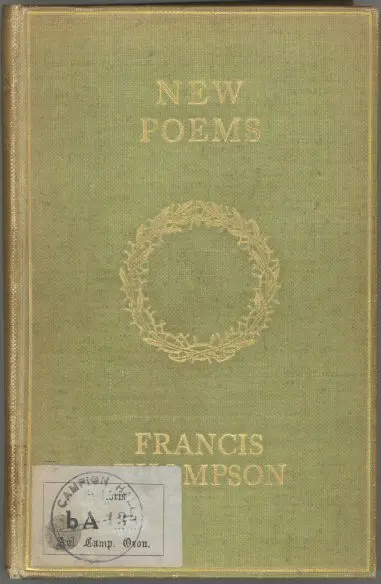
THE CLASSIC COLLECTION · 1897
"New Poems" by Francis Thompson is a collection of poetic works written in the early 20th century. The poems explore themes of love, spirituality, and nature, reflecting Thompson's rich imagination and deep emotional resonance. The opening section introduces the reader to a variety of lyrical forms, showcasing his ability to convey complex feelings and abstract ideas through vivid imagery and intricate language. The beginning of "New Poems" features a dedication to Coventry Patmore, a fellow poet, indicating the personal significance of the work. The collection opens with "The Mistress of Vision," a poem that paints a dreamlike picture of a mysterious garden and a woman whose singing captivates the speaker, intertwining notions of love and longing. This ethereal atmosphere is expanded upon as the poem explores deeper truths and the interplay of light and shadow, setting the tone for the rest of the anthology. Each subsequent poem delves into contemplative reflections on existence, showcasing Thompson's unique voice and mastery of poetic form.
Introduction adapted from the source catalogue; source summaries may be automatically generated.
Free to read · English · 25,123 words · No account needed
MAKE TIME FOR A GOOD BOOK
On by default. Untick to stop anonymous reading totals. Each page counts after 10 seconds in view. How this works.
Anonymous counting is on unless you have switched it off.
In a little dust, in a little dust,
Earth, thou reclaim’st us, who do all our lives
Find of thee but Egyptian villeinage.
Thou dost this body, this enhavocked realm,
Subject to ancient and ancestral shadows;
Descended passions sway it; it is distraught
With ghostly usurpation, dinned and fretted
With the still-tyrannous dead; a haunted tenement,
Peopled from barrows and outworn ossuaries.
Thou giv’st us life not half so willingly
As thou undost thy giving; thou that teem’st
The stealthy terror of the sinuous pard,
The lion maned with curlèd puissance,
The serpent, and all fair strong beasts of ravin,
Thyself most fair and potent beast of ravin;
And thy great eaters thou, the greatest, eat’st.
Thou hast devoured mammoth and mastodon,
And many a floating bank of fangs,
The scaly scourges of thy primal brine,
And the tower-crested plesiosaure.
Thou fill’st thy mouth with nations, gorgest slow
On purple æons of kings; man’s hulking towers
Are carcase for thee, and to modern sun
Disglutt’st their splintered bones.
Rabble of Pharaohs and Arsacidæ
Keep their cold house within thee; thou hast sucked down
How many Ninevehs and Hecatompyloi,
And perished cities whose great phantasmata
O’erbrow the silent citizens of Dis:—
Hast not thy fill?
Tarry awhile, lean Earth, for thou shalt drink,
Even till thy dull throat sicken,
The draught thou grow’st most fat on; hear’st thou not
The world’s knives bickering in their sheaths? O patience!
Much offal of a foul world comes thy way,
And man’s superfluous cloud shall soon be laid
In a little blood.
In a little peace, in a little peace,
Thou dost rebate thy rigid purposes
Of imposed being, and relenting, mend’st
Too much, with nought. The westering Phoebus’ horse
Paws i’ the lucent dust as when he shocked
The East with rising; O how may I trace
In this decline that morning when we did
Sport ’twixt the claws of newly-whelped existence,
Which had not yet learned rending? we did then
Divinely stand, not knowing yet against us
Sentence had passed of life, nor commutation
Petitioning into death. What’s he that of
The Free State argues? Tellus! bid him stoop,
Even where the low hic jacet answers him;
Thus low, O Man! there’s freedom’s seignory,
Tellus’ most reverend sole free commonweal,
And model deeply-policied: there none
Stands on precedence, nor ambitiously
Woos the impartial worm, whose favours kiss
With liberal largesse all; there each is free
To be e’en what he must, which here did strive
So much to be he could not; there all do
Their uses just, with no flown questioning.
To be took by the hand of equal earth
They doff her livery, slip to the worm,
Which lacqueys them, their suits of maintenance,
And that soiled workaday apparel cast,
Put on condition: Death’s ungentle buffet
Alone makes ceremonial manumission;
So are the heavenly statutes set, and those
Uranian tables of the primal Law.
In a little peace, in a little peace,
Like fierce beasts that a common thirst makes brothers,
We draw together to one hid dark lake;
In a little peace, in a little peace,
We drain with all our burthens of dishonour
Into the cleansing sands o’ the thirsty grave.
The fiery pomps, brave exhalations,
And all the glistering shows o’ the seeming world,
Which the sight aches at, we unwinking see
Through the smoked glass of Death; Death, wherewith’s fined
The muddy wine of life; that earth doth purge
Of her plethora of man; Death, that doth flush
The cumbered gutters of humanity;
Nothing, of nothing king, with front uncrowned,
Whose hand holds crownets; playmate swart o’ the strong;
Tenebrous moon that flux and refluence draws
Of the high-tided man; skull-housèd asp
That stings the heel of kings; true Fount of Youth,
Where he that dips is deathless; being’s drone-pipe;
Whose nostril turns to blight the shrivelled stars,
And thicks the lusty breathing of the sun;
Pontifical Death, that doth the crevasse bridge
To the steep and trifid God; one mortal birth
That broker is of immortality.
Under this dreadful brother uterine,
This kinsman feared, Tellus, behold me come,
Thy son stern-nursed; who mortal-motherlike,
To turn thy weanlings’ mouth averse, embitter’st
Thine over-childed breast. Now, mortal-sonlike,
I thou hast suckled, Mother, I at last
Shall sustenant be to thee. Here I untrammel,
Here I pluck loose the body’s cerementing,
And break the tomb of life; here I shake off
The bur o’ the world, man’s congregation shun,
And to the antique order of the dead
I take the tongueless vows: my cell is set
Here in thy bosom; my little trouble is ended
In a little peace.
Your reading position is saved on this browser. Take it to another device with a library code. Reading pages adapt to text, rather than matching a printed edition.
Francis Thompson
Francis Thompson
Francis Thompson
Francis Thompson
BEHIND THE BOOK
This eBook is for the use of anyone anywhere in the United States and most other parts of the world at no cost and with almost no restrictions whatsoever. You may copy it, give it away or re-use it under the terms of the Project Gutenberg License included with this eBook or online at www.gutenberg.org. If you are not located in the United States, you will have to check the laws of the country where you are located before using this eBook. Read the source licence.
The original source file, including credits and licence, is retained by this library. Request an original-format copy at no charge. Please include the book title and Project Gutenberg identifier #1471.
KEEP YOUR CURIOSITY GOING

Eric Mackay
Edmund Gosse
Sophia Margaretta Hensley
Gilbert Parker
George MacDonald

Elizabeth Bibesco