THE CLASSIC COLLECTION✦A dead man’s diaryCLASSIC FREE BOOKS
A dead man’s diary
Coulson Kernahan
THE CLASSIC COLLECTION · 1885
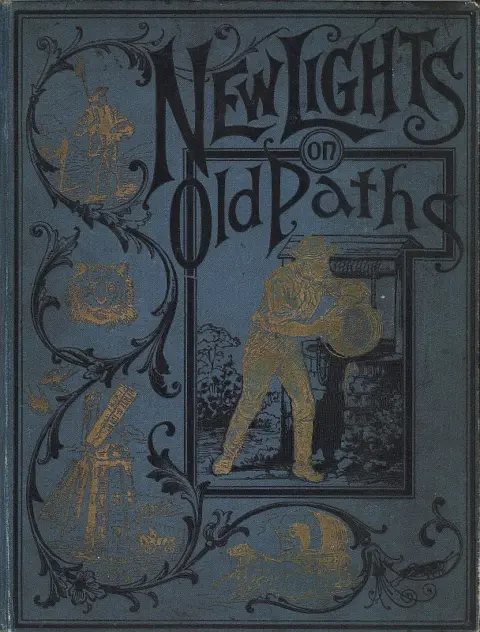
"New Lights on Old Paths" by Charles Foster is a collection of moral tales and fables written in the late 19th century. The work aims to revisit and apply timeless morals to contemporary life, suggesting that the author believes in the importance of applying old truths rather than seeking new ones. Each story is accompanied by illustrations, driving home key lessons intended for personal reflection and growth. The opening of the book introduces a fable about an innkeeper who must choose which type of guests he will welcome into his establishment. On one side, he has the honest farm people who are good for his business but avoid drinking, while on the other are the trouble-making men from the nearby forest who are rowdy and may cause him more trouble than profit. The innkeeper wrestles with his choice, ultimately deciding to favor the farm people for their virtuous behavior and consistent patronage. This tale sets the stage for the overarching themes in the collection: the importance of morals in decision-making and the challenges of maintaining integrity in the face of temptation.
Introduction adapted from the source catalogue; source summaries may be automatically generated.
Free to read · English · 49,101 words · No account needed
MAKE TIME FOR A GOOD BOOK
On by default. Untick to stop anonymous reading totals. Each page counts after 10 seconds in view. How this works.
Anonymous counting is on unless you have switched it off.
The cobbler at once dropped the boot that was in his lap, and, seeming to have caught the man’s ardor, thrust the last into one of his shoes and continued to work diligently until evening, and so finished them.
In the morning the man appeared, with as rapid a step as ever, and, finding his shoes done, paid for them, and was quickly gone.
A little while after this, as the cobbler sat calmly reading his newspaper, the man who left the first pair strolled into the shop.
“As I happen to be passing,” he said, “I’ll just take my boots with me.” But, seeing a confused look on the cobbler’s face, he added:
“Of course they’re ready; you know they were to be done the day before
yesterday.”
Then, looking on the floor, he saw them lying exactly where he had left
them.
“I’ve been so very bu—busy,” stammered the cobbler, “that I haven’t got ’em quite finished yet.”
“‘Quite finished’!” exclaimed the man. “Why, you haven’t touched them!”
“But I’m going to begin this minute,” said the cobbler, “and you shall have them to-morrow, for certain.”
He who is the least urgent is apt to be the last served.
A POOR cripple who had to go on foot to the hospital (where only he could be cured) cut a staff to help him in walking. It was the best he could get from the woods that grew by the way, and was just like those that other cripples used on that same road.
For a time, as long as the road was smooth, the staff seemed to be all that he needed; but when he came to an uneven place, he found that it did not answer. It was too short, though as long as that sort of wood grew, and it was too rough, hurting his hand as he leaned upon it. Beside this, it did not take a firm hold on the ground, but slipped from under him, giving him many falls.
After one of these falls, while he was lying prostrate and hardly able to rise, a man came to him with a pair of crutches in his hand. The man raised him up from the ground, put the crutches under his arms, and showed him how to walk with them.
And now the poor cripple was overjoyed to find that he could walk with comparative ease and with perfect safety. Yet he kept the staff that he had cut for himself, carrying it, thrust under his girdle, across his back, behind him.
Your reading position is saved on this browser. Take it to another device with a library code. Reading pages adapt to text, rather than matching a printed edition.
BEHIND THE BOOK
This eBook is for the use of anyone anywhere in the United States and most other parts of the world at no cost and with almost no restrictions whatsoever. You may copy it, give it away or re-use it under the terms of the Project Gutenberg License included with this eBook or online at www.gutenberg.org. If you are not located in the United States, you will have to check the laws of the country where you are located before using this eBook. Read the source licence.
The original source file, including credits and licence, is retained by this library. Request an original-format copy at no charge. Please include the book title and Project Gutenberg identifier #51062.
KEEP YOUR CURIOSITY GOING
Coulson Kernahan

Maurice Baring
Frances Wright
Cécile Tormay

Frederic Jesup Stimson

W. H. P. (William Henry Pope) Jarvis