THE CLASSIC COLLECTION✦A dead man’s diaryCLASSIC FREE BOOKS
A dead man’s diary
Coulson Kernahan
THE CLASSIC COLLECTION · 1885
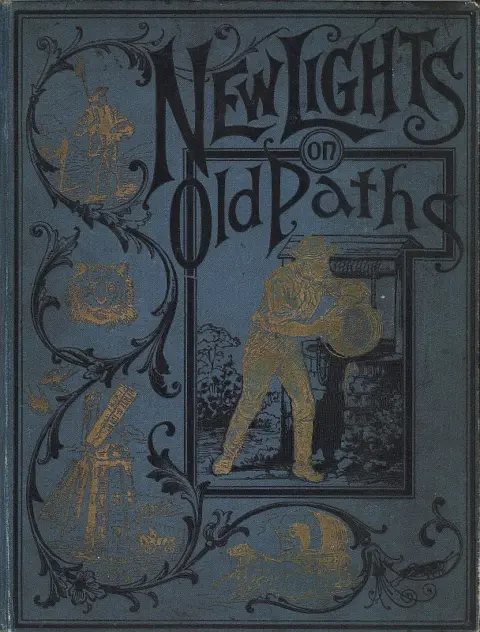
"New Lights on Old Paths" by Charles Foster is a collection of moral tales and fables written in the late 19th century. The work aims to revisit and apply timeless morals to contemporary life, suggesting that the author believes in the importance of applying old truths rather than seeking new ones. Each story is accompanied by illustrations, driving home key lessons intended for personal reflection and growth. The opening of the book introduces a fable about an innkeeper who must choose which type of guests he will welcome into his establishment. On one side, he has the honest farm people who are good for his business but avoid drinking, while on the other are the trouble-making men from the nearby forest who are rowdy and may cause him more trouble than profit. The innkeeper wrestles with his choice, ultimately deciding to favor the farm people for their virtuous behavior and consistent patronage. This tale sets the stage for the overarching themes in the collection: the importance of morals in decision-making and the challenges of maintaining integrity in the face of temptation.
Introduction adapted from the source catalogue; source summaries may be automatically generated.
Free to read · English · 49,101 words · No account needed
MAKE TIME FOR A GOOD BOOK
On by default. Untick to stop anonymous reading totals. Each page counts after 10 seconds in view. How this works.
Anonymous counting is on unless you have switched it off.
The next morning, as the good man was at work in his garden, the two appeared in a pear tree near by.
“Good-morning, sir,” said the oriole.
“Good-morning, my feathered friend,” replied the pastor. “When did you arrive from the South?”
“Only a few days ago, but it was to find a sad change here.”
“Pray, what may it be? Not gunners already, nor boys after your nests?”
“Not these, but the bells in your church-tower.”
“Why, do not they please you?”
“No, indeed! and all the birds have sent us to protest against them. We and our forefathers have enlivened these hills with our songs time out of mind, and we believe the air, for music, belongs to us still. And we have come to give you your choice: Take down the bells, or we will be still and never sing for you again.”
The pastor was dumb with astonishment as the birds flew away. He held the hoe in his hand full five minutes without moving, deep in thought concerning the strange interview. But of course submission to so unreasonable a demand was not to be thought of, and the next Sunday morning the bells again sent forth their glad peal. The ringers were in earnest, and their chimes floated far over hill and vale. But for the rest of the sacred day, and
[Illustration] for full twenty-four hours afterward, not a bird uttered a note. They could be seen flitting through the bushes and the trees, but all was perfectly still.
“How I miss their sweet voices!” said the pastor to his wife. “Though the leaves are unfolding and the rosebuds are swelling, without the birds’ voices it does not seem like spring.”
“Never fear,” replied his wife; “it will all come right again.”
Now, the birds, in resolving not to sing, had forgotten that, besides disobliging the people, they might inconvenience themselves. The spring was the season for their songs, and they soon found this out. After being silent for two whole days, the robin said:
“I really cannot keep still any longer. I will fly down to the other end of the woods, beyond the creek, where nobody can hear me, and sing a little song to myself.”
But great was his surprise, on reaching the woods, to hear the oriole, who had come there for the same purpose a little while before him. And presently the cuckoo, and a number of other birds, joined them at the place.
“What does this mean?” they said, looking round at each other.
Your reading position is saved on this browser. Take it to another device with a library code. Reading pages adapt to text, rather than matching a printed edition.
BEHIND THE BOOK
This eBook is for the use of anyone anywhere in the United States and most other parts of the world at no cost and with almost no restrictions whatsoever. You may copy it, give it away or re-use it under the terms of the Project Gutenberg License included with this eBook or online at www.gutenberg.org. If you are not located in the United States, you will have to check the laws of the country where you are located before using this eBook. Read the source licence.
The original source file, including credits and licence, is retained by this library. Request an original-format copy at no charge. Please include the book title and Project Gutenberg identifier #51062.
KEEP YOUR CURIOSITY GOING
Coulson Kernahan

Maurice Baring
Frances Wright
Cécile Tormay

Frederic Jesup Stimson

W. H. P. (William Henry Pope) Jarvis