THE CLASSIC COLLECTION✦An outlaw’s diary: the CommuneCLASSIC FREE BOOKS
An outlaw’s diary: the Commune
Cécile Tormay
THE CLASSIC COLLECTION · 1921
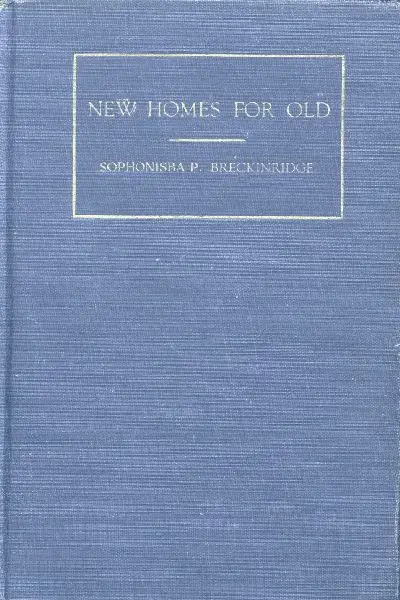
"New Homes for Old" by Sophonisba Preston Breckinridge is a social studies publication written in the early 20th century. The book aims to explore the adjustment of immigrant family life in the United States, particularly focusing on how immigrants adapt to the American way of living and establish their homes. Breckinridge, a professor of social economy, emphasizes the importance of understanding immigrant experiences and the necessary social and infrastructural support to help them integrate into their new communities. The opening of the book introduces the context of rising immigration in America and outlines the challenges that newly arrived families face upon their arrival. It describes how these families often encounter difficulties in finding proper accommodations and integrating into communities that lack established systems for welcoming immigrants. Breckinridge highlights issues of disorganization, social barriers, and the importance of community hospitality, suggesting that genuine engagement from native-born Americans is critical for fostering mutual understanding and support. This section sets the stage for a broader exploration of immigrant experiences, family dynamics, and the need for systemic change to facilitate their transition into American society.
Introduction adapted from the source catalogue; source summaries may be automatically generated.
Free to read · English · 77,738 words · No account needed
MAKE TIME FOR A GOOD BOOK
On by default. Untick to stop anonymous reading totals. Each page counts after 10 seconds in view. How this works.
Anonymous counting is on unless you have switched it off.
The "home service" work of the American Red Cross constituted such a national agency during the period of the war, and if the so-called "peace-time program" is successfully developed, the need urged in this chapter may be met.
The efficient local private agencies suffer in the same way from the lack of a national agency and a national standard in case work. The American Association for Social Work with Families, and the National Conference of Social Work, attempt by conference and publication to spread the knowledge of social technique and to improve the work done by existing societies. But there are whole sections, even in densely populated areas, in which there exists no such agency.
If, then, the benevolence and good will of the community are to be embodied in such service for foreign-born families that fall into distress as will not only relieve but upbuild the life of the family, interpret to them the standards of the community, and help them to become a part of the true American life, a national minimum of skill and information must be developed below which the agencies for such care will nowhere be allowed to fall. From the experience both of these foreign-born families and of the communities into which they finally come we learn again the doctrine laid down a hundred years ago by Robert Owen, that the care of those who suffer is a national and not solely a local concern.
[72] Charity Service Reports, Cook County, Illinois, Fiscal Year
1917, pp. 74, 350.
[73] Richmond, Social Diagnosis, p. 118.
[74] V. G. Kirkpatrick, "War-time Work of the Visiting Housekeeper," in the Yearbook of the United Charities of Chicago, 1917, p. 18.
[75] Illinois Revised Statutes, chap. cvii.
[76] Illinois Revised Statutes, chap. xxiii, sec. 298.
[77] Abbott, E., "Experimental State in Mothers' Pension Legislation," National Conference of Social Work, 1917, pp. 154-164, and U. S. Bureau of Labor Statistics Bulletin, No. 212, p. 818. See also Institution Quarterly of Illinois, March, 1916, p. 97.
[78] Massachusetts General Acts, 1913, chap. 763, sec. 3.
[79] Deering's Political Code of California, sec. 2283 fol., p. 571.
[80] New Jersey Acts, 1915, p. 206 fol.
[81] Laws of Pennsylvania, 1914, p. 118; 1915, p. 1085.
The following list of racial organizations has been generously compiled by the Bureau of Foreign Language Information Service of the American Red Cross. Only those of national scope have been included, with the exception of those starred, which, although not strictly national, have a more than local importance. It contains those organizations and societies doing benevolent, philanthropic or educational work, and, in a few instances, those primarily political or religious in character whose activities have been extended to include other work.
The list was compiled in March, 1921, and, although it is reasonably inclusive, the organizations, the officers, and the addresses are constantly changing.
Your reading position is saved on this browser. Take it to another device with a library code. Reading pages adapt to text, rather than matching a printed edition.
BEHIND THE BOOK
This eBook is for the use of anyone anywhere in the United States and most other parts of the world at no cost and with almost no restrictions whatsoever. You may copy it, give it away or re-use it under the terms of the Project Gutenberg License included with this eBook or online at www.gutenberg.org. If you are not located in the United States, you will have to check the laws of the country where you are located before using this eBook. Read the source licence.
The original source file, including credits and licence, is retained by this library. Request an original-format copy at no charge. Please include the book title and Project Gutenberg identifier #41291.
KEEP YOUR CURIOSITY GOING
Cécile Tormay

Moritz Busch
John L. Ransom
Frances Wright
Cécile Tormay

Mabel Potter Daggett