THE CLASSIC COLLECTION✦Neva’s choice A sequel to “Neva’s three lovers”CLASSIC FREE BOOKS
Neva’s choice A sequel to “Neva’s three lovers”
Harriet Lewis
THE CLASSIC COLLECTION · 1871
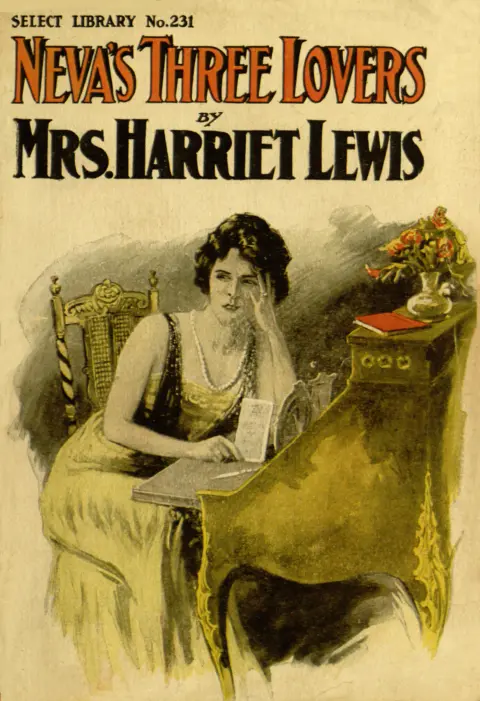
"Neva's Three Lovers" by Harriet Lewis is a novel written in the late 19th century. This story explores themes of ambition, deception, and romantic entanglements through the life of Neva, a young heiress who finds herself entangled in a web of relationships that could change her future forever. The narrative opens with Sir Harold Wynde, a wealthy baronet, and sets the stage for a captivating tale of intrigue as he navigates the social complexities surrounding him. The opening of the book introduces Sir Harold Wynde, who, while at Brighton, reluctantly becomes embroiled in a dramatic incident involving a capsized boat and the mysterious Mrs. Octavia Hathaway, who he saves from drowning. As Harriet Lewis weaves the tale, it becomes clear that Octavia harbors ulterior motives, having manipulated the situation to ensnare the baronet. Their ensuing relationship raises questions about trust and manipulation, as Sir Harold, unaware of the layers of deception surrounding Octavia, finds himself drawn to her alluring charm. Tension builds as we are reminded of the secret plots and schemes at play, hinting that Neva's life will be profoundly affected by the machinations of the adults around her.
Introduction adapted from the source catalogue; source summaries may be automatically generated.
Free to read · English · 77,288 words · No account needed
MAKE TIME FOR A GOOD BOOK
On by default. Untick to stop anonymous reading totals. Each page counts after 10 seconds in view. How this works.
Anonymous counting is on unless you have switched it off.
He was speculating upon the subject when a sudden lurch of the boat upon the short, chopping Channel waves, caused Neva to involuntarily loosen her hold upon the railing, and pitched her abruptly along the deck toward him. He sprang forward and caught her in his arms. She recovered her equilibrium upon the instant, and again grasped the railing, blushing, confused, and murmuring her thanks for his civility.
“The Channel is rough to-day,” remarked the young gentleman. “Shall I not find you a seat?”
“Thank you, no,” returned Neva, in her sweet, low, cultured voice. “I
prefer standing.”
The words were simple enough, and her manner was quiet and reserved, but her voice went to the young man’s heart, thrilling it with a strange sensation. He did not attempt a retreat, and Neva looked up at him with something of surprise in her glorious red-brown eyes.
As he encountered her full gaze, his face flushed, his eyes glowed, and a warm smile curved his mouth.
“I beg your pardon,” he said, “but are you not Miss Wynde of Hawkhurst?”
Neva bowed assent, with an increasing surprise.
“I was sure, when I met your full glance, that you were Neva Wynde,” cried the young gentleman. “You do not remember me, I see; and yet, when you went away to that odious Paris school you and I parted with tears, and you promised to be true to me, little Neva. And you have forgotten me--”
“No, no,” cried the young girl, an answering glow in her face, and her eyes shining like suns. “Is it really you, Arthur? How you have changed!”
She held out her hand to him, and he clasped it with a warm, lingering pressure. Her eyes scanned his face in an earnest scrutiny, and she blushed again when she saw how handsome he was, and how like he was to an ideal she had long cherished in the very depths of her young soul.
He was fair, with warm blue eyes, golden hair, and a mustache of tawny gold. He had a frank, noble face, and his sunny eyes betrayed a generous soul. One who ran might read in his countenance a brave, dauntless soul, a grand, unselfish nature, an enlightened spirit, quick sympathies, and an honest, truthful, resolute character. Neva thought, as she shyly regarded him, that he was very like a hero of romance.
“I can hardly believe that it is Arthur,” she said, smiling, her face softly flushing. “You are not at all like the Arthur Towyn I knew, and yet I can see the old boyish gayety and brightness of spirit. Your mustache has changed your looks greatly, Lord Towyn.”
Your reading position is saved on this browser. Take it to another device with a library code. Reading pages adapt to text, rather than matching a printed edition.
BEHIND THE BOOK
This eBook is for the use of anyone anywhere in the United States and most other parts of the world at no cost and with almost no restrictions whatsoever. You may copy it, give it away or re-use it under the terms of the Project Gutenberg License included with this eBook or online at www.gutenberg.org. If you are not located in the United States, you will have to check the laws of the country where you are located before using this eBook. Read the source licence.
The original source file, including credits and licence, is retained by this library. Request an original-format copy at no charge. Please include the book title and Project Gutenberg identifier #68274.
KEEP YOUR CURIOSITY GOING
Coulson Kernahan

Maurice Baring
Frances Wright
Cécile Tormay

Frederic Jesup Stimson

W. H. P. (William Henry Pope) Jarvis