THE CLASSIC COLLECTION✦Neva’s choice A sequel to “Neva’s three lovers”CLASSIC FREE BOOKS
Neva’s choice A sequel to “Neva’s three lovers”
Harriet Lewis
THE CLASSIC COLLECTION · 1871
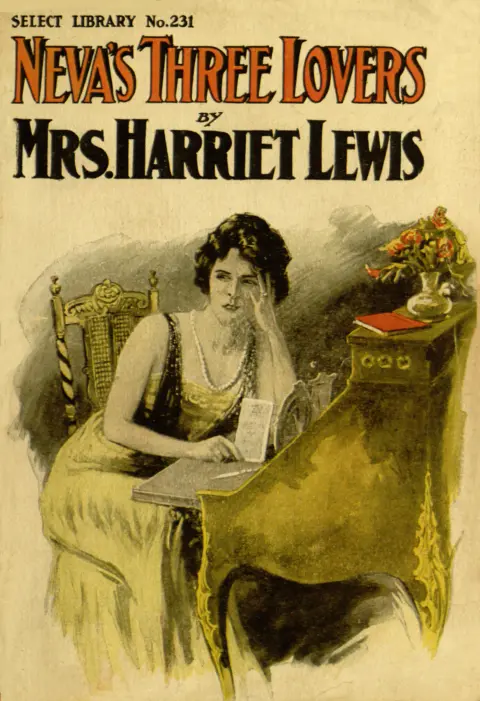
"Neva's Three Lovers" by Harriet Lewis is a novel written in the late 19th century. This story explores themes of ambition, deception, and romantic entanglements through the life of Neva, a young heiress who finds herself entangled in a web of relationships that could change her future forever. The narrative opens with Sir Harold Wynde, a wealthy baronet, and sets the stage for a captivating tale of intrigue as he navigates the social complexities surrounding him. The opening of the book introduces Sir Harold Wynde, who, while at Brighton, reluctantly becomes embroiled in a dramatic incident involving a capsized boat and the mysterious Mrs. Octavia Hathaway, who he saves from drowning. As Harriet Lewis weaves the tale, it becomes clear that Octavia harbors ulterior motives, having manipulated the situation to ensnare the baronet. Their ensuing relationship raises questions about trust and manipulation, as Sir Harold, unaware of the layers of deception surrounding Octavia, finds himself drawn to her alluring charm. Tension builds as we are reminded of the secret plots and schemes at play, hinting that Neva's life will be profoundly affected by the machinations of the adults around her.
Introduction adapted from the source catalogue; source summaries may be automatically generated.
Free to read · English · 77,288 words · No account needed
MAKE TIME FOR A GOOD BOOK
On by default. Untick to stop anonymous reading totals. Each page counts after 10 seconds in view. How this works.
Anonymous counting is on unless you have switched it off.
“You’re safe now, Sir Harold,” cried the major. “I hear a hubbub outside. My fellows have got back, with Karrah, no doubt. I want to superintend the skinning him, and while I am gone, you can refresh yourself with a bath, and put on a suit of Christian garments. My wife is dying to see you. I hear her pacing the hall like a caged leopardess. Get ready, and I’ll come back to you as soon as you have had a little sleep. You’re among friends, my dear Sir Harold; and, by Jove, I’m glad to see you again!”
He pressed Sir Harold’s hand, catching his breath with a peculiar
sobbing, and hurried out.
His servants had returned, but Karrah had escaped. The major indulged in some peculiar profanity, as he listened to this report, and then withdrew to his wife’s cool room, and told her Sir Harold’s story.
The baronet, meanwhile, took a bath and went to bed. He slept for hours, awakening after noon. He shaved and trimmed his beard, dressed himself in the suit of clothes he had formerly worn, and which were now much too large for him, and came forth into the central hall of the dwelling. Major Archer was lounging here, and came forward hastily, with both hands outstretched, and with a beaming face.
“You look more like yourself, Sir Harold!” he exclaimed. “Mrs. Archer is out on the veranda, and is full of impatience to see you.”
He linked his arm in the baronet’s and conducted him out to the veranda, presenting him to Mrs. Archer, who greeted him with a certain awe and kindliness, as one would welcome a hero.
The little Archers were playing about under the charge of an ayah, and they also came forward timidly to welcome their father’s guest.
Tiffin--the India luncheon--was served on the veranda, and after it was over, and the young people had dispersed, Sir Harold said to his host:
“When does the next steamer leave for England?”
“Three days hence. You will have time to catch the mail if you write to-day,” said Major Archer.
“Write! Why, I shall go in her, Major!”
“Impossible, Sir Harold. You are not fit for the voyage,” said Mrs.
Archer.
“I must go,” persisted the baronet, in a tone no one could dispute. “Think of my wife--of my daughter. Every day that keeps me from them seems an eternity. Major, I was robbed by Karrah of every penny I possessed. Plunder was a part of his motive, as well as desire for revenge. I shall have to draw upon you for a sufficient sum for my expenses.”
Your reading position is saved on this browser. Take it to another device with a library code. Reading pages adapt to text, rather than matching a printed edition.
BEHIND THE BOOK
This eBook is for the use of anyone anywhere in the United States and most other parts of the world at no cost and with almost no restrictions whatsoever. You may copy it, give it away or re-use it under the terms of the Project Gutenberg License included with this eBook or online at www.gutenberg.org. If you are not located in the United States, you will have to check the laws of the country where you are located before using this eBook. Read the source licence.
The original source file, including credits and licence, is retained by this library. Request an original-format copy at no charge. Please include the book title and Project Gutenberg identifier #68274.
KEEP YOUR CURIOSITY GOING
Coulson Kernahan

Maurice Baring
Frances Wright
Cécile Tormay

Frederic Jesup Stimson

W. H. P. (William Henry Pope) Jarvis