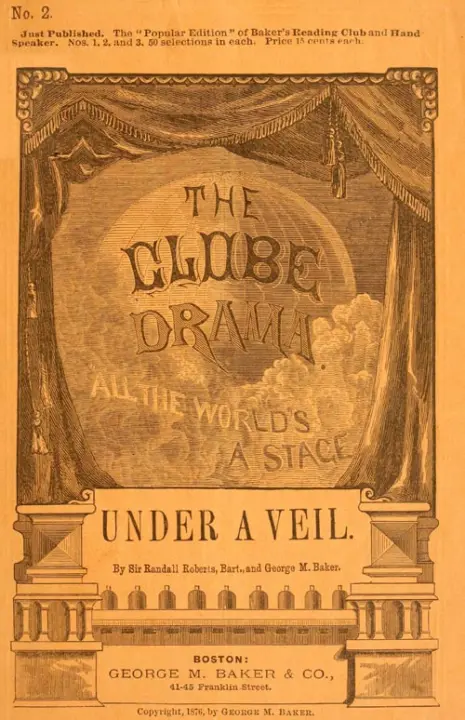
Under a Veil: A Comedietta in One Act
Randal H. (Randal Howland), Sir Roberts & George M. (George Melville) Baker
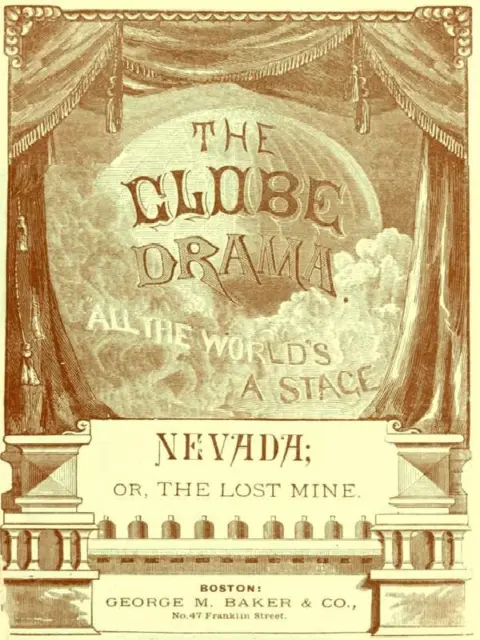
THE CLASSIC COLLECTION · 1876
"Nevada; or, The Lost Mine, A Drama in Three Acts" by George M. Baker is a theatrical play written in the late 19th century. This drama revolves around themes of mining, friendship, and the complexities of human relationships in a rugged frontier setting. The main characters include Nevada, a wandering miner obsessed with a lost gold mine, and various miners and townspeople that interact with him, including Vermont, an old miner with a fatherly bond to a young girl named Moselle. At the start of the play, we are introduced to a cast of colorful characters in a mining camp. The scene opens with Silas Steele, a self-proclaimed "missionary of health," humorously detailing his struggle to promote a miracle cure called Busted's Balm while also coming into contact with Mother Merton, a motherly figure in the camp. As the plot unfolds, we learn about Nevada, a man driven mad by the loss of a rich gold mine he once discovered. The various miners converse about their lives and relationships, setting the stage for a narrative that explores themes of love, betrayal, and redemption against the backdrop of the fierce setting of a gold mining town.
Introduction adapted from the source catalogue; source summaries may be automatically generated.
Free to read · English · 19,660 words · No account needed
MAKE TIME FOR A GOOD BOOK
On by default. Untick to stop anonymous reading totals. Each page counts after 10 seconds in view. How this works.
Anonymous counting is on unless you have switched it off.
VERMONT. What! (Aside.) Another prodigal! This camp's getting lively. (Aloud.) His sister. That's another sort.
MOSELLE. And you will find the money?
VERMONT. Find twenty thousand? Oh, yes, Mosey! I'll take my pick,
and go right off. As finds are about here, it may take a few
years--
MOSELLE. Years! We must have it to-day. O daddy, you've plenty
banked at Carson!
VERMONT. Mosey, when you was a little gal, we used to sit down by
the creek.
MOSELLE. Where you found me, longer ago than I can remember.
VERMONT. We used to sit there day after day, while I told you
stories.
MOSELLE. Yes, fairy stories.
VERMONT (sits on rock, R.). I'll tell you one now.
MOSELLE (sits on the ground beside him, throws arm across his
knee). A fairy story?
VERMONT. I reckon. Once on a time there was a gospel shebang, and in it was a gospel sharp and a pan lifter.
MOSELLE. You mean a church, a parson, and a deacon?
VERMONT. That's just what I mean.
MOSELLE. Then, please remember, you are talking to a young lady,
and not to the boys.
VERMONT. Jes' so. Well, the parson and the deacon didn't hitch horses,--couldn't work in the same hole,--were always flinging dirt all over each other, whenever they got to arguing. So one day they had it hot about wrastling Jacob and the angel. The deacon thought Jacob didn't have a fair show. He allowed that Jacob, at collar and elbow, would have thrown the angel every round; and the parson got mad, and told the deacon if he'd step behind the she--church, he'd show him the angel's trip. The deacon wa'n't to be stumped at wrastlin', so at it they went. Three rounds, and the deacon went to grass every time. Now, when a parson can throw a deacon, it shows a backslidin' that's not healthy. So the deacon thought, and quietly packed his kit, and started for green fields and pasters new, leaving behind a wife and kids. Well, he struck jest about such a place as this, and stuck to it twelve years. He didn't forget the folks at home. Both his heart and his dust went back to 'em, and sometimes he'd have given all his old boots for one look at 'em.
MOSELLE. Why didn't he go back?
VERMONT. What! With that wrastlin' angel bossing the shebang? Not
for Jacob.
MOSELLE. Ho, ho! You are the deacon.
VERMONT. I was. Now I'm only Vermont.
MOSELLE. And my daddy.
VERMONT. Last night I wrastled again. I was thrown, and by a
boy--my kid--from old Vermont.
MOSELLE. Your son?
VERMONT. You bet.
MOSELLE. Oh, daddy! ain't you glad?
Your reading position is saved on this browser. Take it to another device with a library code. Reading pages adapt to text, rather than matching a printed edition.
Randal H. (Randal Howland), Sir Roberts & George M. (George Melville) Baker
George M. (George Melville) Baker
Rachel Baker Gale & George M. (George Melville) Baker
George M. (George Melville) Baker
BEHIND THE BOOK
This eBook is for the use of anyone anywhere in the United States and most other parts of the world at no cost and with almost no restrictions whatsoever. You may copy it, give it away or re-use it under the terms of the Project Gutenberg License included with this eBook or online at www.gutenberg.org. If you are not located in the United States, you will have to check the laws of the country where you are located before using this eBook. Read the source licence.
The original source file, including credits and licence, is retained by this library. Request an original-format copy at no charge. Please include the book title and Project Gutenberg identifier #49407.
KEEP YOUR CURIOSITY GOING
Maurice Baring
W. B. (William Butler) Yeats
Edward Martyn

John Brougham & Charlotte Brontë
Marguerite Merington
Leonid Andreyev