THE CLASSIC COLLECTION✦The Bishop’s purseCLASSIC FREE BOOKS
The Bishop’s purse
Cleveland Moffett & Oliver Herford
THE CLASSIC COLLECTION · 1922
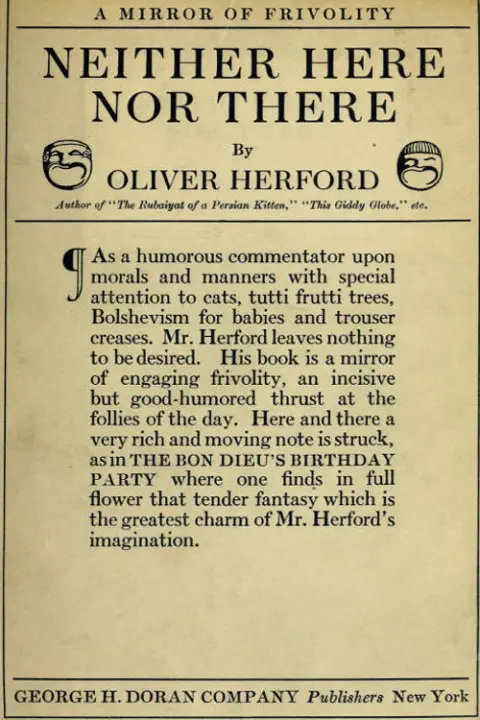
"Neither Here Nor There" by Oliver Herford is a humorous collection of essays and observations written in the early 20th century. The work offers a satirical commentary on societal norms, manners, and a variety of quirky topics, such as cats and the concept of leisure in America. Through wit and whimsy, Herford pokes fun at eccentricities and the foibles of contemporary life. At the start of the text, the author introduces a playful and irreverent tone, showcasing his ability to blend humor with keen observations. The opening chapters present a range of amusing scenarios, from Eve's boredom and her lighthearted exchange with the Serpent, to reflections on the American leisure class, illustrating both societal critique and whimsy. Herford's writing is charmingly engaging, inviting readers into a world where lightheartedness reigns and the absurdities of everyday life are explored with both humor and insight. Overall, the beginning of "Neither Here Nor There" sets the stage for a delightful exploration of frivolity in human behavior.
Introduction adapted from the source catalogue; source summaries may be automatically generated.
Free to read · English · 21,908 words · No account needed
MAKE TIME FOR A GOOD BOOK
On by default. Untick to stop anonymous reading totals. Each page counts after 10 seconds in view. How this works.
Anonymous counting is on unless you have switched it off.
The February magazine peach crop is usually most abundant—All through the merry month of Saint Valentine they hang on the news-stands, singly or in clusters, and Peaches they are to be sure—Peaches in the stupidest, cheapest, slangiest nonsense of the word.
There they hang to quote the redundant Dr. Roget, F. R. S.—“simpering, smirking, sniggling, giggling, ogling, tittering, prinking, preening, flaunting, flirting, mincing, coquetting, frivoling, attitudinizing, self-conscious artificial, smug, namby-pamby, sentimental, unnatural, stagy, shallow, weak, wanting, soft, sappy, spoony, fatuous, idiotic, imbecile, driveling, blatant, babbling, vacant, foolish, silly, senseless, addle-pated, giddy, childish, chuckle-headed, puerile,” and, what is above all else inexcusable in a peach—mushy.
And these (in journals that set the fashions moral, mental, social and sartorial) for our young American sister at the most impressionable age of her life—the age when, whatever may be her dormant possibilities, she is by her nature irresistibly impelled to pattern herself after the favorite girl of her class in school, or the favorite actress on the stage—to copy her coiffure, her dress, her deportment, even the expression of her face.
And how, you ask, can a young girl be harmed by imitating what, however vacuous or silly, is after all only an expression?
The answer is, that just as a persistent bend of thought modifies and in time fixes the expression of the face, so a habitual expression (or lack of expression) of face influences the bend of thought and, in time, fixes the character.
If you don’t believe this, dear girl, stand before your looking-glass and smirk at yourself as hard as you can, until you look (as much as it is possible for a human girl to look) like a magazine-cover Peach. Then try to hold the “Peach” look while you recite:
The stars of midnight shall be dear
To her; and she shall lean her ear
In many a secret place
Where rivulets dance their wayward round
And beauty born of murmuring sound
Shall pass into her face.
You see it’s impossible! You can’t do it, any more than you can stroke your head up and down at the same time as you stroke your chest sideways. Your mouth has come out of curl—the foolish light has gone out of your eyes. Perhaps (if you really feel what you were reciting) you look just the least bit solemn. If so, try to hold the solemn look while you recite the following by a popular song writer:
Your reading position is saved on this browser. Take it to another device with a library code. Reading pages adapt to text, rather than matching a printed edition.
Cleveland Moffett & Oliver Herford
Oliver Herford
Oliver Herford
Oliver Herford
BEHIND THE BOOK
This eBook is for the use of anyone anywhere in the United States and most other parts of the world at no cost and with almost no restrictions whatsoever. You may copy it, give it away or re-use it under the terms of the Project Gutenberg License included with this eBook or online at www.gutenberg.org. If you are not located in the United States, you will have to check the laws of the country where you are located before using this eBook. Read the source licence.
The original source file, including credits and licence, is retained by this library. Request an original-format copy at no charge. Please include the book title and Project Gutenberg identifier #56165.
KEEP YOUR CURIOSITY GOING

David Patterson (Spirit) Hatch

David Patterson (Spirit) Hatch

David Patterson (Spirit) Hatch

Ralph Waldo Emerson

Maurice Baring

Oscar Wilde & James McNeill Whistler