THE CLASSIC COLLECTION✦The Bishop’s purseCLASSIC FREE BOOKS
The Bishop’s purse
Cleveland Moffett & Oliver Herford
THE CLASSIC COLLECTION · 1922
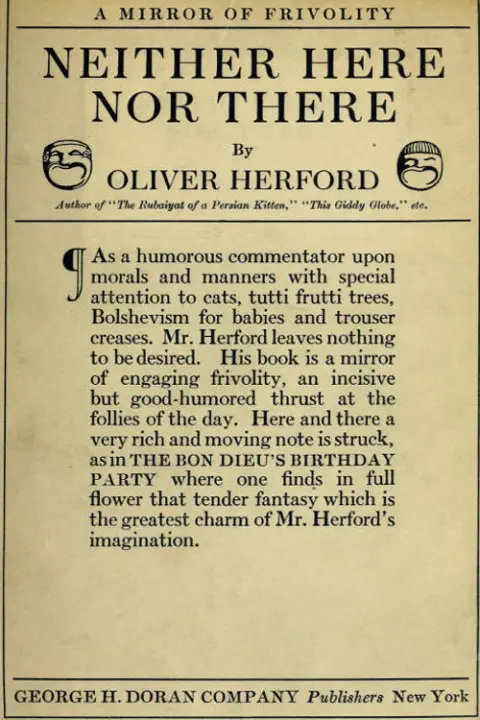
"Neither Here Nor There" by Oliver Herford is a humorous collection of essays and observations written in the early 20th century. The work offers a satirical commentary on societal norms, manners, and a variety of quirky topics, such as cats and the concept of leisure in America. Through wit and whimsy, Herford pokes fun at eccentricities and the foibles of contemporary life. At the start of the text, the author introduces a playful and irreverent tone, showcasing his ability to blend humor with keen observations. The opening chapters present a range of amusing scenarios, from Eve's boredom and her lighthearted exchange with the Serpent, to reflections on the American leisure class, illustrating both societal critique and whimsy. Herford's writing is charmingly engaging, inviting readers into a world where lightheartedness reigns and the absurdities of everyday life are explored with both humor and insight. Overall, the beginning of "Neither Here Nor There" sets the stage for a delightful exploration of frivolity in human behavior.
Introduction adapted from the source catalogue; source summaries may be automatically generated.
Free to read · English · 21,908 words · No account needed
MAKE TIME FOR A GOOD BOOK
On by default. Untick to stop anonymous reading totals. Each page counts after 10 seconds in view. How this works.
Anonymous counting is on unless you have switched it off.
For witnesses, I summon (from wherever they may be) two great shades, to wit: King Solomon, the wisest man of his day, and Noah Webster, the wordiest.
And I say to Mr. Webster, “Mr. Webster, what are the common terms used to designate a domestic feline whose Christian name chances to be unknown to the speaker?” and Mr. Webster answers without a moment’s hesitation:
“Cat, puss, pussy and pussy-cat.”
“And what is the grammatical definition of the above terms?”
“They are called nouns.”
“And what, Mr. Webster, is the accepted definition of a noun?”
“A noun is the name of a person, place or thing.”
“Kindly define the word ‘place’.”
“A particular locality.”
“And ‘thing’.”
“An inanimate object.”
“That will do, Mr. Webster.”
So, according to Mr. Noah Webster, the entity for which the noun cat stands, must, if not a person, be a locality or an inanimate object!
A cat is surely not a locality, and as for being an inanimate object, her chance of avoiding such a condition is nine times better even than a king’s.
Then a cat must be a person.
Suppose we consult King Solomon.
In the Book of Proverbs, Chapter XXX, verse 26, Solomon says: “The coneys are but a feeble folk, yet they make their houses in the rocks.”
A coney is a kind of rabbit; folk, according to Mr. Webster, only another
word for people.
That settles it! If the rabbits are people, cats are people.
Long lives to the cat!
It is harder for a table or chair to behave naturally on the stage than for a camel to be free and easy in a needle’s eye, or for Mr. Rockefeller to get into Heaven (or Hell?) with the money.
What can be more pathetic than the spectacle of a helpless young chair or table or settee starting on a stage career shining with gilt varnish and high ambition to reflect in art’s mirror the drawing-room manners of the furniture of real life.
Mlle. Fauteuil (that is her stage name, in private life she is just plain Sofa) is fresh, charming and of the best manufacture. She appears nightly in a Broadway theater, yet she has attracted no attention. She has received no press notices.
Certainly this is from no lack of charm on her part. Her legs are delightful. In the contemplation of their gilded curves, one scarcely notices that she has no arms or that her back is slightly curved, and her upholstery, a brocade of the season before last.
Your reading position is saved on this browser. Take it to another device with a library code. Reading pages adapt to text, rather than matching a printed edition.
Cleveland Moffett & Oliver Herford
Oliver Herford
Oliver Herford
Oliver Herford
BEHIND THE BOOK
This eBook is for the use of anyone anywhere in the United States and most other parts of the world at no cost and with almost no restrictions whatsoever. You may copy it, give it away or re-use it under the terms of the Project Gutenberg License included with this eBook or online at www.gutenberg.org. If you are not located in the United States, you will have to check the laws of the country where you are located before using this eBook. Read the source licence.
The original source file, including credits and licence, is retained by this library. Request an original-format copy at no charge. Please include the book title and Project Gutenberg identifier #56165.
KEEP YOUR CURIOSITY GOING

David Patterson (Spirit) Hatch

David Patterson (Spirit) Hatch

David Patterson (Spirit) Hatch

Ralph Waldo Emerson

Maurice Baring

Oscar Wilde & James McNeill Whistler