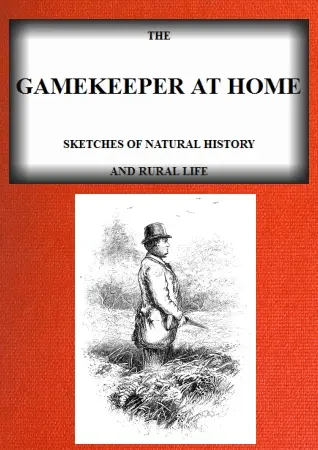
The Gamekeeper at Home: Sketches of natural history and rural life (Illustrated)
Richard Jefferies
THE CLASSIC COLLECTION · 1883
"Nature Near London" by Richard Jefferies is a reflective nature writing piece written in the late 19th century. The work explores the rich and vibrant natural world that exists in close proximity to the urban landscape of London, emphasizing that one does not need to venture far into the countryside to appreciate wildlife. Instead, the author shares his observations of various birds and plants that thrive in the area, challenging the notion that nature can only be fully experienced in remote locations. The opening of the text sets a contemplative tone as Jefferies recounts his experiences living just outside London, where he discovers an abundance of bird life and natural beauty. He vividly describes the sights and sounds of springtime, from the songs of chiffchaffs and nightingales to the rustling foliage where rabbits and pheasants are spotted. Anecdotes about the different species and the changes of the seasons reveal his deep appreciation and connection to the environment around him. As he reflects on the contrasts between the peaceful countryside and the bustling city, he invites readers to observe and find solace in the simple beauty of nature, even in such a metropolitan setting.
Introduction adapted from the source catalogue; source summaries may be automatically generated.
Free to read · English · 65,583 words · No account needed
MAKE TIME FOR A GOOD BOOK
On by default. Untick to stop anonymous reading totals. Each page counts after 10 seconds in view. How this works.
Anonymous counting is on unless you have switched it off.
The spotted leaves of the arum appeared in the ditches in this locality very nearly simultaneously with the first whistling of the blackbirds in February; last spring the chiffchaff sang soon after the flowering of the lesser celandine (not in this hedge, but near by), and the first swift was noticed within a day or two of the opening of the May bloom. Although not exactly, yet in a measure, the movements of plant and bird life correspond.
In a closely cropped hedge opposite this great mound (cropped because enclosing a cornfield) there grows a solitary shrub of the wayfaring tree. Though well known elsewhere, there is not, so far as I am aware, another bush of it for miles, and I should not have noticed this had not this part of the highway been so pleasant a place to stroll to and fro in almost all the year. The twigs of the wayfaring tree are covered with a mealy substance which comes off on the fingers when touched. A stray shrub or plant like this sometimes seems of more interest than a whole group.
For instance, most of the cottage gardens have foxgloves in them, but I had not observed any wild, till one afternoon near some woods I found a tall and beautiful foxglove, richer in colour than the garden specimens, and with bells more thickly crowded, lifting its spike of purple above the low cropped hawthorn. In districts where the soil is favourable to the foxglove it would not have been noticed, but here, alone and unexpected, it was welcomed. The bees in spring come to the broad wayside sward by the great mound to the bright dandelions; presently to the white clover, and later to the heaths.
There are about sixty wild flowers which grow freely along this road, namely, yellow agrimony, amphibious persicaria, arum, avens, bindweed, bird's foot lotus, bittersweet, blackberry, black and white bryony, brooklime, burdock, buttercups, wild camomile, wild carrot, celandine (the great and lesser), cinquefoil, cleavers, corn buttercup, corn mint, corn sowthistle, and spurrey, cowslip, cow-parsnip, wild parsley, daisy, dandelion, dead nettle, and white dog rose, and trailing rose, violets (the sweet and the scentless), figwort, veronica, ground ivy, willowherb (two sorts), herb Robert, honeysuckle, lady's smock, purple loosestrife, mallow, meadow-orchis, meadow-sweet, yarrow, moon daisy, St. John's wort, pimpernel, water plantain, poppy, rattles, scabious, self-heal, silverweed, sowthistle, stitchwort, teazles, tormentil, vetches, and yellow vetch.
Your reading position is saved on this browser. Take it to another device with a library code. Reading pages adapt to text, rather than matching a printed edition.
Richard Jefferies
Richard Jefferies
Richard Jefferies
Richard Jefferies
BEHIND THE BOOK
This eBook is for the use of anyone anywhere in the United States and most other parts of the world at no cost and with almost no restrictions whatsoever. You may copy it, give it away or re-use it under the terms of the Project Gutenberg License included with this eBook or online at www.gutenberg.org. If you are not located in the United States, you will have to check the laws of the country where you are located before using this eBook. Read the source licence.
The original source file, including credits and licence, is retained by this library. Request an original-format copy at no charge. Please include the book title and Project Gutenberg identifier #18629.
KEEP YOUR CURIOSITY GOING
Wilfrid Scawen Blunt
Wilfrid Scawen Blunt

E. W. (Edgar Watson) Howe
Cécile Tormay

Moritz Busch
John L. Ransom