THE CLASSIC COLLECTION✦Tropical AfricaCLASSIC FREE BOOKS
Tropical Africa
Henry Drummond
THE CLASSIC COLLECTION · 1880
"Natural Law in the Spiritual World" by Henry Drummond is a philosophical work that explores the intersection of science and religion, written in the late 19th century. The text seeks to identify whether the laws governing the natural world can also apply to the spiritual realm, challenging traditional distinctions between the two areas. It addresses the perceived discord between scientific understanding and religious beliefs, proposing that a cohesive framework can emerge by recognizing underlying laws shared by both domains. The opening of the work presents Drummond’s argument for the continuity of natural law into the spiritual sphere. He reflects on his dual experiences of teaching science and religion, leading him to conclude that both realms, rather than being entirely separate, may indeed share common principles. Drummond posits that many observed spiritual phenomena might stem from natural laws, thus stimulating a conversation about the legitimacy of spiritual laws while inviting readers to reconsider the separateness of religion and science. His analysis suggests that a scientific approach can lend credibility to theological concepts, helping to bridge gaps in understanding between the two fields.
Introduction adapted from the source catalogue; source summaries may be automatically generated.
Free to read · English · 92,541 words · No account needed
MAKE TIME FOR A GOOD BOOK
On by default. Untick to stop anonymous reading totals. Each page counts after 10 seconds in view. How this works.
Anonymous counting is on unless you have switched it off.
The zeal of these men, assuredly, is not to be questioned: their instincts are right, and their work is often not in vain. It is possible, too, up to a certain point, to defend this Salvation by Formula. Are these not the very words of Scripture? Did not Christ Himself say, "It is finished?" And is it not written, "By grace are ye saved through faith," "Not of works, lest any man should boast," and "He that believeth on the Son hath everlasting life?" To which, however, one might also answer in the words of Scripture, "The Devils also believe," and "Except a man be born again he cannot see the Kingdom of God." But without seeming to make text refute text, let us ask rather what the supposed convert possesses at the end of the process. That Christ saves sinners, even blackguards from the streets, is a great fact; and that the simple words of the street evangelist do sometimes bring this home to man with convincing power is also a fact. But in ordinary circumstances, when the inquirer's mind is rapidly urged through the various stages of the above piece of logic, he is left to face the future and blot out the past with a formula of words.
To be sure these words may already convey a germ of truth, they may yet be filled in with a wealth of meaning and become a life-long power. But we would state the case against Salvation by Formula with ignorant and unwarranted clemency did we for a moment convey the idea that this is always the actual result. The doctrine plays too well into the hands of the parasitic tendency to make it possible that in more than a minority of cases the result is anything but disastrous. And it is disastrous not in that, sooner or later, after losing half their lives, those who rely on the naked syllogism come to see their mistake, but in that thousands never come to see it all. Are there not men who can prove to you and to the world, by the irresistible logic of texts, that they are saved, whom you know to be not only unworthy of the Kingdom of God--which we all are--but absolutely incapable of entering it? The condition of membership in the Kingdom of God is well known; who fulfill this condition and who do not, is not well known. And yet the moral test, in spite of the difficulty of its applications, will always, and rightly, be preferred by the world to the theological. Nevertheless, in spite of the world's verdict, the parasite is content. He is "safe." Years ago his mind worked through a certain chain of phrases in which the words "believe" and "saved" were the conspicuous terms. And from that moment, by all Scriptures, by all logic, and by all theology, his future was guaranteed. He took out, in short, an insurance policy, by which he was infallibly secured eternal life at death. This is not a matter to make light of. We wish we were caricaturing instead of representing things as they are. But we carry with us all who intimately know the spiritual condition of the Narrow Church in asserting that in some cases at least its members have nothing more to show for their religion than a formula, a syllogism, a cant phrase or an experience of some kind which happened long ago, and which men told them at the time was called Salvation. Need we proceed to formulate objections to the parasitism of Evangelicism? Between it and the Religion of the Church of Rome there is an affinity as real as it is unsuspected. For one thing these religions are spiritually disastrous as well as theologically erroneous in propagating a false conception of Christianity. The fundamental idea alike of the extreme Roman Catholic and extreme Evangelical Religions is Escape. Man's chief end is to "get off." And all factors in religion, the highest and most sacred, are degraded to this level. God, for example, is a Great Lawyer. Or He is the Almighty Enemy; it is from Him we have to "get off." Jesus Christ is the One who gets us off--a theological figure who contrives so to adjust matters federally that the way is clear. The Church in the one instance is a kind of conveyancing office where the transaction is duly concluded, each party accepting the others' terms; in the other case, a species of sheep-pen where the flock awaits impatiently and indolently the final consummation. Generally, the means are mistaken for the end, and the opening-up of the possibility of spiritual growth becomes the signal to stop growing.
Your reading position is saved on this browser. Take it to another device with a library code. Reading pages adapt to text, rather than matching a printed edition.
Henry Drummond
Henry Drummond
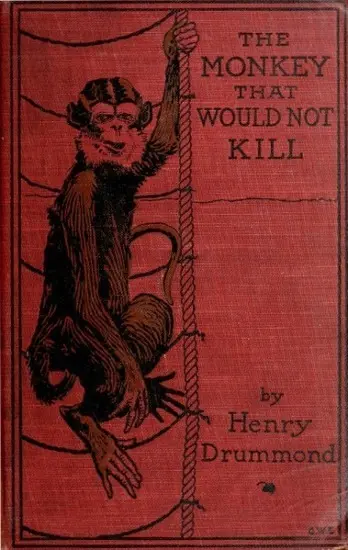
Henry Drummond
Henry Drummond
BEHIND THE BOOK
This eBook is for the use of anyone anywhere in the United States and most other parts of the world at no cost and with almost no restrictions whatsoever. You may copy it, give it away or re-use it under the terms of the Project Gutenberg License included with this eBook or online at www.gutenberg.org. If you are not located in the United States, you will have to check the laws of the country where you are located before using this eBook. Read the source licence.
The original source file, including credits and licence, is retained by this library. Request an original-format copy at no charge. Please include the book title and Project Gutenberg identifier #23334.
KEEP YOUR CURIOSITY GOING

David Patterson (Spirit) Hatch

David Patterson (Spirit) Hatch

David Patterson (Spirit) Hatch
Coulson Kernahan

Ralph Waldo Emerson
Frances Wright