THE CLASSIC COLLECTION✦Love Letters of Nathaniel Hawthorne, Volume 2 (of 2)CLASSIC FREE BOOKS
Love Letters of Nathaniel Hawthorne, Volume 2 (of 2)
Nathaniel Hawthorne
THE CLASSIC COLLECTION · 1897
"Little Masterpieces" by Nathaniel Hawthorne is a collection of short stories written in the late 19th century. This anthology features some of Hawthorne's best-known tales, including "Dr. Heidegger's Experiment," "The Birthmark," and "Ethan Brand," among others. Throughout these stories, Hawthorne explores profound themes such as the nature of human imperfection, the quest for knowledge, and the interplay of morality and consequence, all conveyed through his rich and imaginative prose. The opening of this collection introduces "Dr. Heidegger's Experiment," in which the eccentric doctor invites four elderly friends, each bearing the scars of their past choices, to partake in a mysterious experiment involving a potion purported to restore their youth. The characters—melancholy figures informed by their misfortunes—react with eagerness and skepticism to the promise of rejuvenation. As the experiment progresses, the tale unfolds to examine the folly of seeking to reclaim lost youth and the moral lessons learned from their revelry, ultimately leading to reflections on the fleeting nature of life and the grip of time.
Introduction adapted from the source catalogue; source summaries may be automatically generated.
Free to read · English · 39,501 words · No account needed
MAKE TIME FOR A GOOD BOOK
On by default. Untick to stop anonymous reading totals. Each page counts after 10 seconds in view. How this works.
Anonymous counting is on unless you have switched it off.
"Satan will strike his master-stroke presently," cried some, "because he knoweth that his time is short. All our godly pastors are to be dragged to prison! We shall see them at a Smithfield fire in King Street!"
Hereupon the people of each parish gathered closer round their minister, who looked calmly upwards and assumed a more apostolic dignity, as well befitted a candidate for the highest honor of his profession, the crown of martyrdom. It was actually fancied, at that period, that New England might have a John Rogers of her own, to take the place of that worthy in the Primer.
"The Pope of Rome has given orders for a new St. Bartholomew!" cried others. "We are to be massacred, man and male child!"
Neither was this rumor wholly discredited, although the wiser class believed the Governor's object somewhat less atrocious. His predecessor under the old charter, Bradstreet, a venerable companion of the first settlers, was known to be in town. There were grounds for conjecturing that Sir Edmund Andros intended, at once, to strike terror, by a parade of military force, and to confound the opposite faction by possessing himself of their chief.
"Stand firm for the old charter, Governor!" shouted the crowd, seizing upon the idea. "The good old Governor Bradstreet!"
While this cry was at the loudest, the people were surprised by the well-known figure of Governor Bradstreet himself, a patriarch of nearly ninety, who appeared on the elevated steps of a door, and, with characteristic mildness, besought them to submit to the constituted authorities.
"My children," concluded this venerable person, "do nothing rashly. Cry not aloud, but pray for the welfare of New England, and expect patiently what the Lord will do in this matter!"
The event was soon to be decided. All this time, the roll of the drum had been approaching through Cornhill, louder and deeper, till with reverberations from house to house, and the regular tramp of martial footsteps, it burst into the street. A double rank of soldiers made their appearance, occupying the whole breadth of the passage, with shouldered matchlocks, and matches burning, so as to present a row of fires in the dusk. Their steady march was like the progress of a machine, that would roll irresistibly over everything in its way. Next, moving slowly, with a confused clatter of hoofs on the pavement, rode a party of mounted gentlemen, the central figure being Sir Edmund Andros, elderly, but erect and soldier-like. Those around him were his favorite councillors, and the bitterest foes of New England. At his right hand rode Edward Randolph, our arch-enemy, that "blasted wretch," as Cotton Mather calls him, who achieved the downfall of our ancient government, and was followed with a sensible curse, through life and to his grave. On the other side was Bullivant, scattering jests and mockery as he rode along. Dudley came behind, with a downcast look, dreading, as well he might, to meet the indignant gaze of the people, who beheld him, their only countryman by birth, among the oppressors of his native land. The captain of a frigate in the harbor, and two or three civil officers under the Crown, were also there. But the figure which most attracted the public eye, and stirred up the deepest feeling, was the Episcopal clergyman of King's Chapel, riding haughtily among the magistrates in his priestly vestments, the fitting representative of prelacy and persecution, the union of Church and State, and all those abominations which had driven the Puritans to the wilderness. Another guard of soldiers, in double rank, brought up the rear.
Your reading position is saved on this browser. Take it to another device with a library code. Reading pages adapt to text, rather than matching a printed edition.
Nathaniel Hawthorne
Nathaniel Hawthorne
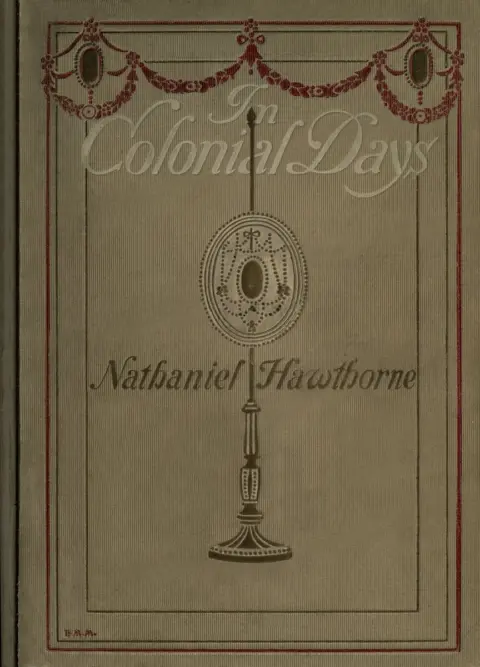
Nathaniel Hawthorne

Rebecca Harding Davis & Thomas De Quincey & Charles Dickens & Nathaniel Hawthorne & Edward Bulwer Lytton, Baron Lytton & Edgar Allan Poe & Harriet Elizabeth Prescott Spofford
BEHIND THE BOOK
This eBook is for the use of anyone anywhere in the United States and most other parts of the world at no cost and with almost no restrictions whatsoever. You may copy it, give it away or re-use it under the terms of the Project Gutenberg License included with this eBook or online at www.gutenberg.org. If you are not located in the United States, you will have to check the laws of the country where you are located before using this eBook. Read the source licence.
The original source file, including credits and licence, is retained by this library. Request an original-format copy at no charge. Please include the book title and Project Gutenberg identifier #39716.
KEEP YOUR CURIOSITY GOING
Coulson Kernahan

Maurice Baring
Frances Wright
Cécile Tormay

Frederic Jesup Stimson

W. H. P. (William Henry Pope) Jarvis