THE CLASSIC COLLECTION✦Love Letters of Nathaniel Hawthorne, Volume 2 (of 2)CLASSIC FREE BOOKS
Love Letters of Nathaniel Hawthorne, Volume 2 (of 2)
Nathaniel Hawthorne
THE CLASSIC COLLECTION · 1897
"Little Masterpieces" by Nathaniel Hawthorne is a collection of short stories written in the late 19th century. This anthology features some of Hawthorne's best-known tales, including "Dr. Heidegger's Experiment," "The Birthmark," and "Ethan Brand," among others. Throughout these stories, Hawthorne explores profound themes such as the nature of human imperfection, the quest for knowledge, and the interplay of morality and consequence, all conveyed through his rich and imaginative prose. The opening of this collection introduces "Dr. Heidegger's Experiment," in which the eccentric doctor invites four elderly friends, each bearing the scars of their past choices, to partake in a mysterious experiment involving a potion purported to restore their youth. The characters—melancholy figures informed by their misfortunes—react with eagerness and skepticism to the promise of rejuvenation. As the experiment progresses, the tale unfolds to examine the folly of seeking to reclaim lost youth and the moral lessons learned from their revelry, ultimately leading to reflections on the fleeting nature of life and the grip of time.
Introduction adapted from the source catalogue; source summaries may be automatically generated.
Free to read · English · 39,501 words · No account needed
MAKE TIME FOR A GOOD BOOK
On by default. Untick to stop anonymous reading totals. Each page counts after 10 seconds in view. How this works.
Anonymous counting is on unless you have switched it off.
"Come, old Dutchman," cried one of the young men, "let us see your pictures, if you can swear they are worth looking at!"
"O yes, Captain," answered the Jew,--whether was a matter of courtesy or craft, he styled everybody Captain,--"I shall show you, indeed, some very superb pictures!"
So, placing his box in a proper position, he invited the young men and girls to look through the glass orifices of the machine, and proceeded to exhibit a series of the most outrageous scratchings and daubings, as specimens of the fine arts, that ever an itinerant showman had the face to impose upon his circle of spectators. The pictures were worn out, moreover, tattered, full of cracks and wrinkles, dingy with tobacco-smoke, and otherwise in a most pitiable condition. Some purported to be cities, public edifices, and ruined castles in Europe; others represented Napoleon's battles and Nelson's sea-fights; and in the midst of these would be seen a gigantic, brown, hairy hand,--which might have been mistaken for the Hand of Destiny, though, in truth, it was only the showman's,--pointing its forefinger to various scenes of the conflict, while its owner gave historical illustrations. When, with much merriment at its abominable deficiency of merit, the exhibition was concluded, the German bade little Joe put his head into the box. Viewed through the magnifying-glasses, the boy's round, rosy visage assumed the strangest imaginable aspect of an immense Titanic child, the mouth grinning broadly, and the eyes and every other feature overflowing with fun at the joke. Suddenly, however, that merry face turned pale, and its expression changed to horror, for this easily impressed and excitable child had become sensible that the eye of Ethan Brand was fixed upon him through the glass.
"You make the little man to be afraid, Captain," said the German Jew, turning up the dark and strong outline of his visage, from his stooping posture. "But look again, and, by chance, I shall cause you to see somewhat that is very fine, upon my word!"
Ethan Brand gazed into the box for an instant, and then starting back, looked fixedly at the German. What had he seen? Nothing, apparently; for a curious youth, who had peeped in almost at the same moment, beheld only a vacant space of canvas.
"I remember you now," muttered Ethan Brand to the showman.
"Ah, Captain," whispered the Jew of Nuremburg, with a dark smile, "I find it to be a heavy matter in my show-box,--this Unpardonable Sin! By my faith, Captain, it has wearied my shoulders, this long day, to carry it over the mountain."
"Peace," answered Ethan Brand, sternly, "or get thee into the furnace
yonder!"
Your reading position is saved on this browser. Take it to another device with a library code. Reading pages adapt to text, rather than matching a printed edition.
Nathaniel Hawthorne
Nathaniel Hawthorne
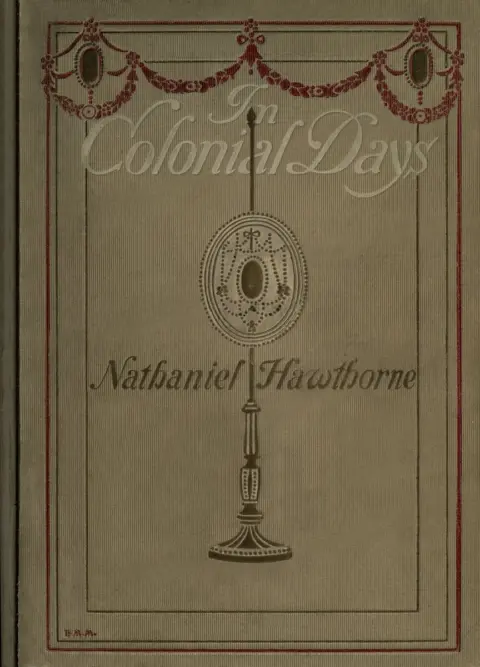
Nathaniel Hawthorne

Rebecca Harding Davis & Thomas De Quincey & Charles Dickens & Nathaniel Hawthorne & Edward Bulwer Lytton, Baron Lytton & Edgar Allan Poe & Harriet Elizabeth Prescott Spofford
BEHIND THE BOOK
This eBook is for the use of anyone anywhere in the United States and most other parts of the world at no cost and with almost no restrictions whatsoever. You may copy it, give it away or re-use it under the terms of the Project Gutenberg License included with this eBook or online at www.gutenberg.org. If you are not located in the United States, you will have to check the laws of the country where you are located before using this eBook. Read the source licence.
The original source file, including credits and licence, is retained by this library. Request an original-format copy at no charge. Please include the book title and Project Gutenberg identifier #39716.
KEEP YOUR CURIOSITY GOING
Coulson Kernahan

Maurice Baring
Frances Wright
Cécile Tormay

Frederic Jesup Stimson

W. H. P. (William Henry Pope) Jarvis