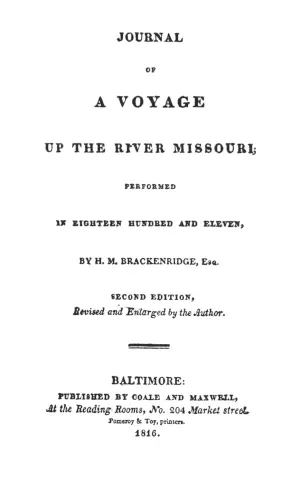
Brackenridge’s Journal of a voyage up the river Missouri, 1811; Franchère’s Voyage to Northwest Coast, 1811-1814
H. M. (Henry Marie) Brackenridge & Gabriel Franchère
THE CLASSIC COLLECTION · 1854
"Narrative of a Voyage to the Northwest Coast of America" by Gabriel Franchere is a historical account written in the mid-19th century. The book recounts the author's experiences during an expedition led by the merchant John Jacob Astor to establish the first American settlement on the Pacific coast. The narration provides insights into early 19th-century exploration, trade, and interactions with indigenous peoples, highlighting the hopes, struggles, and perils faced by those involved in the venture. The opening of the narrative introduces Franchere's journey, beginning with the departure from Montreal and the subsequent arrival in New York. He describes his emotional farewells, the transition to a vastly different environment in the bustling city, and the preparations made for the voyage ahead. The text serves as a personal reflection on the challenges of leaving one's homeland, the dynamics aboard the ship, and the interactions among the crew and passengers as they embark on their expedition toward the unknown wilderness of the Northwest Coast. As Franchere recounts the early stages of the voyage, he sets the stage for the complex journey that will unfold in the chapters to come, filled with adventure, discovery, and cultural encounters.
Introduction adapted from the source catalogue; source summaries may be automatically generated.
Free to read · English · 66,403 words · No account needed
MAKE TIME FOR A GOOD BOOK
On by default. Untick to stop anonymous reading totals. Each page counts after 10 seconds in view. How this works.
Anonymous counting is on unless you have switched it off.
Some days after the departure of Mr. Hunt, the old one-eyed chief Comcomly came to tell us that an Indian of Gray's Harbor, who had sailed on the Tonquin in 1811, and who was the only soul that had escaped the massacre of the crew of that unfortunate vessel, had returned to his tribe. As the distance from the River Columbia to Gray's Harbor was not great, we sent for this native. At first he made considerable difficulty about following our people, but was finally persuaded. He arrived at Astoria, and related to us the circumstances of that sad catastrophe, nearly as follows:[P]
"After I had embarked on the Tonquin," said he, "that vessel sailed for Nootka.[Q] Having arrived opposite a large village called Newity, we dropped anchor. The natives having invited Mr. M'Kay to land, he did so, and was received in the most cordial manner: they even kept him several days at their village, and made him lie, every night, on a couch of sea-otter skins. Meanwhile the captain was engaged in trading with such of the natives as resorted to his ship: but having had a difficulty with one of the principal chiefs in regard to the price of certain goods, he ended by putting the latter out of the ship, and in the act of so repelling him, struck him on the face with the roll of furs which he had brought to trade. This act was regarded by that chief and his followers as the most grievous insult, and they resolved to take vengeance for it. To arrive more surely at their purpose, they dissembled their resentment, and came, as usual, on board the ship. One day, very early in the morning, a large pirogue, containing about a score of natives, came alongside: every man had in his hand a packet of furs, and held it over his head as a sign that they came to trade. The watch let them come on deck. A little after, arrived a second pirogue, carrying about as many men as the other. The sailors believed that these also came to exchange their furs, and allowed them to mount the ship's side like the first. Very soon, the pirogues thus succeeding one another, the crew saw themselves surrounded by a multitude of savages, who came upon the deck from all sides. Becoming alarmed at the appearance of things, they went to apprize the captain and Mr. M'Kay, who hastened to the poop. I was with them," said the narrator, "and fearing, from the great multitude of Indians whom I saw already on the deck, and from the movements of those on shore, who were hurrying to embark in their canoes, to approach the vessel, and from the women being left in charge of the canoes of those who had arrived, that some evil design was on foot, I communicated my suspicions to Mr. M'Kay, who himself spoke to the captain. The latter affected an air of security, and said that with the firearms on board, there was no reason to fear even a greater number of Indians. Meanwhile these gentlemen had come on deck unarmed, without even their sidearms. The trade, nevertheless, did not advance; the Indians offered less than was asked, and pressing with their furs close to the captain, Mr. M'Kay, and Mr. Lewis, repeated the word Makoke! Makoke! "Trade! Trade!" I urged the gentlemen to put to sea, and the captain, at last, seeing the number of Indians increase every moment, allowed himself to be persuaded: he ordered a part of the crew to raise the anchor, and the rest to go aloft and unfurl the sails. At the same time he warned the natives to withdraw, as the ship was going to sea. A fresh breeze was then springing up, and in a few moments more their prey would have escaped them; but immediately on receiving this notice, by a preconcerted signal, the Indians, with a terrific yell, drew forth the knives and war-bludgeons they had concealed in their bundles of furs, and rushed upon the crew of the ship. Mr. Lewis was struck, and fell over a bale of blankets. Mr. M'Kay, however, was the first victim whom they sacrificed to their fury. Two savages, whom, from the crown of the poop, where I was seated, I had seen follow this gentleman step by step, now cast themselves upon him, and having given him a blow on the head with a potumagan (a kind of sabre which is described a little below), felled him to the deck, then took him up and flung him into the sea, where the women left in charge of the canoes, quickly finished him with their paddles. Another set flung themselves upon the captain, who defended himself for a long time with his pocket-knife, but, overpowered by numbers, perished also under the blows of these murderers. I next saw (and that was the last occurrence of which I was witness before quitting the ship) the sailors who were aloft, slip down by the rigging, and get below through the steerage hatchway. They were five, I think, in number, and one of them, in descending, received a knife-stab in the back. I then jumped overboard, to escape a similar fate to that of the captain and Mr. M'Kay: the women in the canoes, to whom I surrendered myself as a slave, took me in, and bade me hide myself under some mats which were in the pirogues; which I did. Soon after, I heard the discharge of firearms, immediately upon which the Indians fled from the vessel, and pulled for the shore as fast as possible, nor did they venture to go alongside the ship again the whole of that day. The next day, haying seen four men lower a boat, and pull away from the ship, they sent some pirogues in chase: but whether those men were overtaken and murdered, or gained the open sea and perished there, I never could learn. Nothing more was seen stirring on board the Tonquin; the natives pulled cautiously around her, and some of the more daring went on board; at last, the savages, finding themselves absolute masters of the ship, rushed on board in a crowd to pillage her. But very soon, when there were about four or five hundred either huddled together on deck, or clinging to the sides, all eager for plunder, the ship blew up with a horrible noise. "I was on the shore," said the Indian, "when the explosion took place, saw the great volume of smoke burst forth in the spot where the ship had been, and high in the air above, arms, legs, heads and bodies, flying in every direction. The tribe acknowledged a loss of over two hundred of their people on that occasion. As for me I remained their prisoner, and have been their slave for two years. It is but now that I have been ransomed by my friends. I have told you the truth, and hope you will acquit me of having in any way participated in that bloody affair."
Your reading position is saved on this browser. Take it to another device with a library code. Reading pages adapt to text, rather than matching a printed edition.
H. M. (Henry Marie) Brackenridge & Gabriel Franchère
BEHIND THE BOOK
This eBook is for the use of anyone anywhere in the United States and most other parts of the world at no cost and with almost no restrictions whatsoever. You may copy it, give it away or re-use it under the terms of the Project Gutenberg License included with this eBook or online at www.gutenberg.org. If you are not located in the United States, you will have to check the laws of the country where you are located before using this eBook. Read the source licence.
The original source file, including credits and licence, is retained by this library. Request an original-format copy at no charge. Please include the book title and Project Gutenberg identifier #15911.
KEEP YOUR CURIOSITY GOING
Wilfrid Scawen Blunt
Wilfrid Scawen Blunt

E. W. (Edgar Watson) Howe
Cécile Tormay

Moritz Busch
John L. Ransom