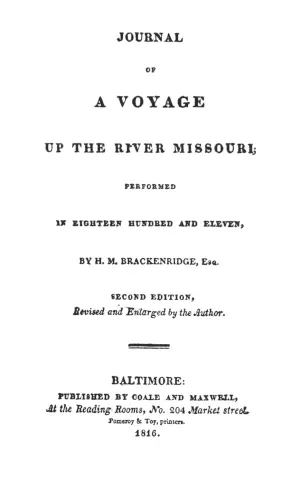
Brackenridge’s Journal of a voyage up the river Missouri, 1811; Franchère’s Voyage to Northwest Coast, 1811-1814
H. M. (Henry Marie) Brackenridge & Gabriel Franchère
THE CLASSIC COLLECTION · 1854
"Narrative of a Voyage to the Northwest Coast of America" by Gabriel Franchere is a historical account written in the mid-19th century. The book recounts the author's experiences during an expedition led by the merchant John Jacob Astor to establish the first American settlement on the Pacific coast. The narration provides insights into early 19th-century exploration, trade, and interactions with indigenous peoples, highlighting the hopes, struggles, and perils faced by those involved in the venture. The opening of the narrative introduces Franchere's journey, beginning with the departure from Montreal and the subsequent arrival in New York. He describes his emotional farewells, the transition to a vastly different environment in the bustling city, and the preparations made for the voyage ahead. The text serves as a personal reflection on the challenges of leaving one's homeland, the dynamics aboard the ship, and the interactions among the crew and passengers as they embark on their expedition toward the unknown wilderness of the Northwest Coast. As Franchere recounts the early stages of the voyage, he sets the stage for the complex journey that will unfold in the chapters to come, filled with adventure, discovery, and cultural encounters.
Introduction adapted from the source catalogue; source summaries may be automatically generated.
Free to read · English · 66,403 words · No account needed
MAKE TIME FOR A GOOD BOOK
On by default. Untick to stop anonymous reading totals. Each page counts after 10 seconds in view. How this works.
Anonymous counting is on unless you have switched it off.
The festival over, our people resumed their ordinary occupations: while some cut timber for building, and others made charcoal for the blacksmith, the carpenter constructed a barge, and the cooper made barrels for the use of the posts we proposed to establish in the interior. On the 18th, in the evening, two canoes full of white men arrived at the establishment. Mr. M'Dougal, the resident agent, being confined to his room by sickness, the duty of receiving the strangers devolved on me. My astonishment was not slight, when one of the party called me by name, as he extended his hand, and I recognised Mr. Donald M'Kenzie, the same who had quitted Montreal, with Mr. W.P. Hunt, in the month of July, 1810. He was accompanied by a Mr. Robert M'Lellan, a partner, Mr. John Reed, a clerk, and eight voyageurs, or boatmen. After having reposed themselves a little from their fatigues, these gentlemen recounted to us the history of their journey, of which the following is the substance.
Messrs. Hunt and M'Kenzie, quitting Canada, proceeded by way of Mackinac and St. Louis, and ascended the Missouri, in the autumn of 1810, to a place on that river called Nadoway, where they wintered. Here they were joined by Mr. R. M'Lellan, by a Mr. Crooks, and a Mr. Mueller, traders with the Indians of the South, and all having business relations with Mr. Astor.
In the spring of 1811, having procured two large keel-boats, they ascended the Missouri to the country of the Arikaras, or Rice Indians, where they disposed of their boats and a great part of their luggage, to a Spanish trader, by name Manuel Lisa. Having purchased of him, and among the Indians, 130 horses, they resumed their route, in the beginning of August, to the number of some sixty-five persons, to proceed across the mountains to the river Columbia. Wishing to avoid the Blackfeet Indians, a warlike and ferocious tribe, who put to death all the strangers that fall into their hands, they directed their course southwardly, until they arrived at the 40th degree of latitude. Thence they turned to the northwest, and arrived, by-and-by, at an old fort, or trading post, on the banks of a little river flowing west. This post, which was then deserted, had been established, as they afterward learned, by a trader named Henry. Our people, not doubting that this stream would conduct them to the Columbia, and finding it navigable, constructed some canoes to descend it. Having left some hunters (or trappers) near the old fort, with Mr. Miller, who, dissatisfied with the expedition, was resolved to return to the United States, the party embarked; but very soon finding the river obstructed with rapids and waterfalls, after having upset some of the canoes, lost one man by drowning, and also a part of their baggage, perceiving that the stream was impracticable, they resolved to abandon their canoes and proceed on foot. The enterprise was one of great difficulty, considering the small stock of provisions they had left. Nevertheless, as there was no time to lose in deliberation, after depositing in a cache the superfluous part of their baggage, they divided themselves into four companies, under the command of Messrs. M'Kenzie, Hunt, M'Lellan and Crooks, and proceeded to follow the course of the stream, which they named Mad river, on account of the insurmountable difficulties it presented. Messrs. M'Kenzie and M'Lellan took the right bank, and Messrs. Hunt and Crook the left. They counted on arriving very quickly at the Columbia; but they followed this Mad river for twenty days, finding nothing at all to eat, and suffering horribly from thirst. The rocks between which the river flows being so steep and abrupt as to prevent their descending to quench their thirst (so that even their dogs died of it), they suffered the torments of Tantalus, with this difference, that he had the water which he could not reach above his head, while our travellers had it beneath their feet. Several, not to die of this raging thirst, drank their own urine: all, to appease the cravings of hunger, ate beaver skins roasted in the evening at the camp-fire. They even were at last constrained to eat their moccasins. Those on the or southeast bank, suffered, however, less than the others, because they occasionally fell in with Indians, utterly wild indeed, and who fled at their approach, carrying off their horses. According to all appearances these savages had never seen white men. Our travellers, when they arrived in sight of the camp of one of these wandering hordes, approached it with as much precaution, and with the same stratagem that they would have used with a troop of wild beasts. Having thus surprised them, they would fire upon the horses, some of which would fall; but they took care to leave some trinkets on the spot, to indemnify the owners for what they had taken from them by violence. This resource prevented the party from perishing of hunger.
Your reading position is saved on this browser. Take it to another device with a library code. Reading pages adapt to text, rather than matching a printed edition.
H. M. (Henry Marie) Brackenridge & Gabriel Franchère
BEHIND THE BOOK
This eBook is for the use of anyone anywhere in the United States and most other parts of the world at no cost and with almost no restrictions whatsoever. You may copy it, give it away or re-use it under the terms of the Project Gutenberg License included with this eBook or online at www.gutenberg.org. If you are not located in the United States, you will have to check the laws of the country where you are located before using this eBook. Read the source licence.
The original source file, including credits and licence, is retained by this library. Request an original-format copy at no charge. Please include the book title and Project Gutenberg identifier #15911.
KEEP YOUR CURIOSITY GOING
Wilfrid Scawen Blunt
Wilfrid Scawen Blunt

E. W. (Edgar Watson) Howe
Cécile Tormay

Moritz Busch
John L. Ransom