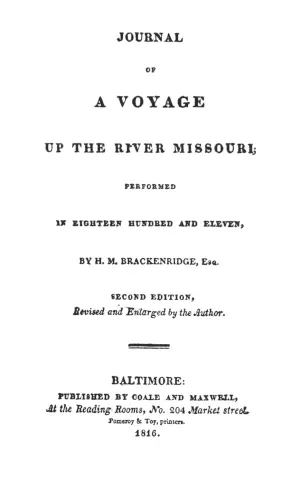
Brackenridge’s Journal of a voyage up the river Missouri, 1811; Franchère’s Voyage to Northwest Coast, 1811-1814
H. M. (Henry Marie) Brackenridge & Gabriel Franchère
THE CLASSIC COLLECTION · 1854
"Narrative of a Voyage to the Northwest Coast of America" by Gabriel Franchere is a historical account written in the mid-19th century. The book recounts the author's experiences during an expedition led by the merchant John Jacob Astor to establish the first American settlement on the Pacific coast. The narration provides insights into early 19th-century exploration, trade, and interactions with indigenous peoples, highlighting the hopes, struggles, and perils faced by those involved in the venture. The opening of the narrative introduces Franchere's journey, beginning with the departure from Montreal and the subsequent arrival in New York. He describes his emotional farewells, the transition to a vastly different environment in the bustling city, and the preparations made for the voyage ahead. The text serves as a personal reflection on the challenges of leaving one's homeland, the dynamics aboard the ship, and the interactions among the crew and passengers as they embark on their expedition toward the unknown wilderness of the Northwest Coast. As Franchere recounts the early stages of the voyage, he sets the stage for the complex journey that will unfold in the chapters to come, filled with adventure, discovery, and cultural encounters.
Introduction adapted from the source catalogue; source summaries may be automatically generated.
Free to read · English · 66,403 words · No account needed
MAKE TIME FOR A GOOD BOOK
On by default. Untick to stop anonymous reading totals. Each page counts after 10 seconds in view. How this works.
Anonymous counting is on unless you have switched it off.
Meanwhile, the natives of the vicinity informed us that they had seen the marks of shoes imprinted on the sand, at the confluence of a small stream in the neighborhood. We got three small canoes, carrying two persons each, and having ascertained that the information was correct, after searching the environs during a part of the 17th, we ascended the small stream as far as some high lands which are seen from Oak Point, and which lie about eight or nine miles south of it. The space between these high lands and the ridge crowned with oaks on the bank of the Columbia, is a low and swampy land, cut up by an infinity of little channels. Toward evening we returned on our path, to regain the schooner; but instead of taking the circuitous way of the river, by which we had come, we made for Oak Point by the most direct route, through these channels; but night coming on, we lost ourselves. Our situation became the most disagreeable that can be imagined. Being unable to find a place where we could land, on account of the morass, we were obliged to continue rowing, or rather turning round, in this species of labyrinth, constantly kneeling in our little canoes, which any unlucky movement would infallibly have caused to upset. It rained in torrents and was dark as pitch. At last, after having wandered about during a considerable part of the night, we succeeded in gaining the edge of the mainland. Leaving there our canoes, because we could not drag them (as we attempted) through the forest, we crossed the woods in the darkness, tearing ourselves with the brush, and reached the schooner, at about two in the morning, benumbed with cold and exhausted with fatigue.
The 18th was spent in getting in the remainder of the lading of the little vessel, and on the morning of the 19th we raised anchor, and dropped down abreast of the Kreluit village, where some of the Indians offering to aid us in the search after our deserters, Mr. Stuart put Mr. Farnham and me on shore to make another attempt. We passed that day in drying our clothes, and the next day embarked in a canoe, with one Kreluit man and a squaw, and ascended the river before described as entering the Columbia at this place. We soon met a canoe of natives, who informed us that our runaways had been made prisoners by the chief of a tribe which dwells upon the banks of the Willamet river, and which they called Cathlanaminim. We kept on and encamped on a beach of sand opposite Deer island. There we passed a night almost as disagreeable as that of the 17th-18th. We had lighted a fire, and contrived a shelter of mats; but there came on presently a violent gust of wind, accompanied with a heavy rain: our fire was put out, our mats were carried away, and we could neither rekindle the one nor find the others: so that we had to remain all night exposed to the fury of the storm. As soon as it was day we re-embarked, and set ourselves to paddling with all our might to warm ourselves. In the evening we arrived near the village where our deserters were, and saw one of them on the skirts of it. We proceeded to the hut of the chief, where we found all three, more inclined to follow us than to remain as slaves among these barbarians. We passed the night in the chief's lodge, not without some fear and some precaution; this chief having the reputation of being a wicked man, and capable of violating the rights of parties. He was a man of high stature and a good mien, and proud in proportion, as we discovered by the chilling and haughty manner in which he received us. Farnham and I agreed to keep watch alternately, but this arrangement was superfluous, as neither of us could sleep a wink for the infernal thumping and singing made by the medicine men all night long, by a dying native. I had an opportunity of seeing the sick man make his last will and testament: having caused to be brought to him whatever he had that was most precious, his bracelets of copper, his bead necklace, his bow and arrows and quiver, his nets, his lines, his spear, his pipe, &c., he distributed the whole to his most intimate friends, with a promise on their part, to restore them, if he recovered.
Your reading position is saved on this browser. Take it to another device with a library code. Reading pages adapt to text, rather than matching a printed edition.
H. M. (Henry Marie) Brackenridge & Gabriel Franchère
BEHIND THE BOOK
This eBook is for the use of anyone anywhere in the United States and most other parts of the world at no cost and with almost no restrictions whatsoever. You may copy it, give it away or re-use it under the terms of the Project Gutenberg License included with this eBook or online at www.gutenberg.org. If you are not located in the United States, you will have to check the laws of the country where you are located before using this eBook. Read the source licence.
The original source file, including credits and licence, is retained by this library. Request an original-format copy at no charge. Please include the book title and Project Gutenberg identifier #15911.
KEEP YOUR CURIOSITY GOING
Wilfrid Scawen Blunt
Wilfrid Scawen Blunt

E. W. (Edgar Watson) Howe
Cécile Tormay

Moritz Busch
John L. Ransom