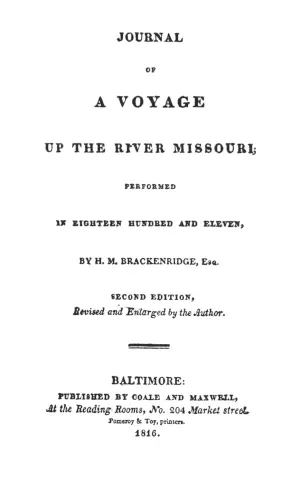
Brackenridge’s Journal of a voyage up the river Missouri, 1811; Franchère’s Voyage to Northwest Coast, 1811-1814
H. M. (Henry Marie) Brackenridge & Gabriel Franchère
THE CLASSIC COLLECTION · 1854
"Narrative of a Voyage to the Northwest Coast of America" by Gabriel Franchere is a historical account written in the mid-19th century. The book recounts the author's experiences during an expedition led by the merchant John Jacob Astor to establish the first American settlement on the Pacific coast. The narration provides insights into early 19th-century exploration, trade, and interactions with indigenous peoples, highlighting the hopes, struggles, and perils faced by those involved in the venture. The opening of the narrative introduces Franchere's journey, beginning with the departure from Montreal and the subsequent arrival in New York. He describes his emotional farewells, the transition to a vastly different environment in the bustling city, and the preparations made for the voyage ahead. The text serves as a personal reflection on the challenges of leaving one's homeland, the dynamics aboard the ship, and the interactions among the crew and passengers as they embark on their expedition toward the unknown wilderness of the Northwest Coast. As Franchere recounts the early stages of the voyage, he sets the stage for the complex journey that will unfold in the chapters to come, filled with adventure, discovery, and cultural encounters.
Introduction adapted from the source catalogue; source summaries may be automatically generated.
Free to read · English · 66,403 words · No account needed
MAKE TIME FOR A GOOD BOOK
On by default. Untick to stop anonymous reading totals. Each page counts after 10 seconds in view. How this works.
Anonymous counting is on unless you have switched it off.
The market-places are eight in number; the most considerable is called
Fly-Market.
The Park, the Battery, and Vauxhall Garden, are the principal promenades. There were, in 1810, thirty-two churches, two of which were devoted to the catholic worship; and the population was estimated at ninety thousand souls, of whom ten thousand were French. It is thought that this population has since been augmented (1819) by some thirty thousand souls.
During my sojourn at New York, I lodged in Brooklyn, on Long Island. This island is separated from the city by a sound, or narrow arm of the sea. There is here a pretty village, not far from which is a basin, where some gun-boats were hauled up, and a few war vessels were on the stocks. Some barracks had been constructed here, and a guard was maintained.
Before leaving New York, it is well to observe that during our stay in that city, Mr. M'Kay thought it the part of prudence to have an interview with the minister plenipotentiary of his Britannic majesty, Mr. Jackson,[D] to inform him of the object of our voyage, and get his views in regard to the line of conduct we ought to follow in case of war breaking out between the two powers; intimating to him that we were all British subjects, and were about to trade under the American flag. After some moments of reflection Mr. Jackson told him, "that we were going on a very hazardous enterprise; that he saw our object was purely commercial, and that all he could promise us, was, that in case of a war we should be respected as British subjects and traders."
[Footnote D: This gentleman was really charge d'affaires.]
This reply appeared satisfactory, and Mr. M'Kay thought we had nothing to apprehend on that side.
The vessel in which we were to sail was called the Tonquin, of about 300 tons burden, commanded by Captain Thorn (a first-lieutenant of the American navy, on furlough for this purpose), with a crew of twenty-one men. The number of passengers was thirty-three. Here follow the names of both.
{ Messrs. Alexander M'Kay }
{ " Duncan M'Dougall, }
PARTNERS { " David Stuart, } all of Canada.
{ " Robert Stuart, }
{ James Lewis of New York,
{ Russel Farnham of Massachusetts,
{ William W. Matthews of New York,
{ Alexander Boss, }
{ Donald M'Gillis, }
CLERKS { Ovide de Montigny, }
{ Francis B. Pillet, } all from Canada.
{ Donald M'Lennan, }
{ William Wallace, }
{ Thomas McKay, }
{ Gabriel Franchere, }
{ Oliver Roy Lapensee, Joseph Lapierre, { Ignace Lapensee, Joseph Nadeau, BOATMEN, { Basile Lapensee, J. B'te. Belleau, ETC. { Jacques Lafantaisie, Antoine Belleau, { Benjamin Roussel, Louis Brusle, { Michel Laframboise, P.D. Jeremie, { Giles Leclerc, all of Canada.
Your reading position is saved on this browser. Take it to another device with a library code. Reading pages adapt to text, rather than matching a printed edition.
H. M. (Henry Marie) Brackenridge & Gabriel Franchère
BEHIND THE BOOK
This eBook is for the use of anyone anywhere in the United States and most other parts of the world at no cost and with almost no restrictions whatsoever. You may copy it, give it away or re-use it under the terms of the Project Gutenberg License included with this eBook or online at www.gutenberg.org. If you are not located in the United States, you will have to check the laws of the country where you are located before using this eBook. Read the source licence.
The original source file, including credits and licence, is retained by this library. Request an original-format copy at no charge. Please include the book title and Project Gutenberg identifier #15911.
KEEP YOUR CURIOSITY GOING
Wilfrid Scawen Blunt
Wilfrid Scawen Blunt

E. W. (Edgar Watson) Howe
Cécile Tormay

Moritz Busch
John L. Ransom