THE CLASSIC COLLECTION✦My diaries, being a personal narrative of events 1888-1914, Part 2 (1900-1914)CLASSIC FREE BOOKS
My diaries, being a personal narrative of events 1888-1914, Part 2 (1900-1914)
Wilfrid Scawen Blunt
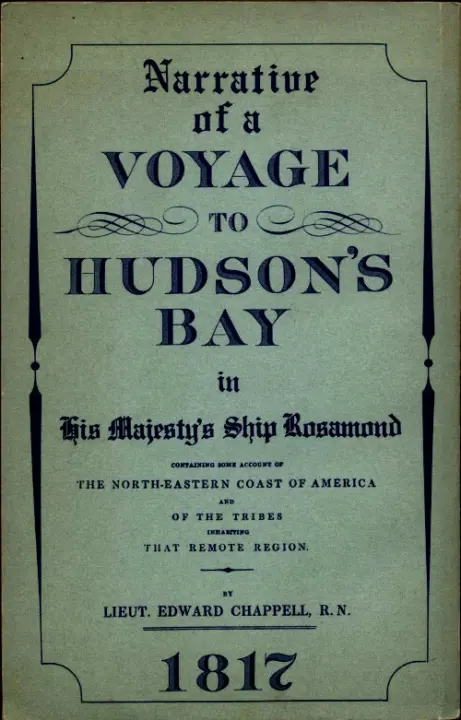
THE CLASSIC COLLECTION · 1817
"Narrative of a Voyage to Hudson's Bay in His Majesty's Ship Rosamond" by Lieutenant Edward Chappell is a historical account written in the early 19th century. This work details Chappell's experiences and observations during his voyage to Hudson's Bay, focusing on the geography and the indigenous tribes inhabiting the northeastern coast of America. It promises a blend of adventure, exploration, and cultural insights into the lives of the local tribes he encounters. The opening of the narrative introduces Lieutenant Chappell as a young naval officer preparing for a voyage that diverges from his initial expectations of conflict to the remote and icy regions of Hudson's Bay. The ship Rosamond sets sail amidst a mixture of apprehension and anticipation. Chappell recounts the various ports they pass, his experiences with fellow naval officers, and the logistical challenges faced during the initial stages of the journey. The descriptions of the ship's journey through challenging waters and the growing sense of trepidation as they approach the unknown territory set the stage for an in-depth examination of the geography and cultures Chappell is about to explore.
Introduction adapted from the source catalogue; source summaries may be automatically generated.
Free to read · English · 43,090 words · No account needed
MAKE TIME FOR A GOOD BOOK
On by default. Untick to stop anonymous reading totals. Each page counts after 10 seconds in view. How this works.
Anonymous counting is on unless you have switched it off.
[13]A List is contained in the Appendix, of the different articles of Esquimaux manufacture which were presented, by the Author, to the University Library at Cambridge; accompanied, also, by a List of things of a similar nature brought to Russia by Commodore Billings, from the N. W. coast of America.
[14]This gallant officer lost his arm in the attack on Java, by a cannon-ball. The seamen seeing him knocked backwards by the shock, and lying senseless, conjectured that he had been killed outright; but as they were bearing him off the field, the Captain recovered his senses, and feeling the hot beams of a vertical sun striking directly on his face and head (his hat having rolled off when he fell), he immediately exclaimed to one of his men, “Damme, Sir! fetch me my hat.”
[15]Some of the arrows brought to England by the Author were barbed flint, and exactly resemble the arrow-heads found in the Tomb of the Athenians in the Plain of Marathon.
[16]See the Plate.
[17]See Hearne’s “Journey to the Northern Ocean,” p. 154, London,
1795.
[18]This practice was common to almost all the antient world; especially to the Celtic and Gothic tribes, as manifested by the antiquities now found in their sepulchres. Possibly, therefore, the Asiatic origin of the Esquimaux may hence be deduced. The same custom also exists among the Greenlanders; who are, in fact, a branch of the Esquimaux. “They like,” says Crantz, “to make the grave in some remote high place, laying a little moss upon the bare ground (for the rock admits of no digging), and spread a skin upon it. . . . . Near the burying spot they deposit the kajak and darts of the deceased, and the tools he daily used.”—See Crantz’s Greenland, vol. I. p. 237. London, 1767.
[19]Moschetos are considered as among the winged agents of the Evil Spirit, by some of the North-American tribes.
[20]See the Sketch of this remarkable Cape, taken on the tops.
[21]Hearne’s Journey to the Northern Ocean, p. 224. Lond. 1795.
[22]See the Voyages of Frobisher, Davies, and others.
[23]This is the denomination of the bottom of Hudson’s Bay to the southward of Cape Henrietta Maria.
[24]The Beluga.
[25]The account of the above transaction was derived from the most
indubitable authority.
[26]Memoirs of Mrs. Mary Robinson.
[27]See the account of Expeditions through the North-West Continent of America to the Pacific Ocean.
[28]The infant colony is called by his Lordship, Osna Boia (two Gaelic words signifying Ossian’s Town), from the resemblance between that and the Indian name of Red River—Asnaboyne.
[29]See Appendix B.
[30]It is astonishing, that, before the return of the ships, the whole of the drift ice in the Straits disappeared.
Your reading position is saved on this browser. Take it to another device with a library code. Reading pages adapt to text, rather than matching a printed edition.
BEHIND THE BOOK
This eBook is for the use of anyone anywhere in the United States and most other parts of the world at no cost and with almost no restrictions whatsoever. You may copy it, give it away or re-use it under the terms of the Project Gutenberg License included with this eBook or online at www.gutenberg.org. If you are not located in the United States, you will have to check the laws of the country where you are located before using this eBook. Read the source licence.
The original source file, including credits and licence, is retained by this library. Request an original-format copy at no charge. Please include the book title and Project Gutenberg identifier #54088.
KEEP YOUR CURIOSITY GOING
Wilfrid Scawen Blunt
Wilfrid Scawen Blunt

E. W. (Edgar Watson) Howe
Cécile Tormay

Moritz Busch
John L. Ransom