THE CLASSIC COLLECTION✦My diaries, being a personal narrative of events 1888-1914, Part 2 (1900-1914)CLASSIC FREE BOOKS
My diaries, being a personal narrative of events 1888-1914, Part 2 (1900-1914)
Wilfrid Scawen Blunt
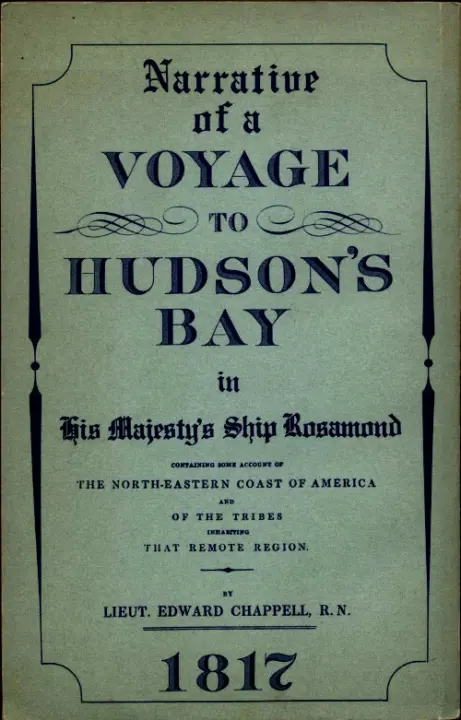
THE CLASSIC COLLECTION · 1817
"Narrative of a Voyage to Hudson's Bay in His Majesty's Ship Rosamond" by Lieutenant Edward Chappell is a historical account written in the early 19th century. This work details Chappell's experiences and observations during his voyage to Hudson's Bay, focusing on the geography and the indigenous tribes inhabiting the northeastern coast of America. It promises a blend of adventure, exploration, and cultural insights into the lives of the local tribes he encounters. The opening of the narrative introduces Lieutenant Chappell as a young naval officer preparing for a voyage that diverges from his initial expectations of conflict to the remote and icy regions of Hudson's Bay. The ship Rosamond sets sail amidst a mixture of apprehension and anticipation. Chappell recounts the various ports they pass, his experiences with fellow naval officers, and the logistical challenges faced during the initial stages of the journey. The descriptions of the ship's journey through challenging waters and the growing sense of trepidation as they approach the unknown territory set the stage for an in-depth examination of the geography and cultures Chappell is about to explore.
Introduction adapted from the source catalogue; source summaries may be automatically generated.
Free to read · English · 43,090 words · No account needed
MAKE TIME FOR A GOOD BOOK
On by default. Untick to stop anonymous reading totals. Each page counts after 10 seconds in view. How this works.
Anonymous counting is on unless you have switched it off.
“The animals of Hudson’s Bay are, the moose-deer, stags, rein-deer, bears, wolves, foxes, beavers, otters, lynxes, martens, squirrels, ermines, wild-cats, and hares; of the feathered kind, geese, bustards, ducks, partridges, and all manner of wild fowl: of fish, whales, morses, seals, cod, sea-horses, and sea-unicorns: and in the rivers and fresh waters, pike, perch, carp, and trout. There have been taken in one season, at Nelson River, 90,000 partridges, as large as hens; and 25,000 hares. Every thing changes white in winter; even European animals after being a short time in the country.
“The inhabitants shew great ingenuity in kindling a fire, in clothing themselves, and in preserving their eyes: in other respects, they are very savage[39]. In their shapes and faces they do not resemble the Indians, who live to the south: they are more like the Laplanders and Samoeids of Europe, from whom they are probably descended. Those on the sea-coast are dexterous in managing their kiacks or boats[40]. The other Americans seem to be of a Tartar original.
“In 1670, a Charter was granted to a Company, which does not consist of more than nine or ten persons, for the exclusive trade to this Bay; and they have acted under it ever since, with great benefit to themselves. The fur and peltry trade might be carried on to a much greater extent, were it not entirely in the hands of this exclusive Company; whose interested, not to say inquisitive spirit, has been the subject of long and just complaint. The Company employ four ships, and 130 seamen[41].
“The French destroyed the forts in 1782, valued at 500,000l. The Company export commodities to the amount of 16,000l. and bring home returns to the value of 29,340l. which yield to the revenue 3,734l. This includes the fishing in Hudson’s Bay.
“This commerce, small as it is, affords great profits to the Company, and is advantageous to Great Britain in general; for the commodities we exchange with the Indians, for their skins and furs, are all manufactured in Great Britain; and as the Indians are not very nice in their choice, those things are sent of which we have the greatest plenty, and which, in the mercantile phrase, are drugs with us.——Though the workmanship, too, happens to be, in many respects, so deficient, that no civilized people would take it off our hands, it may nevertheless be admired by the Indians. On the other hand, the skins and furs we bring from Hudson’s Bay enter largely into our manufactures, and afford us materials for a lucrative trade with many nations of Europe. These circumstances tend to prove incontestably the immense benefit that would redound to Great Britain by throwing open the trade to Hudson’s Bay; since, even in its present restrained state, it is so advantageous. The exclusive Company, it is probable, do not find commerce so advantageous now as it was before we got possession of Canada. The only attempt made to trade with Labrador has been directed towards the fishery.
Your reading position is saved on this browser. Take it to another device with a library code. Reading pages adapt to text, rather than matching a printed edition.
BEHIND THE BOOK
This eBook is for the use of anyone anywhere in the United States and most other parts of the world at no cost and with almost no restrictions whatsoever. You may copy it, give it away or re-use it under the terms of the Project Gutenberg License included with this eBook or online at www.gutenberg.org. If you are not located in the United States, you will have to check the laws of the country where you are located before using this eBook. Read the source licence.
The original source file, including credits and licence, is retained by this library. Request an original-format copy at no charge. Please include the book title and Project Gutenberg identifier #54088.
KEEP YOUR CURIOSITY GOING
Wilfrid Scawen Blunt
Wilfrid Scawen Blunt

E. W. (Edgar Watson) Howe
Cécile Tormay

Moritz Busch
John L. Ransom