THE CLASSIC COLLECTION✦Myths of northern landsCLASSIC FREE BOOKS
Myths of northern lands
H. A. (Hélène Adeline) Guerber
THE CLASSIC COLLECTION · 1893
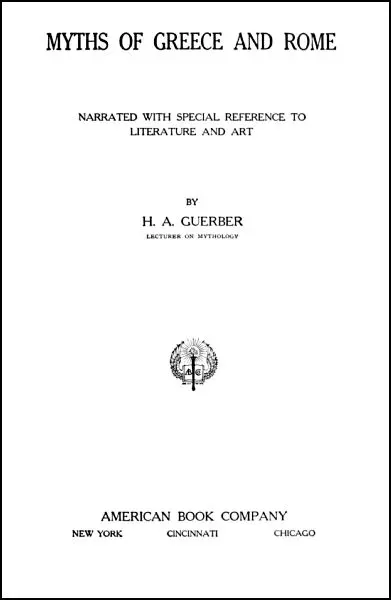
"Myths of Greece and Rome" by H. A. Guerber is a narrative account of classical mythology written in the late 19th century. The work explores the rich tapestry of myths surrounding the ancient Greek and Roman pantheon, providing insights into how these stories influenced literature and art through the ages. The myths are presented in a manner that balances accuracy with readability, making them accessible to a wide audience. The opening of the book introduces readers to the concept of mythology as a collection of ancient narratives explaining the origins of the world and its gods. It begins with the creation myth, describing the chaotic state of the universe before the emergence of order, where elements like Chaos and Nyx (Night) preside over a formless existence. The subsequent emergence of Titans, deities, and the eventual ascendance of Jupiter (Zeus) set the stage for conflicts among gods and the intricate relationships between divinities and mortals. The content reflects a blend of descriptive storytelling and scholarly analysis, showcasing the transformative power these myths held in shaping cultural and artistic expressions.
Introduction adapted from the source catalogue; source summaries may be automatically generated.
Free to read · English · 111,633 words · No account needed
MAKE TIME FOR A GOOD BOOK
On by default. Untick to stop anonymous reading totals. Each page counts after 10 seconds in view. How this works.
Anonymous counting is on unless you have switched it off.
Psyche gratefully accepted and followed Ceres' advice, and labored early and late to satisfy her exacting mistress, who appointed such difficult tasks, that the poor girl would never have been able to accomplish them had she not been aided by all the beasts and insects, who loved her dearly.
[Sidenote: Psyche's journey to Hades.]
Venus repeatedly tested her fidelity and endurance, and finally resolved, as a crucial experiment, to send her to Hades to fetch a box of beauty ointment, for which Proserpina alone had the recipe. Directed by Zephyrus, her old friend, Psyche encountered the terrors of Hades in safety, delivered her message, and in return received a small box. The gates of Hades were closed behind her, and she had nearly finished her last task, when she suddenly fancied that it would be wise to appropriate a little of the magic preparation to efface the traces of sleepless nights and many tears.
The box, however, contained naught but the spirit of Sleep, who, pouncing upon Psyche, laid her low by the roadside. Cupid, passing by, saw her there, marked the ravages of grief, remembered his love and her suffering, and, wrestling with the spirit, forced him to reënter the narrow bounds of his prison, and woke Psyche with a loving kiss.
"'Dear, unclose thine eyes.
Thou mayst look on me now. I go no more,
But am thine own forever.'"
Lewis Morris.
Then, hand in hand, they winged their flight to Olympus, entered the council hall; and there Cupid presented Psyche, his chosen bride, to the assembled deities, who all promised to be present at the nuptial ceremony. Venus even, forgetting all her former envy, welcomed the blushing bride, who was happy ever after.
The ancients, for whom Cupid was an emblem of the heart, considered Psyche the personification of the soul, and represented her with butterfly wings; that little insect being another symbol of the soul, which cannot die.
[Sidenote: Berenice's Hair.]
One of the latest myths concerning Venus is that of Berenice, who, fearing for her beloved husband's life, implored the goddess to protect him in battle, vowing to sacrifice her luxuriant hair if he returned home in safety. The prayer was granted, and Berenice's beautiful locks laid upon Venus' shrine, whence they, however, very mysteriously disappeared. An astrologer, consulted concerning the supposed theft, solemnly pointed to a comet rapidly coming into view, and declared that the gods had placed Berenice's hair among the stars, there to shine forever in memory of her wifely sacrifice.
[Sidenote: Worship of Venus.]
Your reading position is saved on this browser. Take it to another device with a library code. Reading pages adapt to text, rather than matching a printed edition.
H. A. (Hélène Adeline) Guerber

H. A. (Hélène Adeline) Guerber
H. A. (Hélène Adeline) Guerber
BEHIND THE BOOK
This eBook is for the use of anyone anywhere in the United States and most other parts of the world at no cost and with almost no restrictions whatsoever. You may copy it, give it away or re-use it under the terms of the Project Gutenberg License included with this eBook or online at www.gutenberg.org. If you are not located in the United States, you will have to check the laws of the country where you are located before using this eBook. Read the source licence.
The original source file, including credits and licence, is retained by this library. Request an original-format copy at no charge. Please include the book title and Project Gutenberg identifier #39250.
KEEP YOUR CURIOSITY GOING

Maurice Baring
Francis Greenleaf Allinson & Anne C. E. (Anne Crosby Emery) Allinson
Stuart Dodgson Collingwood
Percy Keese Fitzhugh
Mary Macleod & Edmund Spenser

Cooke Don-Carlos