THE CLASSIC COLLECTION✦Myths of northern landsCLASSIC FREE BOOKS
Myths of northern lands
H. A. (Hélène Adeline) Guerber
THE CLASSIC COLLECTION · 1893
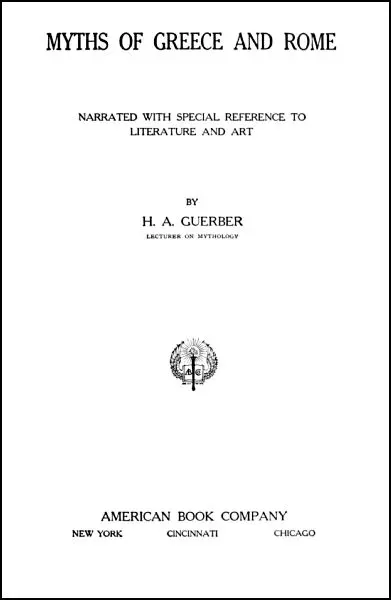
"Myths of Greece and Rome" by H. A. Guerber is a narrative account of classical mythology written in the late 19th century. The work explores the rich tapestry of myths surrounding the ancient Greek and Roman pantheon, providing insights into how these stories influenced literature and art through the ages. The myths are presented in a manner that balances accuracy with readability, making them accessible to a wide audience. The opening of the book introduces readers to the concept of mythology as a collection of ancient narratives explaining the origins of the world and its gods. It begins with the creation myth, describing the chaotic state of the universe before the emergence of order, where elements like Chaos and Nyx (Night) preside over a formless existence. The subsequent emergence of Titans, deities, and the eventual ascendance of Jupiter (Zeus) set the stage for conflicts among gods and the intricate relationships between divinities and mortals. The content reflects a blend of descriptive storytelling and scholarly analysis, showcasing the transformative power these myths held in shaping cultural and artistic expressions.
Introduction adapted from the source catalogue; source summaries may be automatically generated.
Free to read · English · 111,633 words · No account needed
MAKE TIME FOR A GOOD BOOK
On by default. Untick to stop anonymous reading totals. Each page counts after 10 seconds in view. How this works.
Anonymous counting is on unless you have switched it off.
The tidings of his death soon reached poor Clymene, who mourned her only son, and refused to be comforted; while the Heliades, Phaeton's sisters, three in number,--Phaetusa, Lampetia, and Ægle,--spent their days by the riverside, shedding tears, wringing their white hands, and bewailing their loss, until the gods, in pity, transformed them into poplar trees, and their tears into amber, which substance was supposed by the ancients to flow from the poplar trees like teardrops. Phaeton's intimate friend, Cycnus, piously collected his charred remains, and gave them an honorable burial. In his grief he continually haunted the scene of his friend's death, and repeatedly plunged into the river, in the hope of finding some more scattered fragments, until the gods changed him into a swan; which bird is ever sailing mournfully about, and frequently plunging, his head into the water to continue his sad search.
Apollo, as the dearly loved leader of the nine Muses,--daughters of Jupiter and Mnemosyne, goddess of memory,--was surnamed Musagetes.
"Whom all the Muses loved, not one alone;
Into his hands they put the lyre of gold,
And, crowned with sacred laurel at their fount,
Placed him as Musagetes on their throne."
Longfellow.
Although the Muses united at times in one grand song, they had each separate duties assigned them.
[Sidenote: The nine Muses.]
Clio, the Muse of history, recorded all great deeds and heroic actions, with the names of their authors, and was therefore generally represented with a laurel wreath and a book and stylus, to indicate her readiness to note all that happened to mortal men or immortal gods.
Euterpe, the graceful "Mistress of Song," was represented with a flute, and garlands of fragrant flowers.
Thalia, Muse of pastoral poetry, held a shepherd's crook and mask, and wore a crown of wild flowers.
"Mild pastoral Muse!
That, to the sparkling crown Urania wears,
And to her sister Clio's laurel wreath,
Preferr'st a garland culled from purple heath!"
Wordsworth.
Her graver sister, Melpomene, who presided over tragedy, wore a crown of gold, and wielded a dagger and a scepter; while Terpsichore, the light-footed Muse of dancing, was represented treading an airy measure.
Erato, who preferred lyric poetry to all other styles of composition, was pictured with a lyre; and Polyhymnia, Muse of rhetoric, held a scepter to show that eloquence rules with resistless sway.
Calliope, Muse of heroic poetry, also wore a laurel crown; and Urania, Muse of astronomy, held mathematical instruments, indicative of her love of the exact sciences.
This glorious sisterhood was wont to assemble on Mount Parnassus or on Mount Helicon, to hold their learned debates on poetry, science, and music.
Your reading position is saved on this browser. Take it to another device with a library code. Reading pages adapt to text, rather than matching a printed edition.
H. A. (Hélène Adeline) Guerber
H. A. (Hélène Adeline) Guerber
H. A. (Hélène Adeline) Guerber
BEHIND THE BOOK
This eBook is for the use of anyone anywhere in the United States and most other parts of the world at no cost and with almost no restrictions whatsoever. You may copy it, give it away or re-use it under the terms of the Project Gutenberg License included with this eBook or online at www.gutenberg.org. If you are not located in the United States, you will have to check the laws of the country where you are located before using this eBook. Read the source licence.
The original source file, including credits and licence, is retained by this library. Request an original-format copy at no charge. Please include the book title and Project Gutenberg identifier #39250.
KEEP YOUR CURIOSITY GOING

Maurice Baring
Francis Greenleaf Allinson & Anne C. E. (Anne Crosby Emery) Allinson
Stuart Dodgson Collingwood
Percy Keese Fitzhugh
Mary Macleod & Edmund Spenser

Cooke Don-Carlos