THE CLASSIC COLLECTION✦Myths of northern landsCLASSIC FREE BOOKS
Myths of northern lands
H. A. (Hélène Adeline) Guerber
THE CLASSIC COLLECTION · 1893
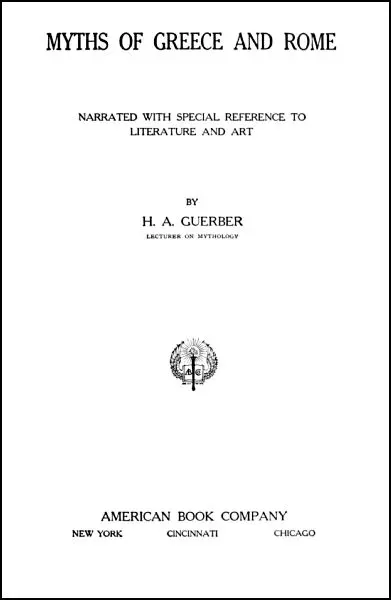
"Myths of Greece and Rome" by H. A. Guerber is a narrative account of classical mythology written in the late 19th century. The work explores the rich tapestry of myths surrounding the ancient Greek and Roman pantheon, providing insights into how these stories influenced literature and art through the ages. The myths are presented in a manner that balances accuracy with readability, making them accessible to a wide audience. The opening of the book introduces readers to the concept of mythology as a collection of ancient narratives explaining the origins of the world and its gods. It begins with the creation myth, describing the chaotic state of the universe before the emergence of order, where elements like Chaos and Nyx (Night) preside over a formless existence. The subsequent emergence of Titans, deities, and the eventual ascendance of Jupiter (Zeus) set the stage for conflicts among gods and the intricate relationships between divinities and mortals. The content reflects a blend of descriptive storytelling and scholarly analysis, showcasing the transformative power these myths held in shaping cultural and artistic expressions.
Introduction adapted from the source catalogue; source summaries may be automatically generated.
Free to read · English · 111,633 words · No account needed
MAKE TIME FOR A GOOD BOOK
On by default. Untick to stop anonymous reading totals. Each page counts after 10 seconds in view. How this works.
Anonymous counting is on unless you have switched it off.
Da-na´i-des.
Daughters of Danaus, who slay their husbands, 166, 167.
Dan´a-us.
King of Argos;
father of the fifty Danaides, 166.
Dan´ube.
River of Europe;
Medea slays Absyrtus near its mouth, 271.
Daph´ne.
Maiden loved by Apollo, and changed into a laurel tree, 68-70;
significance, 387, 389, 395.
Dar´da-nus.
Ancient king of Troy, who gives his name to his race, 364;
mares of, 215.
De-i-a-nei´ra.
Wife of Hercules, 232-236;
causes Hercules' death by using the Nessus robe, 235, 236;
significance, 390.
De-iph´o-bus.
Son of Priam and Hecuba;
married Helen after the death of Paris, 362.
De´los.
Floating island;
birthplace of Apollo and Diana, 62;
shrine of Apollo at, 91, 363, 364;
significance, 386, 396.
Del´phi.
Shrine of Apollo, famed for its oracles, 37, 47, 91;
Ceyx visits, 211;
Oedipus consults oracle at, 281, 282, 285, 290;
Orestes at, 336.
Del´uge.
Caused by Jupiter's wrath, 36;
slime from, 65.
De-me´ter.
Same as Ceres;
goddess of agriculture, 183, 187;
significance, 396.
De´mi-os (Dread).
Attendant or son of Mars, 138.
Des´ti-ny.
One of the ancient deities not subjected to Jupiter, 39.
Deu-ca´li-on.
Only male survivor of Deluge;
father of Hellen, 37, 38.
Di´a.
Maiden loved and deserted by Ixion, king of the Lapithæ, 169;
significance, 389.
Di-a´na.
Goddess of the moon and chase;
daughter of Jupiter and Latona, 93-101;
birth of, 62;
nymphs of, 70, 190;
arrows of, 139;
Arethusa protected by, 192;
Oeneus neglects, 275;
Iphigenia saved by, 316;
temple of, 336;
Camilla rescued by, 373, 374;
significance, 388, 396, 398.
Di´do.
Queen of Tyre and Carthage;
loved and deserted by Æneas, 366-369;
Æneas sees, in Hades, 372.
Di-o-me´des.
1. Greek hero during Trojan war, 314;
recovers Patroclus' body, 328;
helps Ulysses secure the Palladium, 332.
2. The possessor of horses taken by Hercules, 223.
Di-o´ne.
1. Name given to Venus, goddess of beauty, love, laughter, etc., 103.
2. Mother of Venus by Jupiter;
goddess of moisture, 44.
Di-o-nys´i-a.
Festivals held in Greece in honor of Bacchus, 182.
Di-o-nys´us.
Same as Bacchus, god of wine and revelry, 174.
Di-os-cu´ri.
Collective name given to Castor and Pollux, 278.
Di-os-cu´ri-a.
Festivals in honor of Castor and Pollux, 279.
Dir´ce.
Wife of Lycus;
bound to a bull by Amphion and Zethus, 80-82.
Dis.
Same as Pluto, god of Infernal Regions, 159, 370.
Dis-cor´di-a, or Eris.
Goddess of discord, 138;
she appears at Peleus' marriage feast, 306.
Do-do´na.
Temple and grove sacred to Jupiter, 48, 49, 266.
Dol´phin.
Constellation, 82.
Do´ri-an Race.
Descendants of Dorus, 38.
Do´ris.
Wife of Nereus, 154, 305.
Do´rus.
Son of Hellen;
ancestor of Dorian race, 38.
Dreams.
Spirits in cave of Somnus;
passed out through gates of ivory and horn, 210, 211;
Mercury, leader of, 137.
Drep´a-num.
Land visited by Æneas, where Anchises died, 365.
Dry´a-des.
Plant nymphs, supposed to watch over vegetation, 297.
Dry´o-pe.
Princess changed into a tree, 298-300.
Dull´ness.
Obscure deity put to flight by Minerva, 55, 57.
Your reading position is saved on this browser. Take it to another device with a library code. Reading pages adapt to text, rather than matching a printed edition.
H. A. (Hélène Adeline) Guerber
H. A. (Hélène Adeline) Guerber
H. A. (Hélène Adeline) Guerber
BEHIND THE BOOK
This eBook is for the use of anyone anywhere in the United States and most other parts of the world at no cost and with almost no restrictions whatsoever. You may copy it, give it away or re-use it under the terms of the Project Gutenberg License included with this eBook or online at www.gutenberg.org. If you are not located in the United States, you will have to check the laws of the country where you are located before using this eBook. Read the source licence.
The original source file, including credits and licence, is retained by this library. Request an original-format copy at no charge. Please include the book title and Project Gutenberg identifier #39250.
KEEP YOUR CURIOSITY GOING

Maurice Baring
Francis Greenleaf Allinson & Anne C. E. (Anne Crosby Emery) Allinson
Stuart Dodgson Collingwood
Percy Keese Fitzhugh
Mary Macleod & Edmund Spenser

Cooke Don-Carlos