THE CLASSIC COLLECTION✦Myths of northern landsCLASSIC FREE BOOKS
Myths of northern lands
H. A. (Hélène Adeline) Guerber
THE CLASSIC COLLECTION · 1893
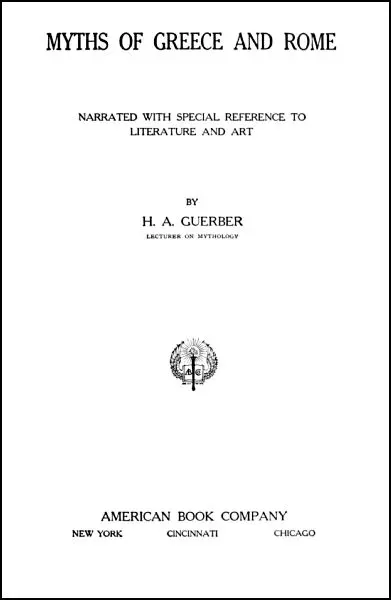
"Myths of Greece and Rome" by H. A. Guerber is a narrative account of classical mythology written in the late 19th century. The work explores the rich tapestry of myths surrounding the ancient Greek and Roman pantheon, providing insights into how these stories influenced literature and art through the ages. The myths are presented in a manner that balances accuracy with readability, making them accessible to a wide audience. The opening of the book introduces readers to the concept of mythology as a collection of ancient narratives explaining the origins of the world and its gods. It begins with the creation myth, describing the chaotic state of the universe before the emergence of order, where elements like Chaos and Nyx (Night) preside over a formless existence. The subsequent emergence of Titans, deities, and the eventual ascendance of Jupiter (Zeus) set the stage for conflicts among gods and the intricate relationships between divinities and mortals. The content reflects a blend of descriptive storytelling and scholarly analysis, showcasing the transformative power these myths held in shaping cultural and artistic expressions.
Introduction adapted from the source catalogue; source summaries may be automatically generated.
Free to read · English · 111,633 words · No account needed
MAKE TIME FOR A GOOD BOOK
On by default. Untick to stop anonymous reading totals. Each page counts after 10 seconds in view. How this works.
Anonymous counting is on unless you have switched it off.
A´cis.
Youth loved by Galatea, and slain by Polyphemus, 341.
A-cris´i-us.
King of Argos, and father of Danae, 240, 241, 249;
significance, 390, 391.
A-crop´o-lis.
Hill in Athens, the site of the Parthenon and Theseus' temple, 262.
Ac-tæ´on.
Hunter changed to a stag by Diana, 100, 101.
Ad-me´te.
Daughter of Eurystheus, covets Hippolyte's girdle, 223.
Ad-me´tus.
King of Thessaly, served by Apollo, and saved from death by
Alcestis, 64, 65;
Hercules restores Alcestis to, 230;
one of the Argonauts, 266;
in Calydonian Hunt, 275;
significance, 386.
A-do´nis.
Hunter loved by Venus and slain by a boar, 108-110;
significance, 195, 389.
A-dras´tus.
King of Argos;
his horse Arion, 153;
father of Hippodamia, 260;
sends expedition against Thebes, 287.
Æ´a-cus.
One of the three judges of the dead in Hades, 163.
Æ-æ´a.
Island inhabited by Circe and visited by Ulysses, 347-350.
Æ-e´tes.
King of Colchis, father of Medea and Absyrtus, 268, 271;
brother of Circe, 347;
significance, 392.
Æ-ge´an Sea.
Delos chained in, 62;
Arion borne by dolphins in, 82, 83;
named after Ægeus, 259.
Æ-ge´us.
King of Athens;
father of Theseus, 250, 252, 253;
drowns himself, 259;
significance, 391.
Æ´gis.
Shield or breastplate of Minerva and Jupiter, 58;
loaned to Perseus, 243;
bears Medusa's head, 249.
Æ-gis´thus.
Murderer of Agamemnon;
slain by Orestes, 336.
Æg´le.
One of the Heliades;
changed to a poplar tree, 87.
Æ-gyp´tus.
Brother of Danaus, 166.
Æ-ne´a-dæ.
City which Æneas proposed to found in Thrace, 363.
Æ-ne´as.
Son of Venus and Anchises, 111;
Æneas' descendants, 140;
worship introduced into Italy by, 198;
hero of Virgil's Æneid, 360-377.
Æ-ne´as Sil´vi-a.
Son of Æneas;
founder of Alba Longa, 377.
Æ-ne´id.
Virgil's epic poem on the adventures of Æneas, 374.
Æ-o´li-a.
1. Same as Æolian Islands.
2. In Asia Minor, near Ægean Sea, 214.
Æ-o´li-an Islands.
The home of Æolus, god of the winds, 213, 346;
supposed to be Lipari Islands, 213.
Æ-o´li-an Race.
Descendants of Æolus, son of Hellen, 38.
Æ´o-lus.
1. God of the winds, 213-215;
Juno's bargain with, 266;
gift to Ulysses, 346;
destruction of Æneas' fleet, 365;
significance, 400.
2. Son of Hellen, founder of the Æolian race, 38.
Æs-cu-la´pi-us.
Son of Apollo and Coronis, 63, 64;
Machaon, son of, 331;
significance, 387.
Æ´son.
Father of Jason, 263;
rejuvenated by Medea, 273.
Æ´ther.
God of light, 13;
dethroned, 17.
Æ´thra.
Princess of Troezene, 250;
mother of Theseus, 253;
Helen intrusted to, 260;
significance, 391.
Æt´na.
Volcano in Sicily, 183;
the tomb of Enceladus, 24;
forge of Vulcan, 145, 148, 326;
Ceres' visit to, 187.
Æ-to´li-a.
Country between Epirus and Locris, 275.
Af´ri-ca.
Hercules' visit to, 226, 227.
Afterthought.
Name given to Epimetheus, 25.
Ag-a-mem´non.
Chief of the expedition against Troy, 314-319;
return of, 336;
troops of, 361;
significance, 394.
A-ga´ve.
Mother of Pentheus;
infuriated by Bacchus, slays her son, 182.
A-ge´nor.
Father of Europa, Cadmus, Cilix, Phoenix, 44-47.
Ag-la´ia.
One of the Graces;
an attendant of Venus, 105.
A-ï´des.
Same as Pluto;
significance, 401.
A-ï-do´neus.
Same as Pluto, god of the Infernal Regions, 159.
Your reading position is saved on this browser. Take it to another device with a library code. Reading pages adapt to text, rather than matching a printed edition.
H. A. (Hélène Adeline) Guerber
H. A. (Hélène Adeline) Guerber
H. A. (Hélène Adeline) Guerber
BEHIND THE BOOK
This eBook is for the use of anyone anywhere in the United States and most other parts of the world at no cost and with almost no restrictions whatsoever. You may copy it, give it away or re-use it under the terms of the Project Gutenberg License included with this eBook or online at www.gutenberg.org. If you are not located in the United States, you will have to check the laws of the country where you are located before using this eBook. Read the source licence.
The original source file, including credits and licence, is retained by this library. Request an original-format copy at no charge. Please include the book title and Project Gutenberg identifier #39250.
KEEP YOUR CURIOSITY GOING

Maurice Baring
Francis Greenleaf Allinson & Anne C. E. (Anne Crosby Emery) Allinson
Stuart Dodgson Collingwood
Percy Keese Fitzhugh
Mary Macleod & Edmund Spenser

Cooke Don-Carlos