THE CLASSIC COLLECTION✦Myths of northern landsCLASSIC FREE BOOKS
Myths of northern lands
H. A. (Hélène Adeline) Guerber
THE CLASSIC COLLECTION · 1893
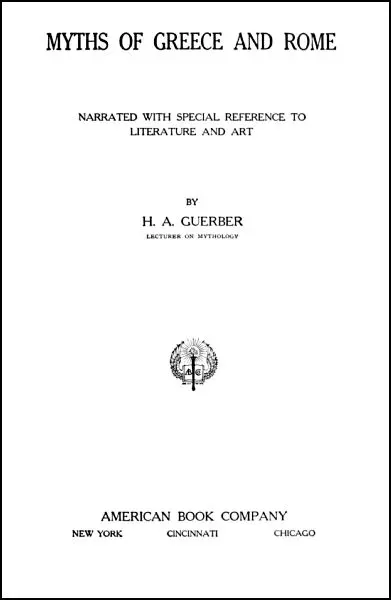
"Myths of Greece and Rome" by H. A. Guerber is a narrative account of classical mythology written in the late 19th century. The work explores the rich tapestry of myths surrounding the ancient Greek and Roman pantheon, providing insights into how these stories influenced literature and art through the ages. The myths are presented in a manner that balances accuracy with readability, making them accessible to a wide audience. The opening of the book introduces readers to the concept of mythology as a collection of ancient narratives explaining the origins of the world and its gods. It begins with the creation myth, describing the chaotic state of the universe before the emergence of order, where elements like Chaos and Nyx (Night) preside over a formless existence. The subsequent emergence of Titans, deities, and the eventual ascendance of Jupiter (Zeus) set the stage for conflicts among gods and the intricate relationships between divinities and mortals. The content reflects a blend of descriptive storytelling and scholarly analysis, showcasing the transformative power these myths held in shaping cultural and artistic expressions.
Introduction adapted from the source catalogue; source summaries may be automatically generated.
Free to read · English · 111,633 words · No account needed
MAKE TIME FOR A GOOD BOOK
On by default. Untick to stop anonymous reading totals. Each page counts after 10 seconds in view. How this works.
Anonymous counting is on unless you have switched it off.
By order of Jocasta's father, Creon, the corpse of Eteocles received all the honors of a Greek burial, while that of Polynices was left on the plain, a prey to the birds and wild beasts.
"Polynices' wretched carcass lies
Unburied, unlamented, left expos'd
A feast for hungry vultures on the plain."
Sophocles (Francklin's tr.).
[Sidenote: Antigone's devotion.]
Then a proclamation was issued, that, if any dared bury the body of the fallen prince, he would incur the penalty of being buried alive. Heedless of this injunction and Ismene's prayers to refrain from endangering her own life, Antigone dug a grave for her brother's remains, and, unaided, fulfilled the various customary funeral rites. Her task was almost completed, when the guards discovered her, and dragged her into the presence of Creon, who, although she was a relative and the promised wife of his son Hæmon, condemned her to death.
"Let her be carried instant to the cave,
And leave her there alone, to live, or die;
Her blood rests not on us: but she no longer
Shall breathe on earth."
Sophocles (Francklin's tr.).
[Sidenote: Antigone and Hæmon.]
Hæmon pleaded passionately for her life; but, when he saw his prayers were vain, he ran to the place where Antigone was confined, sprang into her narrow cell, wound his arms closely around her, and refused to leave her. There they were walled in; Antigone's sufferings were cut mercifully short by asphyxiation; and, when Hæmon saw she was no more, he, in utter despair, thrust his dagger into his side, and perished too.
"On himself bent all his wrath,
Full in his side the weapon fix'd, but still,
Whilst life remain'd, on the soft bosom hung
Of the dear maid, and his last spirit breath'd
O'er her pale cheek, discolor'd with his blood.
Thus lay the wretched pair in death united,
And celebrate their nuptials in the tomb."
Sophocles (Francklin's tr.).
Ismene, the last of Oedipus' unfortunate race, died of grief, and thus the prophecy was fully accomplished. The Theban war was not, however, entirely ended, for, when both brothers fell, the two armies flew to attack each other; and such was their courage, that many fell, and only one of the seven chiefs returned to Argos. There he patiently waited until the children of these brave captains were old enough to bear arms, and then proposed to them to attack Thebes and avenge their fathers' death.
The Epigoni (or those who come after), as these youths are collectively designated, received this proposal with rapture; and Thebes, again besieged, fell into their hands, and was duly sacked, burned, and destroyed, as the Delphic oracle had foretold so many years before.
Your reading position is saved on this browser. Take it to another device with a library code. Reading pages adapt to text, rather than matching a printed edition.
H. A. (Hélène Adeline) Guerber
H. A. (Hélène Adeline) Guerber
H. A. (Hélène Adeline) Guerber
BEHIND THE BOOK
This eBook is for the use of anyone anywhere in the United States and most other parts of the world at no cost and with almost no restrictions whatsoever. You may copy it, give it away or re-use it under the terms of the Project Gutenberg License included with this eBook or online at www.gutenberg.org. If you are not located in the United States, you will have to check the laws of the country where you are located before using this eBook. Read the source licence.
The original source file, including credits and licence, is retained by this library. Request an original-format copy at no charge. Please include the book title and Project Gutenberg identifier #39250.
KEEP YOUR CURIOSITY GOING

Maurice Baring
Francis Greenleaf Allinson & Anne C. E. (Anne Crosby Emery) Allinson
Stuart Dodgson Collingwood
Percy Keese Fitzhugh
Mary Macleod & Edmund Spenser

Cooke Don-Carlos