THE CLASSIC COLLECTION✦Myths of northern landsCLASSIC FREE BOOKS
Myths of northern lands
H. A. (Hélène Adeline) Guerber
THE CLASSIC COLLECTION · 1893
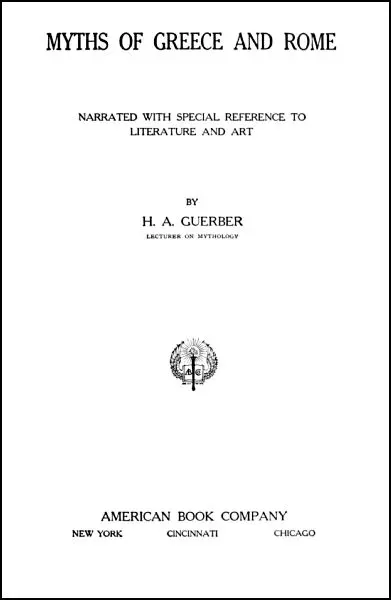
"Myths of Greece and Rome" by H. A. Guerber is a narrative account of classical mythology written in the late 19th century. The work explores the rich tapestry of myths surrounding the ancient Greek and Roman pantheon, providing insights into how these stories influenced literature and art through the ages. The myths are presented in a manner that balances accuracy with readability, making them accessible to a wide audience. The opening of the book introduces readers to the concept of mythology as a collection of ancient narratives explaining the origins of the world and its gods. It begins with the creation myth, describing the chaotic state of the universe before the emergence of order, where elements like Chaos and Nyx (Night) preside over a formless existence. The subsequent emergence of Titans, deities, and the eventual ascendance of Jupiter (Zeus) set the stage for conflicts among gods and the intricate relationships between divinities and mortals. The content reflects a blend of descriptive storytelling and scholarly analysis, showcasing the transformative power these myths held in shaping cultural and artistic expressions.
Introduction adapted from the source catalogue; source summaries may be automatically generated.
Free to read · English · 111,633 words · No account needed
MAKE TIME FOR A GOOD BOOK
On by default. Untick to stop anonymous reading totals. Each page counts after 10 seconds in view. How this works.
Anonymous counting is on unless you have switched it off.
Something in her manner, however, left a lingering doubt in Oedipus' mind, and made him resolve to consult the oracle of Delphi, whose words he knew would reveal the exact truth. He therefore went to this shrine; but, as usual, the oracle answered somewhat ambiguously, and merely warned him that fate had decreed he should kill his father, marry his mother, and cause great woes to his native city.
"I felt
A secret anguish, and unknown to them
Sought out the Pythian oracle; in vain;
Touching my parents, nothing could I learn;
But dreadful were the mis'ries it denounc'd
Against me; 'twas my fate, Apollo said,
To wed my mother, to produce a race
Accursed and abhorr'd; and last, to slay
My father."
Sophocles (Francklin's tr.).
[Sidenote: Oedipus leaves Corinth.]
What! kill Polybus, who had ever been such an indulgent father, and marry the queen, whom he revered as his mother! Never! Rather than perpetrate these awful crimes, and bring destruction upon the people of Corinth, whom he loved, he would wander away over the face of the earth, and never see city or parents again.
"Lest I should e'er fulfill the dire prediction,
Instant I fled from Corinth, by the stars
Guiding my hapless journey."
Sophocles (Francklin's tr.).
But his heart was filled with intense bitterness, and as he journeyed he did not cease to curse the fate which drove him away from home. After some time, he came to three crossroads; and while he stood there, deliberating which direction to take, a chariot, wherein an aged man was seated, came rapidly toward him.
[Sidenote: Death of Laius.]
The herald who preceded it haughtily called to the youth to stand aside and make way for his master; but Oedipus, who, as Polybus' heir, was accustomed to be treated with deference, resented the commanding tone, and refused to obey. Incensed at what seemed unparalleled impudence, the herald struck the youth, who, retaliating, stretched his assailant lifeless at his feet.
This affray attracted the attention of the master and other servants. They immediately attacked the murderer, who slew them all, thus unconsciously accomplishing the first part of the prophecy; for the aged man was Laius, his father, journeying incognito from Thebes to Delphi, where he wished to consult the oracle.
Oedipus then leisurely pursued his way until he came to the gates of Thebes, where he found the whole city in an uproar, "because the king had been found lifeless by the roadside, with all his attendants slain beside him, presumably the work of a band of highway robbers or assassins."
"He fell
By strangers, murdered, for so fame reports,
By robbers in the place where three ways meet."
Your reading position is saved on this browser. Take it to another device with a library code. Reading pages adapt to text, rather than matching a printed edition.
H. A. (Hélène Adeline) Guerber
H. A. (Hélène Adeline) Guerber
H. A. (Hélène Adeline) Guerber
BEHIND THE BOOK
This eBook is for the use of anyone anywhere in the United States and most other parts of the world at no cost and with almost no restrictions whatsoever. You may copy it, give it away or re-use it under the terms of the Project Gutenberg License included with this eBook or online at www.gutenberg.org. If you are not located in the United States, you will have to check the laws of the country where you are located before using this eBook. Read the source licence.
The original source file, including credits and licence, is retained by this library. Request an original-format copy at no charge. Please include the book title and Project Gutenberg identifier #39250.
KEEP YOUR CURIOSITY GOING

Maurice Baring
Francis Greenleaf Allinson & Anne C. E. (Anne Crosby Emery) Allinson
Stuart Dodgson Collingwood
Percy Keese Fitzhugh
Mary Macleod & Edmund Spenser

Cooke Don-Carlos