THE CLASSIC COLLECTION✦Myths of northern landsCLASSIC FREE BOOKS
Myths of northern lands
H. A. (Hélène Adeline) Guerber
THE CLASSIC COLLECTION · 1893
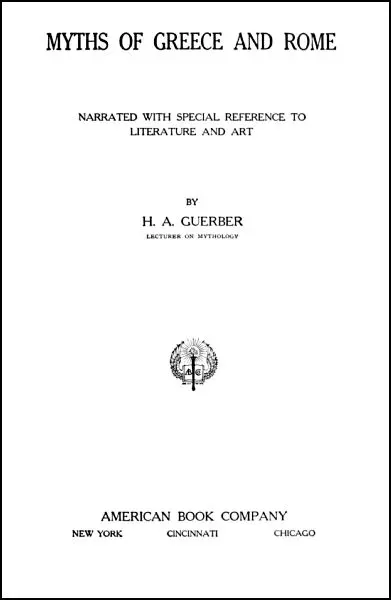
"Myths of Greece and Rome" by H. A. Guerber is a narrative account of classical mythology written in the late 19th century. The work explores the rich tapestry of myths surrounding the ancient Greek and Roman pantheon, providing insights into how these stories influenced literature and art through the ages. The myths are presented in a manner that balances accuracy with readability, making them accessible to a wide audience. The opening of the book introduces readers to the concept of mythology as a collection of ancient narratives explaining the origins of the world and its gods. It begins with the creation myth, describing the chaotic state of the universe before the emergence of order, where elements like Chaos and Nyx (Night) preside over a formless existence. The subsequent emergence of Titans, deities, and the eventual ascendance of Jupiter (Zeus) set the stage for conflicts among gods and the intricate relationships between divinities and mortals. The content reflects a blend of descriptive storytelling and scholarly analysis, showcasing the transformative power these myths held in shaping cultural and artistic expressions.
Introduction adapted from the source catalogue; source summaries may be automatically generated.
Free to read · English · 111,633 words · No account needed
MAKE TIME FOR A GOOD BOOK
On by default. Untick to stop anonymous reading totals. Each page counts after 10 seconds in view. How this works.
Anonymous counting is on unless you have switched it off.
"Now rising all at once, and unconfin'd,
From every quarter roars the rushing wind:
First, from the wide Atlantic Ocean's bed,
Tempestuous Corus rears his dreadful head,
Th' obedient deep his potent breath controls,
And, mountain-high, the foamy flood he rolls;
Him the Northeast encountering fierce, defied,
And back rebuffeted the yielding tide.
The curling surges loud conflicting meet,
Dash their proud heads, and bellow as they beat;
While piercing Boreas, from the Scythian strand,
Plows up the waves and scoops the lowest sand.
Nor Eurus then, I ween, was left to dwell,
Nor showery Notus in th' Æolian cell,
But each from every side, his power to boast,
Ranged his proud forces to defend the coast."
Lucan.
Æolus, king of the winds, shared with Dædalus the honor of inventing the sails which propel the ships so swiftly over the tide. It was he, too, who, according to Homer, bound all his children but one in a leather bag, which he gave to Ulysses when the latter visited Æolia. Thanks to this gift, Ulysses reached the shores of Ithaca, and would have landed in safety, had not his men, in view of port, untied the sack to investigate its contents, and thus set free the angry winds, who stirred up the most frightful tempest in mythic annals.
[Sidenote: Temple of Æolus.]
The ancients, and especially the Athenians, paid particular attention to the winds, to whom they dedicated a temple, which is still extant, and generally known as the Tower of the Winds, or the Temple of Æolus. This temple is hexagonal, and on each side a flying figure of one of the winds is represented.
Eurus, the east wind, was generally depicted "as a young man flying with great impetuosity, and often appearing in a playful and wanton humor." Notus, or Auster, the southwest wind, "appeared generally as an old man, with gray hair, a gloomy countenance, a head covered with clouds, a sable vesture, and dusky wings," for he was considered the dispenser of rain and of all sudden and heavy showers. Zephyrus, mild and gentle, had a lapful of flowers, and, according to the Athenian belief, was wedded to Flora, with whom he was perfectly happy, and visited every land in turn. Corus, the northwest wind, drove clouds of snow before him; while Aquilo, dreadful in appearance, caused cold shivers to run down one's back at his mere sight. Boreas, rough and shivering too, was the father of rain, snow, hail, and tempests, and was therefore generally represented as veiled in impenetrable clouds. His favorite place of abode was in the Hyperborean Mountains, from whence he sallied forth on wild raids. During one of these excursions he carried off Orithyia, who always fled at his approach. But all her fleetness could not save her: she was overtaken, and borne away to the inaccessible regions of snow and ice, where he detained her, and made her his wife. She became the mother of Zetes and Calais,--who took part in the Argonautic expedition, and drove away the Harpies (p. 267),--and of two daughters, Cleopatra and Chione.
Your reading position is saved on this browser. Take it to another device with a library code. Reading pages adapt to text, rather than matching a printed edition.
H. A. (Hélène Adeline) Guerber
H. A. (Hélène Adeline) Guerber
H. A. (Hélène Adeline) Guerber
BEHIND THE BOOK
This eBook is for the use of anyone anywhere in the United States and most other parts of the world at no cost and with almost no restrictions whatsoever. You may copy it, give it away or re-use it under the terms of the Project Gutenberg License included with this eBook or online at www.gutenberg.org. If you are not located in the United States, you will have to check the laws of the country where you are located before using this eBook. Read the source licence.
The original source file, including credits and licence, is retained by this library. Request an original-format copy at no charge. Please include the book title and Project Gutenberg identifier #39250.
KEEP YOUR CURIOSITY GOING

Maurice Baring
Francis Greenleaf Allinson & Anne C. E. (Anne Crosby Emery) Allinson
Stuart Dodgson Collingwood
Percy Keese Fitzhugh
Mary Macleod & Edmund Spenser

Cooke Don-Carlos