THE CLASSIC COLLECTION✦Myths of northern landsCLASSIC FREE BOOKS
Myths of northern lands
H. A. (Hélène Adeline) Guerber
THE CLASSIC COLLECTION · 1893
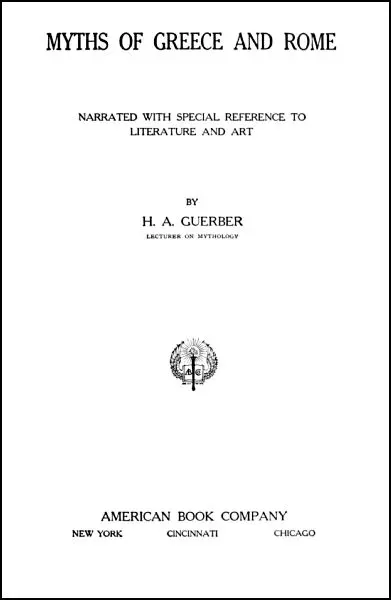
"Myths of Greece and Rome" by H. A. Guerber is a narrative account of classical mythology written in the late 19th century. The work explores the rich tapestry of myths surrounding the ancient Greek and Roman pantheon, providing insights into how these stories influenced literature and art through the ages. The myths are presented in a manner that balances accuracy with readability, making them accessible to a wide audience. The opening of the book introduces readers to the concept of mythology as a collection of ancient narratives explaining the origins of the world and its gods. It begins with the creation myth, describing the chaotic state of the universe before the emergence of order, where elements like Chaos and Nyx (Night) preside over a formless existence. The subsequent emergence of Titans, deities, and the eventual ascendance of Jupiter (Zeus) set the stage for conflicts among gods and the intricate relationships between divinities and mortals. The content reflects a blend of descriptive storytelling and scholarly analysis, showcasing the transformative power these myths held in shaping cultural and artistic expressions.
Introduction adapted from the source catalogue; source summaries may be automatically generated.
Free to read · English · 111,633 words · No account needed
MAKE TIME FOR A GOOD BOOK
On by default. Untick to stop anonymous reading totals. Each page counts after 10 seconds in view. How this works.
Anonymous counting is on unless you have switched it off.
Bacchus, the first to perceive the fair mourner, hastened to her side, and brought all his powers of persuasion into play to console her. His devotion at last induced her to forget her recreant lover, and, after a short courtship, Bacchus won her as a bride.
Their wedding was the gayest ever seen, and the feasting lasted for several days. The bridegroom presented the bride with a crown adorned with seven glittering stars,--an ornament which fitly enhanced her peerless beauty. Shortly after her marriage, however, poor Ariadne sickened and died, leaving a disconsolate widower, who took the crown she had so often worn and flung it up into the air. It rose higher and higher, until the gods fixed it in the sky, where it still forms a brilliant constellation, known as Ariadne's Crown, or Corona.
"And still her sign is seen in heaven,
And, 'midst the glittering symbols of the sky,
The starry crown of Ariadne glides."
Apollonius Rhodius.
Bacchus' lightheartedness had all vanished, and he no longer took any pleasure in music, dance, or revelry, until Jupiter, in pity for his bereavement, restored Ariadne to his longing arms, and, to prevent her being again claimed by Death, gave her immortal life.
[Sidenote: Story of Pentheus.]
When but a short distance from Thebes, Bacchus once sent a herald to Pentheus, the king, to announce his approach, and bespeak a suitable reception and sumptuous entertainment. Rumors of the noise and disorder, which seemed to have been the invariable accompaniment of the god's presence, had already reached Pentheus, who therefore dismissed the herald with an insolent message, purporting that Bacchus had better remain outside of the city gates.
To avenge this insult, Bacchus inspired the Theban women with a species of dementia, which made them rush simultaneously out of the city and join his followers. Then they all clamored for permission to witness the religious rites in his honor, generally called Mysteries, which permission was graciously granted.
The king's spies reported all that had occurred, and their accounts made Pentheus long to view the ceremonies in secret. He therefore disguised himself, and hid in a bush near the consecrated place, hoping to see all without being seen; but an inadvertent movement attracted the attention of the already excited Bacchantes, who, led by Agave, the king's own mother, dragged him from his hiding place and tore him limb from limb.
[Sidenote: Worship of Bacchus.]
Bacchus, god of wine, was worshiped throughout the ancient world, and festivals without number were held in his honor. The most noted were the Greater and Lesser Dionysia, the Liberalia, and the Bacchanalia, where the wildest merrymaking and license were freely indulged in by all participants.
Your reading position is saved on this browser. Take it to another device with a library code. Reading pages adapt to text, rather than matching a printed edition.
H. A. (Hélène Adeline) Guerber
H. A. (Hélène Adeline) Guerber
H. A. (Hélène Adeline) Guerber
BEHIND THE BOOK
This eBook is for the use of anyone anywhere in the United States and most other parts of the world at no cost and with almost no restrictions whatsoever. You may copy it, give it away or re-use it under the terms of the Project Gutenberg License included with this eBook or online at www.gutenberg.org. If you are not located in the United States, you will have to check the laws of the country where you are located before using this eBook. Read the source licence.
The original source file, including credits and licence, is retained by this library. Request an original-format copy at no charge. Please include the book title and Project Gutenberg identifier #39250.
KEEP YOUR CURIOSITY GOING

Maurice Baring
Francis Greenleaf Allinson & Anne C. E. (Anne Crosby Emery) Allinson
Stuart Dodgson Collingwood
Percy Keese Fitzhugh
Mary Macleod & Edmund Spenser

Cooke Don-Carlos