THE CLASSIC COLLECTION✦My diaries, being a personal narrative of events 1888-1914, Part 2 (1900-1914)CLASSIC FREE BOOKS
My diaries, being a personal narrative of events 1888-1914, Part 2 (1900-1914)
Wilfrid Scawen Blunt
THE CLASSIC COLLECTION · 1912
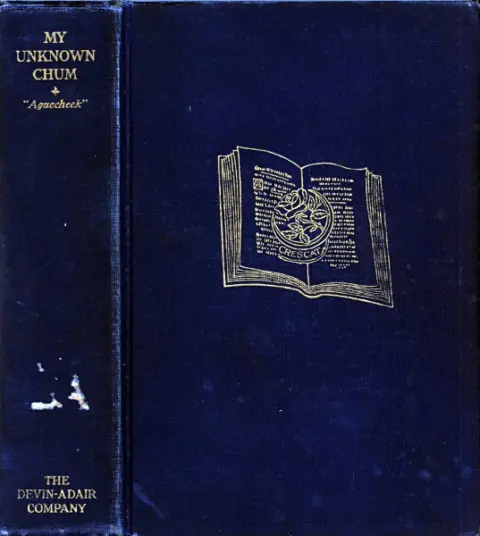
"My Unknown Chum: 'Aguecheek'" by Charles Bullard Fairbanks is a collection of travel sketches and essays written in the early 20th century. The text appears to reflect a deeply contemplative and nostalgic perspective on travel and various experiences across Europe, focusing on themes of art, literature, and human reflection. The book seems to delve into the charms of foreign travels, the joys of life at sea, and thoughtful observations about society. The opening of the work presents a foreword by Henry Garrity, who recounts his admiration for an old, out-of-print book titled "Aguecheek" and its author, believed to be Fairbanks. Garrity expresses how reading this book has offered him both enjoyment and companionship throughout his life, especially during his extensive travels. The writing is enriched with personal reflections, humor, and philosophical musings, as Garrity highlights the author's unique observations on travel, art, and human nature, setting the stage for the travel sketches that follow. The beginning establishes an appreciation for cultural depth and introspection shaped by various travel experiences, promising a rich exploration in the chapters ahead.
Introduction adapted from the source catalogue; source summaries may be automatically generated.
Free to read · English · 104,511 words · No account needed
MAKE TIME FOR A GOOD BOOK
On by default. Untick to stop anonymous reading totals. Each page counts after 10 seconds in view. How this works.
Anonymous counting is on unless you have switched it off.
We know how eagerly we pursue the vicissitudes of fortune which have marked the career of so many of the world's heroes; and this will teach us how future generations will read the history of the present century. Surely the whole range of romance presents no parallel to the simple history of the wonderful man who now governs France. It is easy to see that his varied fortunes will one day perform a conspicuous part in that juvenile classical literature of which I have spoken; and perhaps it may not be unprofitable, dear reader, for us to endeavour to raise ourselves above the excitement of partisanship and the influences of old prejudices, and look upon his career as may the writers of the twenty-fifth century.
It is a popular error in America to regard Louis Napoleon as a singular combination of knavery and half-wittedness. Even Mr. Emerson, in his English Traits, so far forgets the kindliness of his nature as to call him a "successful thief." The English journalists once delighted to ridicule him as the "nephew of his uncle," and the shadow of a great name, and Punch used to represent him as a pygmy standing upon the brim of his uncle's hat, and wondering how he could ever fill it; but he has lived down ridicule, and they have long since learned that there is such a thing as the possibility of a mistake in judgment, even among journalists and politicians. It is time that we Americans got over a notion which has long since been exploded on this side of the Atlantic. I know that I am flying in the face of those who believe in the plenary inspiration of the New York Tribune, when I claim for the Emperor any thing like patriotism or capacity as a statesman. I know that the Greeleian, "philanthropic" code exacts that we should not "give the prisoner the benefit of the doubt," and that when any one whom we dislike does any good, we should attribute it to nothing but a selfish or ambitious motive. I know that this new-fangled love of all mankind requires us to hate those who differ from us politically, and never to lose an opportunity to blacken their characters and diminish their reputation; and therefore I make all due allowances for the refusal of the Tribune, and journals of the same amiable family, to see the truth. In April, 1856, I was waiting for a train in a way station on the Worcester Railroad. A sun-burned, hard-working man was reading the news of the proclamation of peace at Paris from a penny paper, and he commented upon it to two or three others who were present, as follows: "Well, I don't know how 'tis, but it seems to me that we've been most almightily mistaken about this 'ere Lewis Napoleon. We used to think he was a shaller kind o' feller any how, but it really looks now, judging from the position of France in European affairs, as if he was turning out to be altogether the biggest dog in that tanyard!" The old fellow's conclusion was a true one, though his rhetoric would not have been commended at Cambridge; and it is to prevent this conclusion forcing itself upon the public sense, that the sympathizers with socialism have been labouring ever since. We are told that it is our duty as Americans and republicans to wish for the overthrow of Napoleon and his empire, and the establishment of the republique democratique et sociale. Now, having received my political principles from another source than the Tribune, I may be pardoned for having a prejudice in favour of allowing the people of France to govern France; and, as they elected Louis Napoleon President in 1848 by more than five millions of votes, and in 1851 chose him dictator (in their fear of the very party which the Tribune wishes to see in power) by more than seven millions of votes, and finally, in 1852, made him their Emperor by a vote of more than seven millions against a little more than three hundred thousand, we may suppose France to have expressed a pretty decided opinion on this matter. The French empire rests upon the very principle that forms the basis of true republicanism--universal suffrage. Louis Napoleon restored that principle after it had been suppressed or restricted, and proved himself a truer republican than his opponents. For nine years, Napoleon has been sustained by the people of France with a unanimity such as the United States never knew, except in the election of Washington as first President, and his majority has increased every time that he has appealed to the people. It is idle to say that there are parties here that are opposed to him; it would be a remarkable phenomenon if there were not. But there is a more united support here for the Emperor than there is in our own country for the constitution of the United States, and any right-minded man would regret a revolutionary movement in one country as much as in the other.
Your reading position is saved on this browser. Take it to another device with a library code. Reading pages adapt to text, rather than matching a printed edition.
BEHIND THE BOOK
This eBook is for the use of anyone anywhere in the United States and most other parts of the world at no cost and with almost no restrictions whatsoever. You may copy it, give it away or re-use it under the terms of the Project Gutenberg License included with this eBook or online at www.gutenberg.org. If you are not located in the United States, you will have to check the laws of the country where you are located before using this eBook. Read the source licence.
The original source file, including credits and licence, is retained by this library. Request an original-format copy at no charge. Please include the book title and Project Gutenberg identifier #35412.
KEEP YOUR CURIOSITY GOING
Wilfrid Scawen Blunt
Wilfrid Scawen Blunt

E. W. (Edgar Watson) Howe

David Patterson (Spirit) Hatch

David Patterson (Spirit) Hatch

David Patterson (Spirit) Hatch