READ · DISCOVER · ENJOYClassic literature · Always free
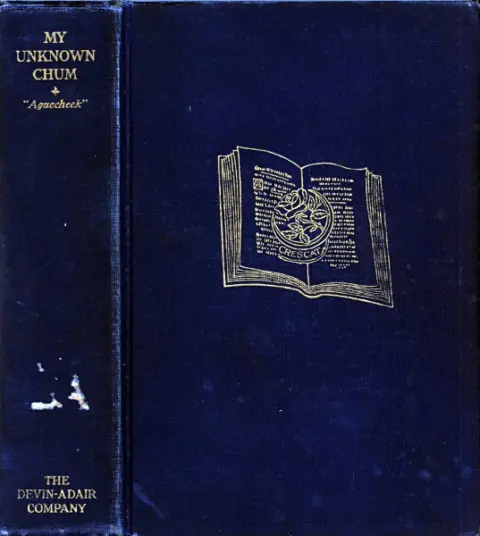
My Unknown Chum: “Aguecheek” — digital edition cover

THE CLASSIC COLLECTION · 1912

My Unknown Chum: “Aguecheek”

"My Unknown Chum: 'Aguecheek'" by Charles Bullard Fairbanks is a collection of travel sketches and essays written in the early 20th century. The text appears to reflect a deeply contemplative and nostalgic perspective on travel and various experiences across Europe, focusing on themes of art, literature, and human reflection. The book seems to delve into the charms of foreign travels, the joys of life at sea, and thoughtful observations about society. The opening of the work presents a foreword by Henry Garrity, who recounts his admiration for an old, out-of-print book titled "Aguecheek" and its author, believed to be Fairbanks. Garrity expresses how reading this book has offered him both enjoyment and companionship throughout his life, especially during his extensive travels. The writing is enriched with personal reflections, humor, and philosophical musings, as Garrity highlights the author's unique observations on travel, art, and human nature, setting the stage for the travel sketches that follow. The beginning establishes an appreciation for cultural depth and introspection shaped by various travel experiences, promising a rich exploration in the chapters ahead.

Introduction adapted from the source catalogue; source summaries may be automatically generated.

Start reading ↓

Free to read · English · 104,511 words · No account needed

MAKE TIME FOR A GOOD BOOK

My Unknown Chum: “Aguecheek”

On by default. Untick to stop anonymous reading totals. Each page counts after 10 seconds in view. How this works.

Anonymous counting is on unless you have switched it off.

My Unknown Chum: “Aguecheek”

The interest which I have seen manifested by so many people in the relics of Napoleon I. has afforded me considerable amusement. I have lately seen so much ridicule cast upon the relics of the saints preserved in many of the churches of Italy, by people of the same class as those who lingered so reverentially before the glass cases of the Napoleon room in the Louvre, that I cannot help thinking how rare a virtue consistency is.

Perhaps it may be owing to some weakness in my mental organization, but I cannot acknowledge the propriety of honouring the burial-places of successful generals, and, at the same time, think the shrines of the saints worthy of nothing but ridicule and desecration. I found myself, a few years ago, looking with grave interest at an old coat of General Jackson's, which is preserved in the Patent Office at Washington; and I cannot wonder at the reverence which some people pay to the garments of a martyr in the cause of religion. I cannot understand how it may be right and proper to celebrate the birthdays of worldly heroes, and "rank idolatry" to commemorate the self-denying heroes of Christianity. I cannot join in the setting-up of statues of generals and statesmen, and condemn a similar homage to the saints by any allusions to the enormity of making a "graven image." In fine, if it is right to adorn and reverence the tomb of the Father of his Country, (and what American heart does not acknowledge its propriety?) it certainly cannot be wrong to beautify and venerate the tomb of the chief apostle, and the shrines of saints and martyrs who achieved for themselves and their fellow-men an independence from a tyranny infinitely worse than that from which Washington liberated America.

I have recently been visiting the three great monuments of the reign of Napoleon III.--the completed Louvre, the Bois de Boulogne, and the Halles Centrales. As to the first, those who remember those narrow, nasty streets, which within six years were the approaches to the Louvre and the Palais Royal, and those rickety old buildings reminding one too strongly of cheese in an advanced stage of mouldiness, that used to intrude their unsightly forms into the very middle of the Place du Carrousel,--those who recollect the junk shops that seemed more fitting to the neighbourhood of the docks than to the entrance to a palace and a gallery of art,--feel in a manner lost, when they walk about the courtyards of the noble edifice which has taken the place of so much deformity. If the new wings of the Louvre had been built in one range instead of quadrangles, they would extend more than half a mile! Half a mile of palace, and a palace, too, which in building has occupied one hundred and fifty sculptors for the past five years! Those who have not visited Paris within five years will recollect the Bois de Boulogne only as a vast neglected tract of woodland, which seemed a great waste of the raw material in a place where firewood is so expensive as it is here. It is now laid out in beautiful avenues and walks, the extent of which is said to be nearly two hundred miles. You are refreshed by the sound of waterfalls and the coolness of grottos, the rocks for the formation of which were brought from Fontainebleau, more than forty miles distant from Paris. You walk on, and find yourself on the shores of a lake, a mile or two in length, with two or three lovely islands in it, and in whose bright blue waters thousands of trout are sporting. That wild waste, the old Bois de Boulogne, which few persons but duellists ever visited, has passed away, and in its place you find the most magnificent park in the world. It is indeed a perfect triumph of landscape gardening. It is nature itself, not in miniature, but on such a scale as to deceive you entirely, and fill you with the same feeling of admiration that is awakened by any striking natural beauty. The old French notions of landscape gardening seem to have been entirely cast aside. The carriage roads and paths go winding about so that the view is constantly changing, and the trees are allowed to grow as they please, without being tortured into fantastic shapes by the pruning knife. The banks of the lake have been made irregular, now steep, now sloping gently to the water's edge, and in some places huge jagged rocks have been most naturally worked in, while ivy has been planted around them, and in their crevices those weeds and shrubs which commonly grow in such places. You would about as readily take Jamaica Pond to be artificial as this lovely sheet of water and its surroundings. The Avenue de l'Imperatrice is the road from the Arc de Triomphe to the Bois de Boulogne. It is half or three quarters of a mile in length, and is destined to be one of the most striking features of Paris. It is laid out with spacious grass plots, with carriage ways and ways for equestrians and foot passengers, with regular double rows of trees on either side. Many elegant chateau-like private residences already adorn it, and others are rapidly rising. An idea of its majestic appearance may be had from the fact that its entire width from house to house is about four hundred feet. The large space around the Arc de Triomphe is already laid out in a square, to be called the Place de l'Europe, and the work has already been commenced of reducing the buildings around it to symmetry. The Halles Centrales, the great central market-house of Paris, has just been opened to the public. It is built mainly of iron and glass. As nearly as I could judge of its size, I should think it would leave but little spare room if it were placed in Union Park, New York. It is about a hundred feet in height, and so well ventilated that it is hard to realize when there that one is under cover. A wide street for vehicles runs through its whole length, crossed by others at equal intervals. I have called these three public improvements the great monuments of the reign of Napoleon III.; not that I would limit his good works to these, but because these may be taken as conspicuous illustrations of his care, no less for the amusements than for the bodily wants of his people, and of his zeal for the promotion of art and the adornment of his capital. But these noble characteristics of the Emperor deserve something more than a mere passing notice, and may well form the subject of my next letter.

Your reading position is saved on this browser. Take it to another device with a library code. Reading pages adapt to text, rather than matching a printed edition.

BEHIND THE WORDS

About Charles Bullard Fairbanks

Charles Bullard Fairbanks (1827–1859). Explore My Unknown Chum: “Aguecheek” in this collection. These books span essays & ideas, travel & exploration.

Explore this author’s books →

THE READERS’ VERDICT

How did this story stay with you?

Not rated yet
Your rating for My Unknown Chum: “Aguecheek”

Be the first to share your verdict.

One rating per browser, which you can change or remove. A necessary browser identifier remembers your vote. How ratings work

A GOOD STORY DESERVES COMPANY

Pass this book along.

A great read is even better when it’s shared.

SEND A LITTLE INSPIRATION

Share this book

BEHIND THE BOOK

Edition & source details.

Title
My Unknown Chum: “Aguecheek”
Author
Charles Bullard Fairbanks
Publication year
1912
Digital edition publisher
Project Gutenberg
Gutenberg release date
2011-02-27
Language
English
Source edition imprint
Not stated in source catalogue
Source identifier
Project Gutenberg #35412
Contributors
No additional named contributors in source metadata

Public-domain source & licence

This eBook is for the use of anyone anywhere in the United States and most other parts of the world at no cost and with almost no restrictions whatsoever. You may copy it, give it away or re-use it under the terms of the Project Gutenberg License included with this eBook or online at www.gutenberg.org. If you are not located in the United States, you will have to check the laws of the country where you are located before using this eBook. Read the source licence.

Full source licence and obtaining an original copy

The original source file, including credits and licence, is retained by this library. Request an original-format copy at no charge. Please include the book title and Project Gutenberg identifier #35412.

the full Project Gutenberg License must appear
prominently whenever any copy of a Project Gutenberg work (any work
on which the phrase “Project Gutenberg” appears, or with which the
phrase “Project Gutenberg” is associated) is accessed, displayed,
performed, viewed, copied or distributed:

This eBook is for the use of anyone anywhere in the United States and most
other parts of the world at no cost and with almost no restrictions
whatsoever. You may copy it, give it away or re-use it under the terms
of the Project Gutenberg™ License included with this eBook or online
at www.gutenberg.org. If you
are not located in the United States, you will have to check the laws
of the country where you are located before using this eBook.

1.E.2. If an individual Project Gutenberg electronic work is
derived from texts not protected by U.S. copyright law (does not
contain a notice indicating that it is posted with permission of the
copyright holder), the work can be copied and distributed to anyone in
the United States without paying any fees or charges. If you are
redistributing or providing access to a work with the phrase “Project
Gutenberg” associated with or appearing on the work, you must comply
either with the requirements of paragraphs 1.E.1 through 1.E.7 or
obtain permission for the use of the work and the Project Gutenberg
trademark as set forth in paragraphs 1.E.8 or 1.E.9.

1.E.3. If an individual Project Gutenberg electronic work is posted
with the permission of the copyright holder, your use and distribution
must comply with both paragraphs 1.E.1 through 1.E.7 and any
additional terms imposed by the copyright holder. Additional terms
will be linked to the Project Gutenberg License for all works
posted with the permission of the copyright holder found at the
beginning of this work.

1.E.4. Do not unlink or detach or remove the full Project Gutenberg
License terms from this work, or any files containing a part of this
work or any other work associated with Project Gutenberg.

1.E.5. Do not copy, display, perform, distribute or redistribute this
electronic work, or any part of this electronic work, without
prominently displaying the sentence set forth in paragraph 1.E.1 with
active links or immediate access to the full terms of the Project
Gutenberg License.

1.E.6. You may convert to and distribute this work in any binary,
compressed, marked up, nonproprietary or proprietary form, including
any word processing or hypertext form. However, if you provide access
to or distribute copies of a Project Gutenberg work in a format
other than “Plain Vanilla ASCII” or other format used in the official
version posted on the official Project Gutenberg website
(www.gutenberg.org), you must, at no additional cost, fee or expense
to the user, provide a copy, a means of exporting a copy, or a means
of obtaining a copy upon request, of the work in its original “Plain
Vanilla ASCII” or other form. Any alternate format must include the
full Project Gutenberg License as specified in paragraph 1.E.1.

1.E.7. Do not charge a fee for access to, viewing, displaying,
performing, copying or distributing any Project Gutenberg works
unless you comply with paragraph 1.E.8 or 1.E.9.

1.E.8. You may charge a reasonable fee for copies of or providing
access to or distributing Project Gutenberg electronic works
provided that:

• You pay a royalty fee of 20% of the gross profits you derive from
the use of Project Gutenberg works calculated using the method
you already use to calculate your applicable taxes. The fee is owed
to the owner of the Project Gutenberg trademark, but he has
agreed to donate royalties under this paragraph to the Project
Gutenberg Literary Archive Foundation. Royalty payments must be paid
within 60 days following each date on which you prepare (or are
legally required to prepare) your periodic tax returns. Royalty
payments should be clearly marked as such and sent to the Project
Gutenberg Literary Archive Foundation at the address specified in
Section 4, “Information about donations to the Project Gutenberg
Literary Archive Foundation.”

• You provide a full refund of any money paid by a user who notifies
you in writing (or by e-mail) within 30 days of receipt that s/he
does not agree to the terms of the full Project Gutenberg™
License. You must require such a user to return or destroy all
copies of the works possessed in a physical medium and discontinue
all use of and all access to other copies of Project Gutenberg™
works.

• You provide, in accordance with paragraph 1.F.3, a full refund of
any money paid for a work or a replacement copy, if a defect in the
electronic work is discovered and reported to you within 90 days of
receipt of the work.

• You comply with all other terms of this agreement for free
distribution of Project Gutenberg™ works.


1.E.9. If you wish to charge a fee or distribute a Project
Gutenberg™ electronic work or group of works on different terms than
are set forth in this agreement, you must obtain permission in writing
from the Project Gutenberg Literary Archive Foundation, the manager of
the Project Gutenberg™ trademark. Contact the Foundation as set
forth in Section 3 below.

1.F.

1.F.1. Project Gutenberg volunteers and employees expend considerable
effort to identify, do copyright research on, transcribe and proofread
works not protected by U.S. copyright law in creating the Project
Gutenberg™ collection. Despite these efforts, Project Gutenberg™
electronic works, and the medium on which they may be stored, may
contain “Defects,” such as, but not limited to, incomplete, inaccurate
or corrupt data, transcription errors, a copyright or other
intellectual property infringement, a defective or damaged disk or
other medium, a computer virus, or computer codes that damage or
cannot be read by your equipment.

1.F.2. LIMITED WARRANTY, DISCLAIMER OF DAMAGES - Except for the “Right
of Replacement or Refund” described in paragraph 1.F.3, the Project
Gutenberg Literary Archive Foundation, the owner of the Project
Gutenberg™ trademark, and any other party distributing a Project
Gutenberg™ electronic work under this agreement, disclaim all
liability to you for damages, costs and expenses, including legal
fees. YOU AGREE THAT YOU HAVE NO REMEDIES FOR NEGLIGENCE, STRICT
LIABILITY, BREACH OF WARRANTY OR BREACH OF CONTRACT EXCEPT THOSE
PROVIDED IN PARAGRAPH 1.F.3. YOU AGREE THAT THE FOUNDATION, THE
TRADEMARK OWNER, AND ANY DISTRIBUTOR UNDER THIS AGREEMENT WILL NOT BE
LIABLE TO YOU FOR ACTUAL, DIRECT, INDIRECT, CONSEQUENTIAL, PUNITIVE OR
INCIDENTAL DAMAGES EVEN IF YOU GIVE NOTICE OF THE POSSIBILITY OF SUCH
DAMAGE.

1.F.3. LIMITED RIGHT OF REPLACEMENT OR REFUND - If you discover a
defect in this electronic work within 90 days of receiving it, you can
receive a refund of the money (if any) you paid for it by sending a
written explanation to the person you received the work from. If you
received the work on a physical medium, you must return the medium
with your written explanation. The person or entity that provided you
with the defective work may elect to provide a replacement copy in
lieu of a refund. If you received the work electronically, the person
or entity providing it to you may choose to give you a second
opportunity to receive the work electronically in lieu of a refund. If
the second copy is also defective, you may demand a refund in writing
without further opportunities to fix the problem.

1.F.4. Except for the limited right of replacement or refund set forth
in paragraph 1.F.3, this work is provided to you ‘AS-IS’, WITH NO
OTHER WARRANTIES OF ANY KIND, EXPRESS OR IMPLIED, INCLUDING BUT NOT
LIMITED TO WARRANTIES OF MERCHANTABILITY OR FITNESS FOR ANY PURPOSE.

1.F.5. Some states do not allow disclaimers of certain implied
warranties or the exclusion or limitation of certain types of
damages. If any disclaimer or limitation set forth in this agreement
violates the law of the state applicable to this agreement, the
agreement shall be interpreted to make the maximum disclaimer or
limitation permitted by the applicable state law. The invalidity or
unenforceability of any provision of this agreement shall not void the
remaining provisions.

1.F.6. INDEMNITY - You agree to indemnify and hold the Foundation, the
trademark owner, any agent or employee of the Foundation, anyone
providing copies of Project Gutenberg™ electronic works in
accordance with this agreement, and any volunteers associated with the
production, promotion and distribution of Project Gutenberg™
electronic works, harmless from all liability, costs and expenses,
including legal fees, that arise directly or indirectly from any of
the following which you do or cause to occur: (a) distribution of this
or any Project Gutenberg work, (b) alteration, modification, or
additions or deletions to any Project Gutenberg work, and (c) any
Defect you cause.

Section 2. Information about the Mission of Project Gutenberg

Project Gutenberg is synonymous with the free distribution of
electronic works in formats readable by the widest variety of
computers including obsolete, old, middle-aged and new computers. It
exists because of the efforts of hundreds of volunteers and donations
from people in all walks of life.

Volunteers and financial support to provide volunteers with the
assistance they need are critical to reaching Project Gutenberg’s
goals and ensuring that the Project Gutenberg collection will
remain freely available for generations to come. In 2001, the Project
Gutenberg Literary Archive Foundation was created to provide a secure
and permanent future for Project Gutenberg and future
generations. To learn more about the Project Gutenberg Literary
Archive Foundation and how your efforts and donations can help, see
Sections 3 and 4 and the Foundation information page at www.gutenberg.org.

Section 3. Information about the Project Gutenberg Literary Archive Foundation

The Project Gutenberg Literary Archive Foundation is a non-profit
501(c)(3) educational corporation organized under the laws of the
state of Mississippi and granted tax exempt status by the Internal
Revenue Service. The Foundation’s EIN or federal tax identification
number is 64-6221541. Contributions to the Project Gutenberg Literary
Archive Foundation are tax deductible to the full extent permitted by
U.S. federal laws and your state’s laws.

The Foundation’s business office is located at 41 Watchung Plaza #516,
Montclair NJ 07042, USA, +1 (862) 621-9288. Email contact links and up
to date contact information can be found at the Foundation’s website
and official page at www.gutenberg.org/contact

Section 4. Information about Donations to the Project Gutenberg
Literary Archive Foundation

Project Gutenberg™ depends upon and cannot survive without widespread
public support and donations to carry out its mission of
increasing the number of public domain and licensed works that can be
freely distributed in machine-readable form accessible by the widest
array of equipment including outdated equipment. Many small donations
($1 to $5,000) are particularly important to maintaining tax exempt
status with the IRS.

The Foundation is committed to complying with the laws regulating
charities and charitable donations in all 50 states of the United
States. Compliance requirements are not uniform and it takes a
considerable effort, much paperwork and many fees to meet and keep up
with these requirements. We do not solicit donations in locations
where we have not received written confirmation of compliance. To SEND
DONATIONS or determine the status of compliance for any particular state
visit www.gutenberg.org/donate.

While we cannot and do not solicit contributions from states where we
have not met the solicitation requirements, we know of no prohibition
against accepting unsolicited donations from donors in such states who
approach us with offers to donate.

International donations are gratefully accepted, but we cannot make
any statements concerning tax treatment of donations received from
outside the United States. U.S. laws alone swamp our small staff.

Please check the Project Gutenberg web pages for current donation
methods and addresses. Donations are accepted in a number of other
ways including checks, online payments and credit card donations. To
donate, please visit: www.gutenberg.org/donate.

Section 5. General Information About Project Gutenberg electronic works

Professor Michael S. Hart was the originator of the Project
Gutenberg concept of a library of electronic works that could be
freely shared with anyone. For forty years, he produced and
distributed Project Gutenberg eBooks with only a loose network of
volunteer support.

Project Gutenberg eBooks are often created from several printed
editions, all of which are confirmed as not protected by copyright in
the U.S. unless a copyright notice is included. Thus, we do not
necessarily keep eBooks in compliance with any particular paper
edition.

Most people start at our website which has the main PG search
facility: www.gutenberg.org.

This website includes information about Project Gutenberg,
including how to make donations to the Project Gutenberg Literary
Archive Foundation, how to help produce our new eBooks, and how to
subscribe to our email newsletter to hear about new eBooks.


KEEP YOUR CURIOSITY GOING

Your next chapter awaits.