THE CLASSIC COLLECTION✦My diaries, being a personal narrative of events 1888-1914, Part 2 (1900-1914)CLASSIC FREE BOOKS
My diaries, being a personal narrative of events 1888-1914, Part 2 (1900-1914)
Wilfrid Scawen Blunt
THE CLASSIC COLLECTION · 1912
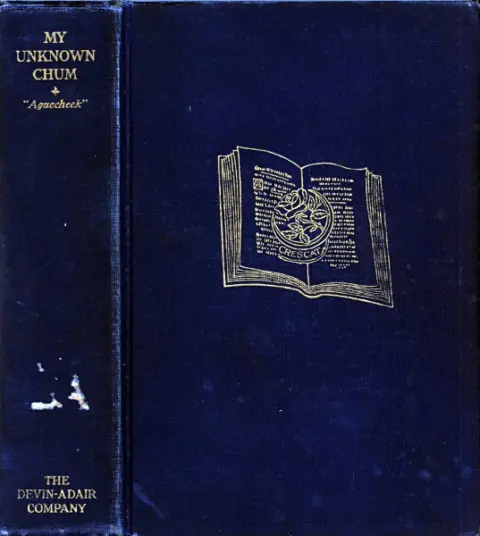
"My Unknown Chum: 'Aguecheek'" by Charles Bullard Fairbanks is a collection of travel sketches and essays written in the early 20th century. The text appears to reflect a deeply contemplative and nostalgic perspective on travel and various experiences across Europe, focusing on themes of art, literature, and human reflection. The book seems to delve into the charms of foreign travels, the joys of life at sea, and thoughtful observations about society. The opening of the work presents a foreword by Henry Garrity, who recounts his admiration for an old, out-of-print book titled "Aguecheek" and its author, believed to be Fairbanks. Garrity expresses how reading this book has offered him both enjoyment and companionship throughout his life, especially during his extensive travels. The writing is enriched with personal reflections, humor, and philosophical musings, as Garrity highlights the author's unique observations on travel, art, and human nature, setting the stage for the travel sketches that follow. The beginning establishes an appreciation for cultural depth and introspection shaped by various travel experiences, promising a rich exploration in the chapters ahead.
Introduction adapted from the source catalogue; source summaries may be automatically generated.
Free to read · English · 104,511 words · No account needed
MAKE TIME FOR A GOOD BOOK
On by default. Untick to stop anonymous reading totals. Each page counts after 10 seconds in view. How this works.
Anonymous counting is on unless you have switched it off.
But, pardon me; all this has little to do with the voyage to Liverpool. The days follow each other rapidly, and it begins to seem as if the voyage would stretch out to the crack of doom, for the head wind stands by us with the constancy of a sheriff, and when that lacks power to retard us we have a calm. But the weather is beautiful, and all the time is spent in the open air. Nut brown maids work worsted and crochet on the cooler side of the deck, and gentlemen in rusty suits, with untrimmed beards, wearing the "shadowy livery of the burning sun," talk of the prospects of a fair wind or read innumerous novels. The evenings are spent in gazing at a cloudless sky, and promenading in the moonshine. Music lends its aid and banishes impatience; my young co-voyagers seem not to have forgotten "Sweet Home," and the "Old Folks at Home" would be very much gratified to know how green their memory is kept.
At length we all begin to grow tired of fair weather. The cloudless sky, the gorgeous sunrises and sunsets, and the bright blue sea, with its lazily spouting whales and its lively porpoises playing around our bows,--grow positively distasteful to us; and we begin to think that any change would be an agreeable one. We do not have to wait many days before we are awaked very early in the morning, by the throwing down of heavy cordage on deck, and the shouts of the sailors, and are soon aware that we are subject to an unusual motion--as if the ship were being propelled by a strong force over a corduroy road constructed on an enormous scale. Garments, which yesterday were content to hang in an orderly manner against the partitions of one's state-room, now obstinately persist in hanging at all sorts of peculiar and disgraceful angles. Hat boxes, trunks, and the other movables of the voyager manifest great hilarity at the change in the weather, and dance about the floor in a manner that must satisfy the most fastidious beholder. Every timber in the ship groans as if in pain. The omnipresent steward rushes about, closing up sky-lights and dead lights, and "chocking" his rattling crockery and glassware. On deck the change from the even keel and the clear sunlight of the day before is still more wonderful. The colour of the sky reminds you of the leaden lining of a tea-chest; that of the sea, of the dingy green paper which covers the same. The sails, which so many days of sunshine have bleached to a dazzling whiteness, are now all furled, except those which are necessary to keep some little headway on the ship. The captain has adorned his manly frame with a suit of India rubber, which certainly could not have been selected for its gracefulness, and has overshadowed his honest face with a sou'wester of stupendous proportions. With the exception of occasional visits to the sinking barometer, he spends his weary day on the wet deck, and tries to read the future in the blackening waves and stormy sky. The wheel, which heretofore has required but one man, now taxes the strength of two of the stoutest of our crew;--so hard is it to keep our bashful ship heading up to that rude sea, and to "ease her when she pitches." The breakfast suffers sadly from neglect, for every one is engrossed with the care of the weather. At noon there is a lull for half an hour or so, and, in spite of the threats of the remorseless barometer, some of our company try to look for an amelioration in the meteorological line. But their hopes are crushed when they find that the wind has shifted one or two points, and has set in to blow more violently than before. The sea, too, begins to behave in a most capricious and disagreeable style. When the ship has, with a great deal of straining and cracking, ridden safely over two mighty ridges of water, and seems to be easily settling down into a black valley between two foam-capped hills, there comes a sudden shock, as if she had met the Palisades of the Hudson in her path--a crackling, grating sound, like that of a huge nutmeg-grater operating on a coral reef, a crash like the combined force of all the battering-rams of Titus Flavius Vespasianus on one of the gates of Jerusalem,--and a hundred tons of angry water roll aft against the cabin doors, in a manner not at all agreeable to weak nerves. For a moment the ship seems to stand perfectly still, as if deliberating whether to go on or turn back; then, realizing that the ship that deliberates in such a time is lost, she rises gracefully over a huge pile of water which was threatening to submerge her.
Your reading position is saved on this browser. Take it to another device with a library code. Reading pages adapt to text, rather than matching a printed edition.
BEHIND THE BOOK
This eBook is for the use of anyone anywhere in the United States and most other parts of the world at no cost and with almost no restrictions whatsoever. You may copy it, give it away or re-use it under the terms of the Project Gutenberg License included with this eBook or online at www.gutenberg.org. If you are not located in the United States, you will have to check the laws of the country where you are located before using this eBook. Read the source licence.
The original source file, including credits and licence, is retained by this library. Request an original-format copy at no charge. Please include the book title and Project Gutenberg identifier #35412.
KEEP YOUR CURIOSITY GOING
Wilfrid Scawen Blunt
Wilfrid Scawen Blunt

E. W. (Edgar Watson) Howe

David Patterson (Spirit) Hatch

David Patterson (Spirit) Hatch

David Patterson (Spirit) Hatch