THE CLASSIC COLLECTION✦My diaries, being a personal narrative of events 1888-1914, Part 2 (1900-1914)CLASSIC FREE BOOKS
My diaries, being a personal narrative of events 1888-1914, Part 2 (1900-1914)
Wilfrid Scawen Blunt
THE CLASSIC COLLECTION · 1912
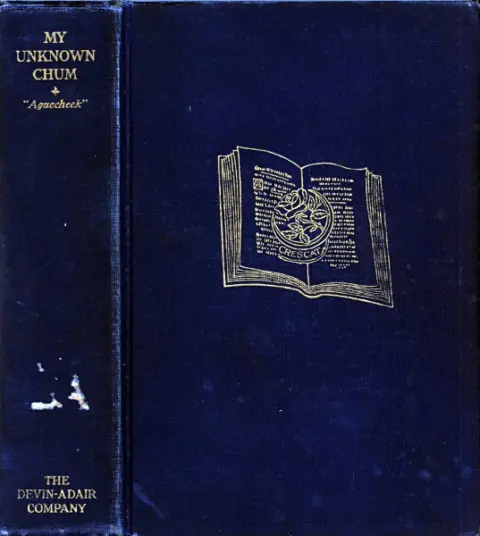
"My Unknown Chum: 'Aguecheek'" by Charles Bullard Fairbanks is a collection of travel sketches and essays written in the early 20th century. The text appears to reflect a deeply contemplative and nostalgic perspective on travel and various experiences across Europe, focusing on themes of art, literature, and human reflection. The book seems to delve into the charms of foreign travels, the joys of life at sea, and thoughtful observations about society. The opening of the work presents a foreword by Henry Garrity, who recounts his admiration for an old, out-of-print book titled "Aguecheek" and its author, believed to be Fairbanks. Garrity expresses how reading this book has offered him both enjoyment and companionship throughout his life, especially during his extensive travels. The writing is enriched with personal reflections, humor, and philosophical musings, as Garrity highlights the author's unique observations on travel, art, and human nature, setting the stage for the travel sketches that follow. The beginning establishes an appreciation for cultural depth and introspection shaped by various travel experiences, promising a rich exploration in the chapters ahead.
Introduction adapted from the source catalogue; source summaries may be automatically generated.
Free to read · English · 104,511 words · No account needed
MAKE TIME FOR A GOOD BOOK
On by default. Untick to stop anonymous reading totals. Each page counts after 10 seconds in view. How this works.
Anonymous counting is on unless you have switched it off.
I wonder whether every body judges of all new things by the criterion of childhood, as I find myself constantly doing. Whatever it may be, I apply to it the test of my youthful recollections of something similar, and it almost always suffers by the process. Those beautiful architectural wonders that pierce the sky at Strasburg and Antwerp will bear no comparison, in point of height, with the steeple of the Old South as it exists in the memory of my childhood. I have never seen a picture gallery in Europe which awakened any thing like my old feelings on visiting one of the first Athenaeum exhibitions many years ago. Those wonderful productions of Horace Vernet, in which one may read the warlike history of France, are nothing compared to my recollections of Trumbull's "Sortie of Gibraltar," as seen through an antediluvian tin trumpet which considerably interfered with my vision, but which I thought it was necessary to use. I have visited libraries which antedated by centuries the discovery of America,--I have rambled over castles which seemed to reecho with the clank of armour and the clarion calls of the old days of chivalry,--I have walked through the long corridors and halls of the Vatican with cardinals and kings,--I have mused in church-crypts and cloisters, in whose silent shade the dead of a thousand years reposed,--but I have never yet been impressed with any thing like the awe which the old Athenaeum in Pearl Street used to inspire into my boyish heart. Pearl Street in those days was as innocent of traffic and its turmoil as the quiet roads around Jamaica Pond are now. A pasture, in which the Hon. Jonathan Phillips kept a cow, extended through to Oliver Street, and handsome old-fashioned private houses with gardens around them occupied the place of the present rows of granite warehouses. The Athenaeum, surrounded by horse-chestnut trees, stood there in aristocratic dignity and repose, which it seemed almost sacrilegious to disturb with the noise of our childish sports. There were a few old gentlemen who used to frequent its reading-room, whose white hair, (and some of them even wore knee breeches and queues and powder,) always stilled our boyish clamour as we played on the grass-plots in the yard. To some of these old men our heads were often uncovered,--for children were politer in those days than now,--and to our young imagination it seemed as if they were sages, who carried about with them an atmosphere of learning and the fragrance of academic groves. They seemed as much a part of the mysterious old establishment as the books in the library, the dusty busts in the entries, or the old librarian himself. Sometimes I used to venture into those still passages, and steal a look into that reading-room whose quiet was never broken, save by the wealthy creak of some old citizen's boots, or by the long breathing of some venerable frequenter of the place, enjoying his afternoon nap. In later years I came to know the Athenaeum more familiarly; the old gentlemen lost the character of sages and became estimable individuals of quiet tastes, who were fatiguing the Massachusetts Hospital Life Insurance Company by their long-continued perusal of the Daily Advertiser and the Gentleman's Magazine; but my old impression of the awful mystery of the building remains to this day. I mourned over the removal to the present fine position, and I seek in vain amid the stucco-work and white paint of the new edifice for the charm which enthralled me in the old home of the institution. Some people, carried away by the utilitarian spirit of the age, may think that it is a great improvement; but to me it seems nothing but an unwarrantable innovation on the established order of things, and a change for the worse. Where is the quiet of the old place? Younger and less reverential men have risen up in the places of the old, and have destroyed all that rendered the old library respectable. The good old times when Dr. Bass, the librarian, sat on one side of the fireplace, and the late John Bromfield (with his silk handkerchief spread over his knees) on the other, and read undisturbed for hours, have passed away. A hundred persons use the library now for one who did then; and I am left to feed upon the memory of better times, when learning was a quiet, comfortable, select sort of thing, and mutter secret maledictions on the revolutionary spirits who have made it otherwise.
Your reading position is saved on this browser. Take it to another device with a library code. Reading pages adapt to text, rather than matching a printed edition.
BEHIND THE BOOK
This eBook is for the use of anyone anywhere in the United States and most other parts of the world at no cost and with almost no restrictions whatsoever. You may copy it, give it away or re-use it under the terms of the Project Gutenberg License included with this eBook or online at www.gutenberg.org. If you are not located in the United States, you will have to check the laws of the country where you are located before using this eBook. Read the source licence.
The original source file, including credits and licence, is retained by this library. Request an original-format copy at no charge. Please include the book title and Project Gutenberg identifier #35412.
KEEP YOUR CURIOSITY GOING
Wilfrid Scawen Blunt
Wilfrid Scawen Blunt

E. W. (Edgar Watson) Howe

David Patterson (Spirit) Hatch

David Patterson (Spirit) Hatch

David Patterson (Spirit) Hatch