THE CLASSIC COLLECTION✦My diaries, being a personal narrative of events 1888-1914, Part 2 (1900-1914)CLASSIC FREE BOOKS
My diaries, being a personal narrative of events 1888-1914, Part 2 (1900-1914)
Wilfrid Scawen Blunt
THE CLASSIC COLLECTION · 1912
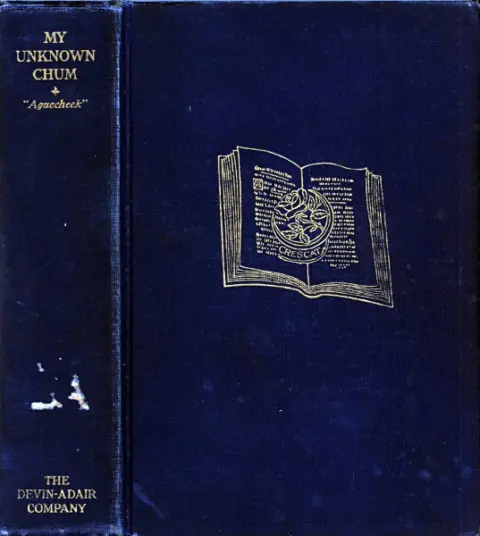
"My Unknown Chum: 'Aguecheek'" by Charles Bullard Fairbanks is a collection of travel sketches and essays written in the early 20th century. The text appears to reflect a deeply contemplative and nostalgic perspective on travel and various experiences across Europe, focusing on themes of art, literature, and human reflection. The book seems to delve into the charms of foreign travels, the joys of life at sea, and thoughtful observations about society. The opening of the work presents a foreword by Henry Garrity, who recounts his admiration for an old, out-of-print book titled "Aguecheek" and its author, believed to be Fairbanks. Garrity expresses how reading this book has offered him both enjoyment and companionship throughout his life, especially during his extensive travels. The writing is enriched with personal reflections, humor, and philosophical musings, as Garrity highlights the author's unique observations on travel, art, and human nature, setting the stage for the travel sketches that follow. The beginning establishes an appreciation for cultural depth and introspection shaped by various travel experiences, promising a rich exploration in the chapters ahead.
Introduction adapted from the source catalogue; source summaries may be automatically generated.
Free to read · English · 104,511 words · No account needed
MAKE TIME FOR A GOOD BOOK
On by default. Untick to stop anonymous reading totals. Each page counts after 10 seconds in view. How this works.
Anonymous counting is on unless you have switched it off.
Dijon is a fine old city. Every body knows that it used to be the capital of Burgundy, but to the general reader it is more particularly interesting as being the place to which Mrs. Dombey and Mr. Carker fled after the elopement. There is a fine cathedral and public library, and the whole place has an eminently Burgundian flavour which makes one regret that he got tired so soon when he tried to read Froissart's Chronicles. There is a church there which was desecrated during the old revolution, and is now used as a market-house. It bears an inscription which presents a satirical commentary on its recent history: "Domine, dilexi decorem domus tuae!" The Dijon gingerbread (which the people, in their ignorance and lack of our common school advantages, call pain d'epice) would really merit a diploma from that academy of connoisseurs, the Massachusetts House of Representatives. But Dombey and Dijon are all forgotten in our first glimpse of the "gay capital of bewildering France." There lay Paris, sparkling under the noonday sun. The sight of its domes and monuments awoke all my fellow-travellers: shabby caps and handkerchiefs were exchanged for hats and bonnets, which gave their wearers an air of respectability perfectly uncalled for. We were soon inside the fortifications, which have been so outgrown by the city that one hardly notices them; and, after the usual luggage examination, I found myself in an omnibus, and once more on the Boulevards.
And what a good, comfortable home-feeling it was! There were the old, familiar streets, the well-known advertisements, painted conspicuously, in blue, and green, and gold, on what would else have been a blank, unsightly wall, and inviting me to purchase cloths and cashmeres; there were the same ceaseless tides of life ebbing and flowing through those vast thoroughfares, the same glossy beavers, the same snowy caps and aprons, the same blouses, the same polite, s'il vous-plait, pardon, m'sieur, take-it-easy air, that Paris, as seen from an omnibus window, always presents. We rolled through the Rue St. Antoine, and it was hard to realize that it had ever been the theatre of so much appalling history. I tried to imagine the barricades, the street ploughed up by artillery, and that heroic martyr, Archbishop Affre, falling there, and praying that his blood might be the last shed in that fratricidal strife; but it was useless; the lively present made the past seem but the mere invention of the historian. All traces of the frightful scenes of 1848 have been effaced, and the facilities for barricades have been disposed of in a way that must make red republicanism very disrespectful to the memory of MacAdam. As we passed a church in that bloody locality, a wedding party came out; the bridegroom looked as if he had taken chloroform to enable him to get through his difficulties, and the effect of it had not entirely passed off. The bride (for women, you know, have greater power of endurance than men) seemed to take it more easily, and, beaming in the midst of a sort of wilderness of lace, and gauze, and muslin, like a lighthouse in a fog, she tripped briskly into the carriage, with a bouquet in her hand, and happiness in her heart. Before the bridal party got fairly out of sight, a funeral came along. The white pall showed that it was a child who slept upon the bier; for the Catholic church does not mourn over those who are removed from the temptations of life before they have known them. The vehicles all gave way to let the little procession pass, the hum seemed to cease for a moment, every head was uncovered, even the porter held his burden on his shoulder with one hand that he might pay his respects to that sovereign to whom even republicans are obliged to bow, and the many-coloured hats of the omnibus drivers were doffed. I had often before noticed those striking contrasts that one sees in a capital like Paris; but to meet such a one at my very entrance impressed me deeply. Such is Paris. You think it the liveliest place in the world, (and so it is;) but suddenly you come upon something that makes you thoughtful, if it does not sadden you. Life and death elbow and jostle each other along these gay streets, until it seems as if they were rivals striving to drive each other out. I entered a church a day or two since. There was a funeral at the high altar. The black vestments and hangings, the lighted tapers, the solemn chant of the De profundis were eloquent of death and what must follow it. I was startled by hearing a child's cry, and looking round into the chapel which served as a baptistery, there stood two young mothers who had just received their infants from that purifying laver which made them members of the great Christian family. I never before had that beautiful thought of Chateaubriand's so forced upon me--"Religion has rocked us in the cradle of life, and her maternal hand shall close our eyes, while her holiest melodies soothe us to rest in the cradle of death."
Your reading position is saved on this browser. Take it to another device with a library code. Reading pages adapt to text, rather than matching a printed edition.
BEHIND THE BOOK
This eBook is for the use of anyone anywhere in the United States and most other parts of the world at no cost and with almost no restrictions whatsoever. You may copy it, give it away or re-use it under the terms of the Project Gutenberg License included with this eBook or online at www.gutenberg.org. If you are not located in the United States, you will have to check the laws of the country where you are located before using this eBook. Read the source licence.
The original source file, including credits and licence, is retained by this library. Request an original-format copy at no charge. Please include the book title and Project Gutenberg identifier #35412.
KEEP YOUR CURIOSITY GOING
Wilfrid Scawen Blunt
Wilfrid Scawen Blunt

E. W. (Edgar Watson) Howe

David Patterson (Spirit) Hatch

David Patterson (Spirit) Hatch

David Patterson (Spirit) Hatch