THE CLASSIC COLLECTION✦My diaries, being a personal narrative of events 1888-1914, Part 2 (1900-1914)CLASSIC FREE BOOKS
My diaries, being a personal narrative of events 1888-1914, Part 2 (1900-1914)
Wilfrid Scawen Blunt
THE CLASSIC COLLECTION · 1912
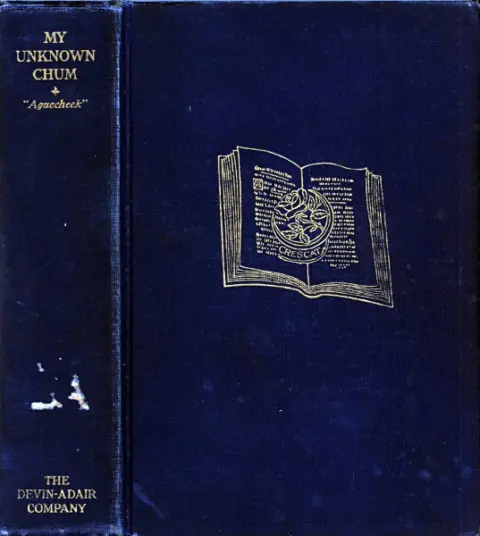
"My Unknown Chum: 'Aguecheek'" by Charles Bullard Fairbanks is a collection of travel sketches and essays written in the early 20th century. The text appears to reflect a deeply contemplative and nostalgic perspective on travel and various experiences across Europe, focusing on themes of art, literature, and human reflection. The book seems to delve into the charms of foreign travels, the joys of life at sea, and thoughtful observations about society. The opening of the work presents a foreword by Henry Garrity, who recounts his admiration for an old, out-of-print book titled "Aguecheek" and its author, believed to be Fairbanks. Garrity expresses how reading this book has offered him both enjoyment and companionship throughout his life, especially during his extensive travels. The writing is enriched with personal reflections, humor, and philosophical musings, as Garrity highlights the author's unique observations on travel, art, and human nature, setting the stage for the travel sketches that follow. The beginning establishes an appreciation for cultural depth and introspection shaped by various travel experiences, promising a rich exploration in the chapters ahead.
Introduction adapted from the source catalogue; source summaries may be automatically generated.
Free to read · English · 104,511 words · No account needed
MAKE TIME FOR A GOOD BOOK
On by default. Untick to stop anonymous reading totals. Each page counts after 10 seconds in view. How this works.
Anonymous counting is on unless you have switched it off.
The sun was as bright as it always is in fair Provence, the sky as blue. The white dusty roads wound around over the green landscape, like great serpents seeking to hide their folds amid those hills. The almond, the lemon, and the fig attracted the attention of the traveller from the north, before all other trees,--not to forget however, the pale foliage of that tree which used to furnish wreaths for Minerva's brow, but now supplies us with oil for our salads. Arles, with its old amphitheatre (a broken shadow of the Coliseum) looming up above it, lay stifled with dust and broiling in the sun, as we hurried on towards Avignon. It does not take much time to see that old city, which, from being so long the abode of the exiled popes, seems to have caught and retained something of the quiet dignity and repose of Rome itself. That gloomy old palace of the popes, with its lofty turrets, seems to brood over the town, and weigh it down as with sorrow for its departed greatness. Centuries have passed, America has been discovered, the whole face of Europe has changed, since a pontiff occupied those halls; and yet there it stands, a monument commemorating a mere episode in the history of the see of St. Peter.
Arriving at Lyons, I found another palatial station, on even a grander scale than that of Marseilles. The architect has worked the coats of arms of the different cities of France into the stone work of the exterior in a very effective manner. Lyons bears witness, no less than Marseilles, to the genius of the wonderful man who now governs France. It is a popular notion in England and America, that the enterprise of Napoleon III. has been confined to the improvement of Paris. If persons who labour under this error would extend their journeyings a little beyond the ordinary track of a summer excursion, they would find that there is scarcely a town in the empire that has not felt the influence of his skill as a statesman and political economist. The Rue Imperiale of Lyons is a monument of which any sovereign might be justly proud. The activity of Lyons, the new buildings rising on every side, and its look of prosperity, would lead one to suppose that it was some place that had just been settled, instead of a city with twenty centuries of history. The Sunday, I was glad to see, was well observed; perhaps not exactly in the style which Aminadab Sleek would commend, but in a very rational, Christian, un-Jewish manner. The shops were, for the most part, closed, the churches were crowded with people, and in the afternoon and evening the entire population was abroad enjoying itself--and a cleaner, better-behaved, happier-looking set of people I never saw. The excessive heat still continues. It is now more than two months since I opened my umbrella; the prospects of the harvest are good, but they are praying hard in the churches for a little rain. During my stay at Lyons, I lived almost entirely on fresh figs, and plums and ices. How full the cafes were those sultry evenings! How busy must the freezers have been in the cellars below! I read through all the newspapers I could lay my hands on, and then amused myself with watching the gay, chattering throng around me. How my mind flew across the ocean that evening to a quiet back parlour at the South End! I could see the venerable Baron receiving a guest on such a night as that, and making the weather seem cool by contrast with the warmth of his hospitality. I could see him offering to his perspiring visitor a release from the slavery of broadcloth, in the loan of a nankeen jacket, and then busying himself in the preparation of a compound of old Cochituate, (I had almost said old Jamaica,) of ice, of sugar, yea, of lemons, and commending the grateful chalice to the parched lips of his guest. Such an evening in the Baron's back parlour is the very ecstasy of hospitality. It is many months since that old nankeen jacket folded me in its all-embracing arms, but the very thought of it awakes a thrill of pleasure in my heart. When I last saw it, "decay's effacing fingers" had meddled with the buttons thereof, and it was growing a trifle consumptive in the vicinity of the elbows; but I hope that it is good for many a year of usefulness yet, before the epitaph writer shall commence the recital of its merits with those melancholy words, Hic jacet! Pardon me, dear reader, for this digression from the recital of my wanderings; but this jacket, the remembrance of which is so dear to me, is not the trifle it may seem to you. It is, I believe, the only institution in the world of the same age and importance, which has not been apostrophized in verse by that gifted bard, Mr. Martin Farquhar Tupper. If this be not celebrity, what is it?
Your reading position is saved on this browser. Take it to another device with a library code. Reading pages adapt to text, rather than matching a printed edition.
BEHIND THE BOOK
This eBook is for the use of anyone anywhere in the United States and most other parts of the world at no cost and with almost no restrictions whatsoever. You may copy it, give it away or re-use it under the terms of the Project Gutenberg License included with this eBook or online at www.gutenberg.org. If you are not located in the United States, you will have to check the laws of the country where you are located before using this eBook. Read the source licence.
The original source file, including credits and licence, is retained by this library. Request an original-format copy at no charge. Please include the book title and Project Gutenberg identifier #35412.
KEEP YOUR CURIOSITY GOING
Wilfrid Scawen Blunt
Wilfrid Scawen Blunt

E. W. (Edgar Watson) Howe

David Patterson (Spirit) Hatch

David Patterson (Spirit) Hatch

David Patterson (Spirit) Hatch