THE CLASSIC COLLECTION✦My diaries, being a personal narrative of events 1888-1914, Part 2 (1900-1914)CLASSIC FREE BOOKS
My diaries, being a personal narrative of events 1888-1914, Part 2 (1900-1914)
Wilfrid Scawen Blunt
THE CLASSIC COLLECTION · 1912
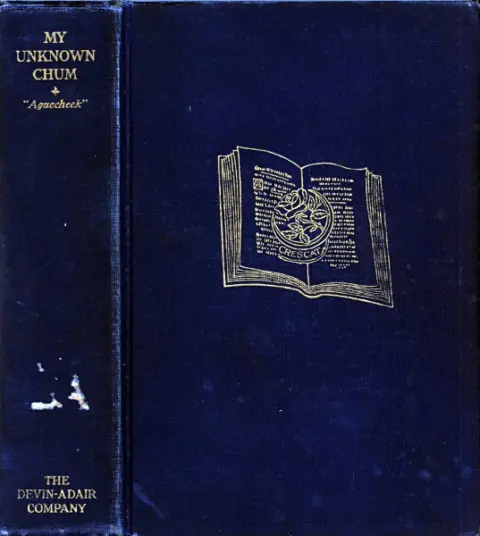
"My Unknown Chum: 'Aguecheek'" by Charles Bullard Fairbanks is a collection of travel sketches and essays written in the early 20th century. The text appears to reflect a deeply contemplative and nostalgic perspective on travel and various experiences across Europe, focusing on themes of art, literature, and human reflection. The book seems to delve into the charms of foreign travels, the joys of life at sea, and thoughtful observations about society. The opening of the work presents a foreword by Henry Garrity, who recounts his admiration for an old, out-of-print book titled "Aguecheek" and its author, believed to be Fairbanks. Garrity expresses how reading this book has offered him both enjoyment and companionship throughout his life, especially during his extensive travels. The writing is enriched with personal reflections, humor, and philosophical musings, as Garrity highlights the author's unique observations on travel, art, and human nature, setting the stage for the travel sketches that follow. The beginning establishes an appreciation for cultural depth and introspection shaped by various travel experiences, promising a rich exploration in the chapters ahead.
Introduction adapted from the source catalogue; source summaries may be automatically generated.
Free to read · English · 104,511 words · No account needed
MAKE TIME FOR A GOOD BOOK
On by default. Untick to stop anonymous reading totals. Each page counts after 10 seconds in view. How this works.
Anonymous counting is on unless you have switched it off.
Another most salutary principle in my philosophy is, never to allow myself to be frightened until I have examined and fairly established the necessity of such a humiliation. I adopted this principle in my childhood, being led to it in the following manner: I was visiting my grandfather, who lived in a fine old mansion-house in the country, with high wainscotings, capacious fireplaces, heavy beams in the ceilings, and wide-arching elms overshadowing the snug porch where two or three generations had made love. Sixty years and more have elapsed since that happy time, yet it seems fresher in my memory than the events of only quarter of a century back. My grandfather was a lover of books, and possessed a good deal of general information. He thought it as advisable to keep up with the history of his own times as to be skilled in that of empires long since passed away. It is not to be wondered at that he should have treasured every newspaper--especially every foreign journal--that he could lay his hands upon. It was under his auspices that I first read the dreadful story of the Reign of Terror, and acquired my anti-revolutionary principles.
I shall never forget the bright autumnal afternoon when the mail coach from Boston brought a package of books and papers to my grandfather. It was the last friendly favour, in fact the last communication, that he ever received from his old Tory friend, Mr. Barmesyde, whom I mentioned with respect in a former essay; for that genial old gentleman died in London not long after. The parcel had made a quick transit for those days, Mr. Barmesyde's letter being dated only forty-six days before it was opened by my grandsire, and we enjoyed the strong fragrance of its uncut contents together. The old gentleman seized upon a copy of Burke's splendid Essay on the French Revolution, which the package contained, and left me to revel in the newspapers, which were full of the dreadful details of that bloody Saturnalia. I got leave from my grandfather (who was so deep in Burke that he answered me at random) to sit up an hour later than usual. Terrible as all the things of which I read seemed to my young mind, there was a fascination about the details of that sanguinary orgie that completely enchanted me. My imagination was full of horrible shapes when I was obliged to leave the warm, cheerful parlour, and Robespierre, Danton, and Marat were the infernal chamberlains that attended me as I went up the broad, creaking staircase unwillingly to bed. A fresh north-west breeze was blowing outside, and the sere woodbines and honeysuckles that filled the house with fragrance, and gave it such a rural look in summer, startled me with their struggles to escape from bondage. Had it been spring, my young imagination was so excited that I should have feared that they might imitate the insurgents of whom I had been reading and begin to shoot! In the night my troubled slumbers were disturbed by a noise that seemed to me louder than the discharge of a heavy cannon. I sat up in the high, old-fashioned bed, and glared around the room, which was somewhat lighted by the beams of the setting moon. There was no mistake about my personal identity--I was neither royalist nor jacobin; there was no doubt that I was in the best "spare chamber" of my grandfather's house, and not in the Bastile, and that the dark-looking thing in the corner was a solid mahogany chest of drawers, and not a guillotine; but all these things only served to increase my terror when I noticed a dark form standing near the foot of the bed and staring at me with pale, fiery eyes. I rubbed my own eyes hard, and pinched myself severely, to make sure that I was awake. The room was as still as the great chamber in the pyramid of Cheops. I could hear the old clock tick at the foot of the stairs as plainly as if I had been shut up in its capacious case. In the midst of my perturbation it made every fibre of my frame tremble by striking one with a solemn clangour that I thought must have waked every sleeper in the house. The stillness that followed was deeper and more terrifying than before. I heard distinctly the breathing of the monster at the foot of the bed. I tried to whistle at the immovable shape, but I had lost the power to pucker. At last, I formed a desperate resolution. I knew that, if the being whose big, fierce eyes filled me with terror were a genuine supernatural fiend, it was all over with me, and I might as well give up at once. But, if perchance a human form were hid beneath that dreadful disguise, there was some room for hope of ultimate escape. To settle this point, therefore, became necessary to my peace of mind, and I determined that it should be done. Bending up "each corporal agent to the terrible feat," I slid quietly out of bed. The monster was as motionless as before, but I noticed that his head was covered with a white cloth, which made his head seem ghastlier than ever. Setting my teeth firmly together, and clinching my little fists to persuade myself that I was not afraid, I made the last, decisive effort. I walked across the room, and stood face to face with that formidable shape. My grandfather's best coat hung there against the wall, its velvet collar protected from the dust by a white cloth, and the two gilt buttons on its back glittering in the moonlight. This was the tremendous presence that had appalled me. The weakness in the knees, the chattering of my teeth, and the profuse perspiration which followed my recognition of that harmless garment, bore witness to the severity of my fright. Before I crawled back into the warm bed, I resolved never in future to yield to fear, until I had ascertained that there was no escape from it; and I have had many occasions since to act upon that principle.
Your reading position is saved on this browser. Take it to another device with a library code. Reading pages adapt to text, rather than matching a printed edition.
BEHIND THE BOOK
This eBook is for the use of anyone anywhere in the United States and most other parts of the world at no cost and with almost no restrictions whatsoever. You may copy it, give it away or re-use it under the terms of the Project Gutenberg License included with this eBook or online at www.gutenberg.org. If you are not located in the United States, you will have to check the laws of the country where you are located before using this eBook. Read the source licence.
The original source file, including credits and licence, is retained by this library. Request an original-format copy at no charge. Please include the book title and Project Gutenberg identifier #35412.
KEEP YOUR CURIOSITY GOING
Wilfrid Scawen Blunt
Wilfrid Scawen Blunt

E. W. (Edgar Watson) Howe

David Patterson (Spirit) Hatch

David Patterson (Spirit) Hatch

David Patterson (Spirit) Hatch