THE CLASSIC COLLECTION✦My diaries, being a personal narrative of events 1888-1914, Part 2 (1900-1914)CLASSIC FREE BOOKS
My diaries, being a personal narrative of events 1888-1914, Part 2 (1900-1914)
Wilfrid Scawen Blunt
THE CLASSIC COLLECTION · 1912
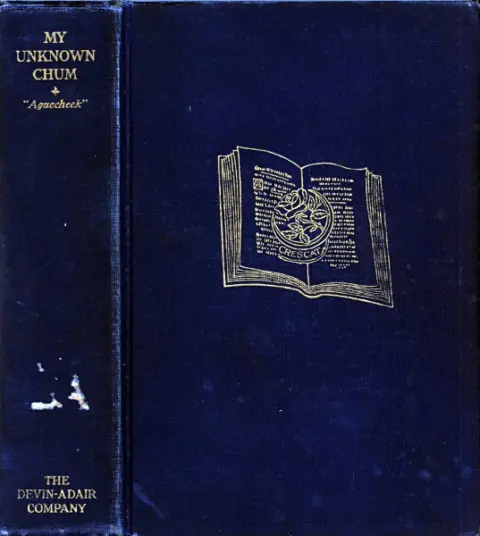
"My Unknown Chum: 'Aguecheek'" by Charles Bullard Fairbanks is a collection of travel sketches and essays written in the early 20th century. The text appears to reflect a deeply contemplative and nostalgic perspective on travel and various experiences across Europe, focusing on themes of art, literature, and human reflection. The book seems to delve into the charms of foreign travels, the joys of life at sea, and thoughtful observations about society. The opening of the work presents a foreword by Henry Garrity, who recounts his admiration for an old, out-of-print book titled "Aguecheek" and its author, believed to be Fairbanks. Garrity expresses how reading this book has offered him both enjoyment and companionship throughout his life, especially during his extensive travels. The writing is enriched with personal reflections, humor, and philosophical musings, as Garrity highlights the author's unique observations on travel, art, and human nature, setting the stage for the travel sketches that follow. The beginning establishes an appreciation for cultural depth and introspection shaped by various travel experiences, promising a rich exploration in the chapters ahead.
Introduction adapted from the source catalogue; source summaries may be automatically generated.
Free to read · English · 104,511 words · No account needed
MAKE TIME FOR A GOOD BOOK
On by default. Untick to stop anonymous reading totals. Each page counts after 10 seconds in view. How this works.
Anonymous counting is on unless you have switched it off.
Of all the studies to which I was ever impelled in my youth, either by fear of the birch or by the hope of the laurel or the bays, mythology was perhaps the most charming. It was refreshing, after trying in vain to conjugate a verb, and being at last obliged to decline it--after adding up a column of figures several times, and getting many different results, and none of them the right one--and after making a vain attempt to comprehend the only algebraic knowledge that ever was forced into my unmathematical brain, viz., that x equals an unknown quantity,--it was, I say, refreshing to turn over the leaves of my Classical Dictionary, and revel among the gods and heroes whose wondrous careers were embalmed in its well-thumbed pages. Lempriere was the great magician who summoned up before my delighted eyes the denizens of a sphere where existence was unvexed by any pestilent arithmetics, and where the slavery of the inky desk was unknown. It always seemed to me as if the knowledge that I gained out of those enchanted chronicles not only improved my mind, but made my body more robust; for I joined in the chase, fought desperate battles, as the gods willed it, and breathed all the while the pure, invigorating air of old Olympus. The consecrated groves were the dwelling-place of my mind, and I became for a time a sharer in the joys of beings in whom I believed with all the ardour and simplicity of childhood. I enjoyed my mythological readings all the more because they did not generally find favour with my school companions, most of whom vindicated their nationality by professing their affection for the Rule of Three. One of them, I remember, was especially severe on the uselessness of the studies in which I took pleasure. He, parcus deorum cultor, et infrequens, could get no satisfaction out of the books in which I revelled; if he had got to study or read, he could not afford to waste his brains over the foolish superstitions of three thousand years ago. He did not care how much romance and poetic beauty there might be in the ancient mythology: what did it all come to in the end? It didn't pay. It was a humbug. Our paths in life separated when we graduated from jackets and peg-tops. He remained faithful to his boyish instincts, and pursued the practical as if it were a reality. After a few years his face lost all its youthful look; an intense spirit of acquisitiveness gleamed in his calculating eye, and an interest table seemed to be written in the lines of his care-worn countenance. We seldom had any conversation in our after years, for he always seemed to be under some restraint, as if he feared that I wished to borrow a little money of him, and he did not wish to refuse for the sake of the old time when we sat at the same desk, although he knew that my note was good for nothing. His devotion to his deity, the practical, did not go unrewarded. He became like the only mythological personage whom he would have envied, had he known any thing of the science he despised. His touch seemed to transmute every thing into gold. His speculations during the war of 1812 were all successful. Eastern lands harmed him not. The financial panic of 1837 only put money in his purse. He rolled up a large fortune, and was happy. He looked anxious, but of course he was happy. What man ever devoted his life to the working out of the dreams of his youth in the acquisition of riches, and succeeded beyond his anticipations, without being very happy? But, if his gains were something practical and real, his losses were doubly so. Each one of them was as a dagger stuck into that sere heart. His only son gave him much trouble by his wild life, and, what touched him still more, wasted the money he had laboured to pile up, at the gaming tables of Baden. I saw him walking down Tremont Street the other day, looking care-worn and miserable, and I longed to ask him what he thought of the real and practical after trying them. He would certainly have been willing to acknowledge that there is more reality in the romance and poetry of mythology than in the thousands which he invested in the Bay State Mills. His practical life has brought him vanity and vexation of spirit, while the old Lempriere, which he used to treat so contemptuously, flourishes in immortal youth, unhurt amid the wreck of fortunes and the depreciation of stocks.
Your reading position is saved on this browser. Take it to another device with a library code. Reading pages adapt to text, rather than matching a printed edition.
BEHIND THE BOOK
This eBook is for the use of anyone anywhere in the United States and most other parts of the world at no cost and with almost no restrictions whatsoever. You may copy it, give it away or re-use it under the terms of the Project Gutenberg License included with this eBook or online at www.gutenberg.org. If you are not located in the United States, you will have to check the laws of the country where you are located before using this eBook. Read the source licence.
The original source file, including credits and licence, is retained by this library. Request an original-format copy at no charge. Please include the book title and Project Gutenberg identifier #35412.
KEEP YOUR CURIOSITY GOING
Wilfrid Scawen Blunt
Wilfrid Scawen Blunt

E. W. (Edgar Watson) Howe

David Patterson (Spirit) Hatch

David Patterson (Spirit) Hatch

David Patterson (Spirit) Hatch