THE CLASSIC COLLECTION✦My diaries, being a personal narrative of events 1888-1914, Part 2 (1900-1914)CLASSIC FREE BOOKS
My diaries, being a personal narrative of events 1888-1914, Part 2 (1900-1914)
Wilfrid Scawen Blunt
THE CLASSIC COLLECTION · 1912
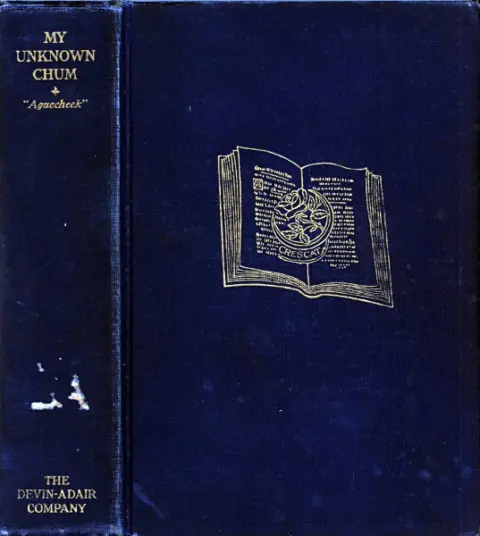
"My Unknown Chum: 'Aguecheek'" by Charles Bullard Fairbanks is a collection of travel sketches and essays written in the early 20th century. The text appears to reflect a deeply contemplative and nostalgic perspective on travel and various experiences across Europe, focusing on themes of art, literature, and human reflection. The book seems to delve into the charms of foreign travels, the joys of life at sea, and thoughtful observations about society. The opening of the work presents a foreword by Henry Garrity, who recounts his admiration for an old, out-of-print book titled "Aguecheek" and its author, believed to be Fairbanks. Garrity expresses how reading this book has offered him both enjoyment and companionship throughout his life, especially during his extensive travels. The writing is enriched with personal reflections, humor, and philosophical musings, as Garrity highlights the author's unique observations on travel, art, and human nature, setting the stage for the travel sketches that follow. The beginning establishes an appreciation for cultural depth and introspection shaped by various travel experiences, promising a rich exploration in the chapters ahead.
Introduction adapted from the source catalogue; source summaries may be automatically generated.
Free to read · English · 104,511 words · No account needed
MAKE TIME FOR A GOOD BOOK
On by default. Untick to stop anonymous reading totals. Each page counts after 10 seconds in view. How this works.
Anonymous counting is on unless you have switched it off.
I did not stop to read the papers that morning. As I was leaving the establishment, I met its chief partner, to whom I could not help expressing my disappointment. He was one of your hard-faced, high-cheek-boned Yankees, with a great deal of speculation in his eyes. I should as soon have thought of attempting the cultivation of figs and dates at Franconia as of trying to get a small loan from him. So I pushed on into those busy streets whose liveliness seemed to mock my pitiable condition. I had come to it at last. I had got to borrow. A physician, who now stands high among the faculty in Boston, was then residing in Paris, and, as I had been on familiar terms with him, I determined to have recourse to him. He occupied two rooms in the fifth story of a house in the Rue St. Honore. His apartments were more remarkable for their snugness than for the extent of accommodation they afforded. A snuff-taking friend once offered to present the doctor with one of his silk handkerchiefs to carpet that parlour with. But the doctor's heart was not to be measured by the size of his rooms, and I knew that he would be a friend in need. The concierge told me that the doctor had not gone out, and, in obedience to the instructions of that functionary, I mounted the long staircase and frapped at the door of that estimable disciple of Galen. It was not my usual thrice-repeated stroke upon the door; it was a timid and uncertain knock--the knock of a borrower. The doctor said that he had been rather short himself for a week or two, but that he should undoubtedly find a letter in the General Post that morning that would place him in a condition to give me a lift. This was said in a manner that put me entirely at my ease, and made me feel that by accepting his loan I should be conferring an inestimable favour upon him. As we walked towards the Rue Jean Jacques Rousseau, I amused him with the story of the preceding week's adventures. He laughed heartily, and after a few minutes I joined with him, though I must say that the events, as they occurred, did not particularly impress me as subjects for very hilarious mirth. The doctor inquired at the poste restante in vain. His friends had been as remiss as mine, and we had both got to wait another week. The doctor was not an habitually profane man, but as we came through the court-yard of the post office, he expressed his anxiety as to what the devil we should do. He examined his purse, and found that his available assets amounted to a trifle more than nineteen francs. He looked as troubled as he had before looked gay. I generously offered him my four remaining coppers, and told him that I would stand by him as long as he had a centime in his pocket. Such an exhibition of magnanimity could not be made in vain. We stopped in front of the church of Our Lady of Victories, and took the heroic resolve to club our funds and go through the week of expectation together. And we did it. I wish that space would allow of my describing the achievements of that week. Medical books were cast aside for the study of domestic economy. I do not believe that a similar sum of money ever went so far before, even in Paris. We found a place in a narrow street, near the Odeon, where fried potatoes were sold very cheap; we bought our bread by the loaf, as it was cheaper--the loaves being so long that the doctor said that he understood, when he first saw them, why bread was called the staff of life. We resorted to all sorts of expedients to make a franc buy as much as possible of the necessaries of life. We frequented with great assiduity all places of public amusement where there was no fee for admission. The public galleries, the libraries, the puppet shows in the Champs Elysees, were often honoured with our presence. We made a joke of our necessities, and carried it through to the end. The next Tuesday morning found us, after breakfasting, on our way to the post office, with a franc left in our united treasury. I had begun to give up all hopes of our ever getting a letter from home, and insisted upon the doctor's trying his luck first. He was successful, but the severest part of the joke came when he found that his letter (contrary to all precedent) was not postpaid. The polite official at the window must have thirty-two sous for it, and we had but twenty. Our laughter showed him the whole state of the case, and we left him greatly amused at our promises to return soon, and get the desirable prize. My application at the banker's was successful, too, and before noon we were both prepared to laugh a siege to scorn. I paid the rosy-cheeked washerwoman, bought Marie a neat crucifix to hang up in the place of a very rude one in her conciergerie, out of sheer good humour; and that evening the doctor and I laughed over the recollections of the week and a good dinner in a quiet restaurant in the Palais Royal.
Your reading position is saved on this browser. Take it to another device with a library code. Reading pages adapt to text, rather than matching a printed edition.
BEHIND THE BOOK
This eBook is for the use of anyone anywhere in the United States and most other parts of the world at no cost and with almost no restrictions whatsoever. You may copy it, give it away or re-use it under the terms of the Project Gutenberg License included with this eBook or online at www.gutenberg.org. If you are not located in the United States, you will have to check the laws of the country where you are located before using this eBook. Read the source licence.
The original source file, including credits and licence, is retained by this library. Request an original-format copy at no charge. Please include the book title and Project Gutenberg identifier #35412.
KEEP YOUR CURIOSITY GOING
Wilfrid Scawen Blunt
Wilfrid Scawen Blunt

E. W. (Edgar Watson) Howe

David Patterson (Spirit) Hatch

David Patterson (Spirit) Hatch

David Patterson (Spirit) Hatch