
The Yoke of the Thorah
Henry Harland
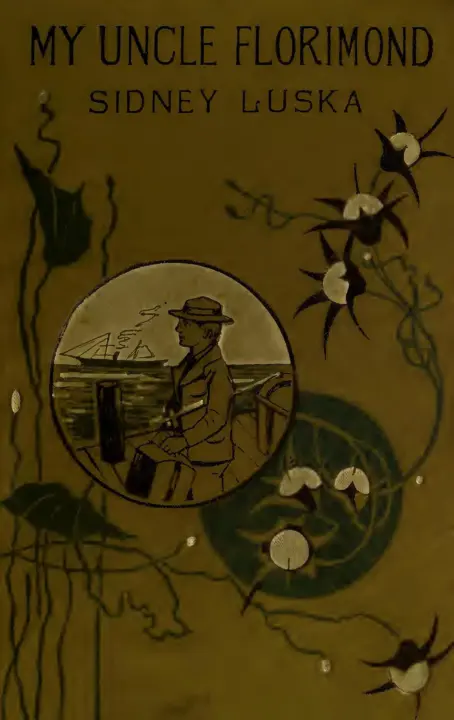
THE CLASSIC COLLECTION · 1888
"My Uncle Florimond" by Henry Harland is a novel written in the late 19th century. The story introduces a young boy named Gregory Brace, who is raised by his strict Uncle Peter after his parents' deaths, and is deeply influenced by his loving grandmother, a French émigré. This familial dynamic sets the stage for Gregory's struggles and aspirations, particularly concerning his idolized Uncle Florimond, who resides in France and embodies the nobility and gallantry that Gregory admires. The opening of the book details Gregory's troubled childhood living under the oppressive guardianship of Uncle Peter, whose stern demeanor sparks fear in the boy. He fondly remembers his grandmother's kindness and her stories about Uncle Florimond, which fill him with wonder and longing. As the narrative unfolds, Gregory receives a beautiful golden-hilted sword from his grandmother and a coveted book from Florimond, igniting his ambition to emulate his uncle's nobility. Yet, the darkening events caused by war and personal loss lead to a pivotal moment in Gregory’s life, pushing him to seek a new future—ultimately leading him to New York City for opportunities and self-discovery.
Introduction adapted from the source catalogue; source summaries may be automatically generated.
Free to read · English · 28,854 words · No account needed
MAKE TIME FOR A GOOD BOOK
On by default. Untick to stop anonymous reading totals. Each page counts after 10 seconds in view. How this works.
Anonymous counting is on unless you have switched it off.
“Well, sir, if you want to have some fun, I'll tell you what let's do. Let's go call on your Uncle Peter, and confront him with this little piece of villainy, and politely ask him to explain it: and then see him squirm. It'll sort of square accounts with him for the number of times he's given you a flogging.”
“O, no! I--I guess we'd better not,” I demurred, faltering at the prospect of a personal encounter with my redoubtable relative.
“But, man alive, you have nothing to fear. We've got the whip-hand of him. Just think, we can threaten him with criminal prosecution. Oh! come on. It'll be the jolliest kind of a lark.”
Well, I allowed myself to be persuaded; and we set forth for Uncle Peter's office, Ripley all agog for excitement, and I trying not to appear afraid. But Uncle Peter wasn't in. An oldish man, who seemed to be in charge, informed us that the Jedge had got a touch of the rheumatiz, and was stayin' hum.
“Never mind,” said Ripley to me; “we'll visit him at his home, we'll beard him in his den. Come along!”
I tried to beg off, but Rip insisted; and I weakly gave in.
If I had been stirred by strong emotions at the sight of Norwich City, conceive how much more deeply I was stirred when we reached Norwich Town--when I saw our old house peeping out from among the great elm-trees that embosomed it--when I actually stood upon its doorstep, with my hand upon the old brass knocker! A strange servant girl opened the door, and to my request to see Judge Brace, replied, “The Jedge is sick in his room.”
“That doesn't matter,” I explained. “You know, I am his nephew. Tell him his nephew Gregory wants to see him.” And I marched boldly through the hall--where the same tall eight-day clock, with its silver face that showed the phases of the moon, was ticking just as it had used to tick as long ago as I could remember--and into the parlor, Ripley following. I say I marched in boldly, yet I was really frightened half to death, as the moment of a face-to-face meeting with my terrible uncle became so imminent. There in the parlor stood the piano upon which my grandmother had labored so patiently to teach me to play. There hung the oil portrait of her, in her robe of cream-colored silk, taken when she was a beautiful young girl, and there, opposite it, above the fireplace, the companion-picture of my Uncle Florimond, in his lieutenant's uniform, with his sword and his crimson sash. Ripley started back a little when he saw this painting, and cried, “For mercy's sake, Greg, who is it? I never saw anything like it. The same eyes, nose, mouth, chin, everything. It's you all over”--thus confirming what my grandmother used to tell me: “Gregory, thou art his living image.” The room was haunted by a myriad dear associations. I forgot the errand that had brought me there; I forgot my fear of meeting Uncle Peter; I forgot all of the recent past, and was carried back to the happiest days of my childhood; and my heart just swelled, and thrilled, and ached. But next instant it gave a great spasmodic leap, and stood still for a second, and then began to gallop ahead like mad, while a perspiration broke out over my forehead; for the maid-servant entered, and said “Please walk upstairs to the Jedge's room.” I really thought I should faint. It was as much as I could do to get my breath. My knees knocked together. My hands shook like those of an aged palsy-stricken man. However, there was no such thing as backing out at this late date; so I screwed my courage to the sticking place, and led Ripley upstairs to Uncle Peter's room.
Your reading position is saved on this browser. Take it to another device with a library code. Reading pages adapt to text, rather than matching a printed edition.
Henry Harland

Henry Harland

Henry Harland

Henry Harland
BEHIND THE BOOK
This eBook is for the use of anyone anywhere in the United States and most other parts of the world at no cost and with almost no restrictions whatsoever. You may copy it, give it away or re-use it under the terms of the Project Gutenberg License included with this eBook or online at www.gutenberg.org. If you are not located in the United States, you will have to check the laws of the country where you are located before using this eBook. Read the source licence.
The original source file, including credits and licence, is retained by this library. Request an original-format copy at no charge. Please include the book title and Project Gutenberg identifier #50698.
KEEP YOUR CURIOSITY GOING
Coulson Kernahan

Maurice Baring
Frances Wright
Cécile Tormay

Frederic Jesup Stimson

W. H. P. (William Henry Pope) Jarvis