THE CLASSIC COLLECTION✦An outlaw’s diary: the CommuneCLASSIC FREE BOOKS
An outlaw’s diary: the Commune
Cécile Tormay
THE CLASSIC COLLECTION · 1919
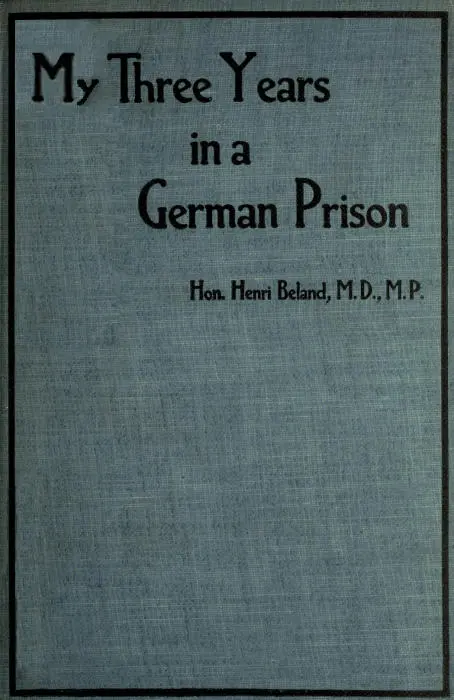
"My Three Years in a German Prison" by Henri Béland is a historical account written in the early 20th century. The book recounts the author's personal experiences and observations during his internment in Germany following the outbreak of World War I. It explores themes of war, patriotism, and the human spirit in the face of adversity. The opening of the narrative details the author's life shortly before the war begins, capturing the atmosphere of uncertainty and tension as news of the conflict between Austria and Serbia spreads. Béland describes his journey from France to Belgium as Germany's intentions to invade begin to reveal themselves, noting the reactions of various citizens along the way. This initial chapter sets the stage for the escalating conflict that leads to the author's eventual capture and imprisonment, while highlighting the sense of shock and anxiety felt by many during those tumultuous times.
Introduction adapted from the source catalogue; source summaries may be automatically generated.
Free to read · English · 45,363 words · No account needed
MAKE TIME FOR A GOOD BOOK
On by default. Untick to stop anonymous reading totals. Each page counts after 10 seconds in view. How this works.
Anonymous counting is on unless you have switched it off.
I related what had just taken place between the officer and myself, whereupon the poor non-commissioned officer, lifting his arms, exclaimed: “I am done for!”
“No, no,” I said, “I assure you that all is not lost. There is a means to arrange matters.”
“How?” he asked.
“Well, according to regulations, one day each week you spend the afternoon in town. Let us suppose,” I said, “that the afternoon the instructions concerning me were read by the sergeant-major, you were absent.”
“Ah!” replied Hoch; “but I was present.”
“I am not asking you,” I said, “if you were present. I am affirming that you were absent.…”
“Very well,” said he, “but the sergeant-major will remember that I was
present.”
“I will attend to this,” I said. “For the time being we will take it that you were absent when the instructions were read.”
I left him, and proceeded to the sergeant-major’s room. This officer was at that time a sick man, and had consulted me three or four times about some kidney trouble he was suffering. He was surprised to see me and asked the reason for my visit.
“Well,” I said, “you remember the famous instructions concerning me? Three months ago, when you read them to the non-commissioned officers, Non-Commissioned Officer Hoch was out on his afternoon leave, was he not?”
“That is true,” he said.
“Well, on my last outing, I asked him to pass along Koenig street with me, and he consented.”
“Then there was no offence,” said the sergeant-major.
“Certainly not,” I agreed. “There is need only for a little
explanation.”
I went on speaking of other matters, particularly of his illness, and leaving him then I hurried off to see Officer Block. I explained to him that when the instructions concerning myself were read three months previously Non-Commissioned Officer Hoch was absent.
“Well,” he said, “I will report in that sense.”
We waited four days for the outcome of this explanation, and during this time Hoch was in terrible fear. He imagined himself condemned to the dungeon or sent back to the trenches where three of his brothers had been killed.
Finally, on the fourth day, Lieutenant Block told me he had received the answer from the Ober-Kommando. “The explanation,” the document stated, “is satisfactory, but Non-Commissioned Officer Hoch must be severely reprimanded.”
“I hope the reprimand will not be too severe,” I ventured to say.
Lieut. Block did not reply. A German officer never commits himself when discipline is in question.
He left me, and a few minutes later the Alsatian non-commissioned officer was summoned before him. The following colloquy took place between them:
“Non-Commissioned Officer Hoch?”
“Yes, my Lieutenant.”
Your reading position is saved on this browser. Take it to another device with a library code. Reading pages adapt to text, rather than matching a printed edition.
BEHIND THE BOOK
This eBook is for the use of anyone anywhere in the United States and most other parts of the world at no cost and with almost no restrictions whatsoever. You may copy it, give it away or re-use it under the terms of the Project Gutenberg License included with this eBook or online at www.gutenberg.org. If you are not located in the United States, you will have to check the laws of the country where you are located before using this eBook. Read the source licence.
The original source file, including credits and licence, is retained by this library. Request an original-format copy at no charge. Please include the book title and Project Gutenberg identifier #49350.
KEEP YOUR CURIOSITY GOING
Cécile Tormay

Moritz Busch
John L. Ransom
Frances Wright
Cécile Tormay

Mabel Potter Daggett